Total Pageviews

Friday, 8 April 2022

From Rio de Janiero to Ulladulla: The Remington 15 Portable Typewriter


It seemed entirely appropriate that on the “Magical Mystery Tour” my wonderful wife Harriet went to so much time and effort to plan and organise for my 74th birthday this week, we should find on our travels an extreme rarity among portable typewriters – a Brazilian-made Remington 15. I can find only one other example of the 15 online, one which appeared a year ago on the “subreddit for typewriter fans”, r/typewriters (and it has an orange base, like the Remington 25). Richard Polt featured a dark blue Sperry Rand Remington 10 on The Typewriter Revolution blog in November 2014 – a model Miguel Ángel Chávez Silva had picked up for Richard in Mexico City.

These Brazilian Remingtons (10, 15 and 25, as well as the electric portables 611 and 612) were designed by Richard Horace Penney (1937-1996) for the Sperry Rand Corporation in 1969 and made by Remington Indústria E Comércio de Sistemas Para Escritorio (Remington Industry and Commerce Office Systems) SA in Guadalupe, Rio de Janiero, some time between 1986-89. This range of years is suggested both by the inclusion on the keyboard of the 15 (and I think the 25 as well) for the Brazilian cruzado (Cz$), the currency of Brazil in those years, and by the history of the company, which was abandoned by Sperry Rand in August 1989 but continued by its workers from 1990-94. The 15 also has ‘dead’ keys and its keyboard covers such diacritics as the acute, circumflex and grave accents, as well as the tilde and the cedilla to denote stress, vowel height, nasalisation and other sound changes in the Portuguese language.

On our way from our “base camp” at Mollymook - a gorgeous seaside village on the South Coast of New South Wales - to Nowra on Tuesday morning we stopped in the town of Ulladulla and were walking up a narrow street back from the main thoroughfare when I looked into an antiques shop window and there was the Remington 15, sitting on a bottom shelf patiently waiting for me to find it. Given the great care Harriet took in ensuring everything was just so on our very special trip, I am tempted to imagine she had planted it there. The shop owner, a Māori lady called Moo, couldn’t give me any details about how she had come by the Remington 15, other than that her young sons had tested it out by writing some obscenities. However it came to be in her possession, Rio is an awful long way from Ulladulla – as the crow would fly if it could pass over the South Pole, at least 8600 miles!


The Remington 15’s mechanical design, and its performance, reminded me more of the 1959 Carl Sundberg-designed all-metal Monarch range of Remington portables rather than Sundberg’s later 1960s Cycolac-cased line (Envoy III, Starfire, Riviera, Ten Forty etc). These were made at Den Bosch in Holland, after Remington pulled out of Glasgow in Scotland in February 1963 because of industrial disputes. The Remington 15 feels more a solid and steady machine to type with. Many typewriter enthusiasts have remarked on the likeness between the Remington 15 design and the 1968 Stefan Lengyel-designed Monpti, made by  Zbrojovka Brno NP in what was then Czechoslovakia (I must confess the Cz$ symbol on the Remington 15's keyboard had me thinking Czechoslovakia as the country of origin for the Remington 15, before I could find evidence to the contrary inside the machine). Happily, the Remington 15 has the ribbon colour selector switch as a wheel in the same position as the Monarch line, while the Monpti and the Dutch-made Cycolac Remingtons have a ridiculous, troublesome switch up near the ribbon vibrator. The indent on the left side of the Remington 15's keyboard is where the tab wheel is situated on the 25.


The Remington 15’s designer, Richard Penney, does indeed cite the Monarch in his patent references, as well as George H. Kress’s 1964 design for the Royal Empress standard, Norman Bel Geddes’s 1950 design for the IBM Model B and Russell G. Thompson’s 1942 design for the Remington Rand Noiseless Model 10. But I suspect that Penney was as much influenced by the great Henry Dreyfuss, who in 1945 designed the Royal Quiet DeLuxe. After all, Penney worked for Dreyfuss from the late 1950s through the 60s, and together, Penney and Dreyfuss designed the Remington 25 electric typewriter in 1969. Penney later joined industrial design company Peter Schladermundt Associates. Schladermundt, of Bronxville, New York, was an architect and industrial designer who had been a partner of Bel Geddes and an associate of Dreyfuss. In 1973 Penney also designed the Remington Rand SR101 golfball typewriter and a Sperry Rand copying machine, as well as an automatic typewriter control console.


Richard Horace Penney was born in Evanston, Illinois, on February 13, 1937, the son of renowned artist Julia Penney (née Joseph, 1911-2003). Julia was one of the founders of the Greenwich Art Centre in 1956, while a member of the Silvermine Guild of Artists. Richard attended Brunswick School in Greenwich and graduated from the School of Art and Design at Syracuse University. He also studied painting at Colombia. On July 20, 1962, Richard married Alexandra Dracos, a graduate of Bronxville School and Smith College (MA degree in Studio Art and Criticism, Hunter). Between 1962-64 the couple travelled extensively throughout Europe observing industrial design in a range of Continental countries. Richard, who also worked for General Aniline & Film (GAF) designing such things as the View-Master, died on June 30, 1996, at Southbridge, Massachusetts, aged 59.


Arlington, Massachusetts-born Alexandra Penney (right, 1939-) is an American artist, journalist and author. She became assistant editor at Vogue and wrote a weekly column at The New York Times Magazine. She was the author of the 1981 best-seller, How to Make Love to a Man, which was on The New York Times best-seller list for more than a year. In 1989 she returned to Conde Nast as editor of Self, where in 1991 she conceived and created the Pink Ribbon, an international symbol for breast cancer, in honour of the magazine’s founder, Phyllis Starr.

Penney earned a substantial amount of money from her writing, almost all of which was invested with Bernie Madoff in the 1990s. From December 2008 Penney wrote a series of posts on The Daily Beast titled “The Bag Lady Papers”, in which she chronicled her experiences and feelings in the wake of the Madoff scandal.


By an odd coincidence, Richard Polt posted on his The Typewriter Revolution blog about his Sperry Rand Remington 10 (above) on November 16, 2014, just four days after the bankruptcy of Remington Indústria E Comércio de Sistemas Para Escritorio had become complete. Proceedings are started on June 21, 1983, when Remington requested of Judge Mario Guaraci de Carvalho Rangel that it be allowed to continue operating. Eventually, in 1989, an issue of wage arrears emerged and Remington withdrew and allowed a group of employees to manage the company. The self-management process was effective from 1990-94. At one time Remington had employed 2500 workers. Production activities ended in 1995. There’s a very interesting history of the company (in Portuguese) here.

The Remington Indústria E Comércio de Sistemas Para Escritorio SA 
plant in Guadalupe, Rio de Janiero, 

611
612

Sunday, 3 April 2022

Not So Much a Transgression as a Confession


On Wednesday, December 18, 1968, I was sitting at my desk in the sports department of The New Zealand Herald on Wyndham Street in Auckland, typing my boxing column on an old Remington standard, when the assistant editor, Noel Chappell, handed me a handwritten letter. It had been posted the day before by a H.E. Harwood, of 177 Kitchener Street, Pukekohe, a town south of Auckland, between the shore of Manukau Harbour and the mouth of the Waikato River. It was signed “Beachcomber and Tropical Tramp”. For all that, the letter’s contents were breathtaking.

What had inspired Mr Harwood to write to the Herald was my article about the death of former world heavyweight boxing champion Jess Willard, a story which had appeared in the Herald on December 17. Willard died in Los Angeles, aged 86, on December 15, from congestive heart failure following a stroke. On the Monday Brian Humberstone, my sports editor, had handed me the Associated Press story about Willard’s death, asking me to write my own angle on his passing.

My knowledge of, and interest in, Willard had not long been greatly heightened by reading a review in the October 7, 1968, Sports Illustrated of the opening at the Alvin Theatre on Broadway of Howard Sackler’s play The Great White Hope, in which James Earl Jones played Jack Johnson (he also had the role in the 1970 movie of the same name). Sports Illustrated said, “many still believe [Johnson] agreed to take a dive [against Willard] at Havana, in return for having a Mann Act conviction quashed”. Essentially, my own take on Willard’s death was that the truth of what had happened on April 5, 1915, at the Oriental Park Racetrack in Havana, would go to Willard’s grave with him. And so it did.

Harold Edward Harwood, however, was in no doubt that Johnson had thrown the fight. He wrote, “Your article in today’s Herald regarding the famous heavyweight contest in Havana … brings back many nostalgic memories to me. At that time I was 26 years old and was working for the United Fruit Company of Boston, Massachusetts, at Banes in central Cuba, between Havana and Santiago. I was a keen fight fan in those days and had a ringside seat at that fight … I have no hesitation whatever in saying that in my opinion and that of many of my pals that fight was ‘rigged’. On three occasions at least, especially in the 12th round, Jack had Willard wide open and groggy, but he deliberately backed away.


“Jack was the most scientific boxer I have ever seen, and I saw most of the top notchers in those days – Tommy Burns, etc. Those were the days of [Ahmed] Madrali, the ‘Terrible Turk’ and other famous wrestlers. Jack Johnson toured the music halls and variety shows after he had retired and I have never in my life seen such a magnificent physique on any man.”

To that point of Mr Harwood’s letter I was in complete awe. My Herald story had fleshed out a man who had actually been there, right there at ringside, 53 years earlier (which, admittedly, seemed like an eon to a 20-year-old back then). And he was living a mere hour and a half’s drive away from me. There was no telephone number for a H.E. Harwood in Pukekohe, but if I could track down this “Beachcomber and Tropical Tramp”, what a story it would make. And so topical, too, with plans announced for a movie of The Great White Hope and with Willard’s passing.

To my lasting regret, I hesitated. I did so because what Mr Harwood added to his letter seemed just too incredible to believe. That one man - a man living in faraway New Zealand - could have done all the things that he said he did struck me as not merely verging on the Walter Mitty, but outdoing the Walter Mitty by a good stretch. It was astonishing enough to unearth someone, just 54 miles away, who had actually been at the Johnson-Willard title fight in Havana in 1915. But the rest of it … well, to a young, untravelled journalist, it appeared to cross the boundary of credibility.


Mr Harwood went on to say that he believed he was possibly the only one man in New Zealand, or, at the outside, to be one of a very few, to have met Vladimir Lenin. This was when, said Mr Harwood, Lenin “was living in a garret over a warehouse in Houndsditch [in the East End] of London, early in 1911”. We had no such research resources such as Google or Wikipedia in 1968, they were still more than 30 years in the future for me. Nowadays it’s easy to find out that Lenin did make a fifth visit to London, but not until November 1911, when he stayed at 6 Oakley Square off Crowndale Road, north of Euston Station and some distance from Houndsditch.


Perhaps Mr Harwood was getting confused, after 57 years, with the “Peter the Painter” affair, during which Mr Harwood and other bank clerks had “tried to ‘see the show’ during the lunch hour, but [we] were turned away by the police”. In the wake of the Houndsditch Murders in December 1910, the following month police and army laid a six-hour siege to 100 Sidney Street in Stepney, to flush out two Latvian radicals. Then Home Secretary Winston Churchill was there, according to Mr Harlow, dressed “in top hat and frock coat crouched behind a pillar box”.

Being at ringside in Havana for one of the most controversial bouts in world boxing history, meeting Lenin, being close enough to the famous Sidney Street siege to see how Churchill was dressed … it all seemed a bit too much for me. A bit too fanciful. So in the end I stored Mr Harwood’s letter safely away and never made an effort to find him and interview the “Beachcomber and Tropical Tramp”. And now, more than 53 years later, I find myself seriously regretting not having done so.

My regrets led me to considering, when the opportunity emerged earlier this year, to submit a story based on Mr Harwood’s letter to “Margin Releases: Typewriter Tales of Transgression”, before other commitments got in the way. Still, while my story might have involved “self-inflicted pain”, it would have been more about a confession than a transgression.

Armed as I am now with access to ancestry.com, I have come to the conclusion that Mr Harwood was telling the truth. I know that Harold Edward Harwood was born in Bristol, England, on May 13, 1889, and died in Pukekohe in 1971. I also know he was, as he said, a bank clerk and an accountant, but was working in Clifton, a suburb of Bristol, at the time of the 1911 census of England and Wales. He was working for the Massachusetts-headquartered United Fruit Company in Central America when he registered for US World War I duty on June 4, 1917. Indeed, he had returned to England from Jamaica around that time. He was still living in England at the time of the 1939 census, so presumably he settled in New Zealand sometime after World War II. Yes, regrets, I have a few … 

Saturday, 2 April 2022

Alexander’s Raggedy Life as a Typewriter Inventor

Jesse Alexander's 1919 US Passport photo.

Jesse Alexander went to his grave in the Forest Lawn cemetery in Glendale, San Fernando Valley, Los Angeles County, on August 19, 1929, leaving behind, unsettled, more typewriter trouble than he could handle. In July 1927 he had been found guilty of seven counts of voliations under the Californian Corporate Securities Act and six counts of obtaining $150,000 under false pretences – all related to his last typewriter manufacturing venture, a company he had incorporated in Nevada to avoid California corporation taxes. Alexander faced a long stretch of up to 35 years in San Quentin after he had sold stock in the company in California without a permit from the State Corporations Commissioner. Alexander was out on a pending appeal when he died at his home at 1937 Delta Street, Victor Heights, Los Angeles, on August 16, aged 60.


So ended a colourful typewriter-designing career of almost 30 years – one which, it seems, produced just two tangible typewriters, the Perfect and the Alexander (though typewriter historians appear to be unanimous in their opinion that the Gourland was no more than an updated version of the Alexander and was produced in Jesse Alexander’s lifetime). The long, sorry saga of Jesse Alexander and his efforts to produce a commercially successful typewriter was recalled on April Fool’s Day when Richard Polt posted a teaser about the Alexander on The Typewriter Revolution’s Facebook page (photo above).


It's going on for 10 years now since I last posted here on Alexander (On This Day in Typewriter History, Part 173: The Perfect Typewriter). But Richard’s post renewed my interest in Alexander and my research was to uncover what the entry on the Alexander Typewriter Company in A Condensed History of the Writing Machine (1923) was referring to when it mentioned that the company’s history was “marked by troubles”, and that Jesse Alexander had ran into constant court action over his designs. That, it turns out, was understating the facts by the length of a good country mile.


Jesse Alexander had heaps of troubles in his efforts to manufacture and market typewriters. Indeed, the charges he faced in California in 1927 marked the third time he had risked jail over his typewriter patents – and he had actually spend more than 18 months in the Auburn Correctional Facility in New York, from January 16, 1917, until June 11, 1918.  This followed his conviction on December 6, 1916, for grand larceny in the first degree over the selling of shares in his typewriter patents, a scandal referred to in Brooklyn newspapers as a “$500,000 stock swindle”. Described in court by prosecutors as “the cleverest of thieves” and as a “supposed inventor”, Alexander was charged with six indictments after selling typewriter patent shares at $1000 a pop to more than 180 “victims” (each promised a $6000 return). He had advertised for partners in a typewriter manufacturing enterprise. It took a jury just 15 minutes to find him guilty, and initally he was sentenced to two years to four years and eight months in the maximum security Sing Sing Correctional Facility in Ossining.


It probably didn’t help his chances in court that Alexander had been acquitted in August 1913 of very similar offences. On that occasion, he was charged with attempted grand larceny, second degree, because his patent selling scheme was stopped after he’d taken $1000 from only two “victims”. 


After his release from the Auburn jail in 1918, Alexander, who himself had an artificial right leg, went to work for Archelaus Condell at Condell’s Improved Life-Like Artificial Limbs at 10 Union Square East. Alexander went to England in 1919 to make and sell artificial arms and legs, though A Condensed History claimed Alexander joined a “famous British munitions works who proposed the manufacture of another Alexander invention, a four-bank, single shift lightweight typewriter”. Alexander returned to the US in March 1923 and, leaving his family in the east, settled in California.


My own check of Jesse Alexander typewriter patents stretched from 1901-29 and I lost count way past 100.  His Perfect typewriter was said to have been produced in 1904. A Condensed History of the Writing Machine placed the Alexander Typewriter Company in Endicott, New York, in 1907 and said that it was resurrected as the United States Typewriter Company in East New York, Long Island, in January 1908. In 1914, “another or the former” Alexander company had a factory at 35 Ormond Place, Brooklyn. A Perfect was put up for auction by Uwe Breker in Cologne in 2009, when it was stated that only three complete models were known to exist. Michael Adler’s Antique Typewriters dated the Alexander typewriter to 1914.

The once commonly-available "mock Gourland", or "Govrland", made of tin.

Alexander was born in Lexington, Kentucky, on October 22, 1868, and began work as a telegraph operator. His inventing began in Chicago in 1894, mostly on bicycles and odometers and velocimeters. He had settled in Brooklyn by 1900 and soon after entered the typewriter business. By 1905 he was describing himself as a typewriter manufacturer, in 1910 as an inventor, in 1915 as a typewriter manufacturer again, and in 1920 as the owner of a manufacturing plant.

Friday, 1 April 2022

When Shakespeare Employed a Typewriter

Livingston York Yourtee Hopkins was an Ohio-born pioneering cartoonist who worked for the Sydney weekly magazine The Bulletin (1880-2008). Writing humour and drawing cartoons under the name “Hop”, Hopkins contributed to The Bulletin from 1883 until he suffered a serious hand injury in an accident aboard the USS Tahiti while returning to Australia after a five-month tour of the US and Britain 1914. He remained a part-proprietor and director of The Bulletin. One his final pages appeared in the Christmas edition of The Bulletin, published on December 12, 1914, and was headed “The Author and The Typewriter”. In it, Hopkins, who had not long earlier visited Stratford-upon-Avon, imagined The Bard needing the assistance of a typist while completing The Tragedy of Julius Caesar – first performed in 1599, 115 years before the idea of a writing machine was even conceived (and no monkeys were envisaged in Hopkins’s scenario either).


Hopkins’s story read:

MR SHAKSPEARE, a celebrated dramatic author, was hard at work upon a new play entitled “Julius Caesar.” The date announced for its production was near at hand, and the author was working overtime to fulfil his contract with the  management. He had got well into the third act to the Forum scene, in fact. Mark Antony was about to mount the pulpit to preach his now celebrated funeral sermon over the remains of his friend Julius Caesar, when the author suddenly experienced symptoms of a nervous breakdown. The symptoms declared themselves in the form of writer’s cramp, failing eyesight, pains in the head, spots before the eyes, palpitation, vertigo, bad dreams, and all the rest of it. The alarmed author consulted a nerve specialist, who overhauled him and ordered a complete rest, a long sea voyage, and at once. “And,” added the specialist, “you must also give up whisky and tobacco and any other pleasant little vices you may be attached to.”  “Can’t get away just now,” said the dramatist. “Must finish my tragedy. Penalty clause in the contract.” 

“Well, then, why not dictate your stuff to an amanuensis? If you go on as you are, you will be blind in no time, and your hand will be permanently crippled.” 

So our author advertised for a typist who must also be an expert stenographer. She came with a certificate of high efficiency from a local business college; a fluffy-haired blonde with eyes like a startled fawn. She was engaged at first sight, and proceeded at once to “take down” Mark Antony’s harangue to the Roman mob, at the dictation of the Bard of Avon. Now drowsiness is one of the stigmata of a nervous breakdown. At the end of Antony’s long-winded speech the author fell asleep, having first given his amanuensis a lethargic injunction to typewrite her shorthand notes, and hand them to the printer, who was shrieking out for copy. 

Next morning the printer sent in a galley-proof of  the oration. 

Here it is : 

Ant. :  Fiends, rum ’uns, up-country people, lend me your  cars 

I came to bully Siezer, not to please him. 

The anvil that mend to look after the 

Goods is often tarred with her bones. 

So let it be. With scissors' the nobby brute 

Hath told you, Kaiser was amphibious: 

If it wears so it was a greasy salt. 

And greasily hath Snoozer Hansarded it.  

Here under the leaves let the brute take a rest, 

(For Asbestos is a huggermugger man — 

So are they all tall hubble-bubble men.) 

Come I to squeak and sneeze at Snoozer’s funeral. 

He was a find; a hatful of dust to me, 

But Brute he says he was Suspicious, 

And Booth he is a hobble-skirted man. 

He hath brought many captains home to roam 

Whose rams’ sons did the General’s coffee spill! 

Died thus at sea, sir — Seems Suspicious. 

When the poor have lied, Louisa hath swept. 

Ablutions should be made of steamer’s duff ; 

Yet Bulltoad swears he was religious ! Huh! 

You all did see that on the lump-o’-coal 

Three times I offered him a half a crown 

Which twice he did refuse. Was this nutrition ? 

Yet Bluenose says he litigious, 

And sure he is a rumble tumble man. 

Beer for me. 

My hat is in the cottage there with Susan, 

And I must pause till Susan sends it back, 

Or go home barefooted.... 

Ist Cit. : Methinks there is much reason in his sayings. 

Perhaps there was, but the printer didn’t trouble his head about that. He merely followed copy from the typewritten MS. and sent in his galley-proof as  above. 

Shakspeare swore a good deal and finished Julius Caesar by hand, in spite of medical advice. Ann Hathaway gave the fawn-eyed girl a regular job to wash her cottage windows and show sightseers over Shakspeare’s birthplace and things. 

The printer above referred to started a dramatic newspaper called the Stratford Barnstormer, and married the fluffy-haired one (there must be some heart interest in a short story nowadays), who gave Ann Hathaway a week’s notice. She contributed a series of articles entitled “Great Men I Have Washed Windows For.” 


For those not entirely familiar with Mark Antony’s speech in Act III, Scene II of Julius Caesar, here it is:

Friends, Romans, countrymen, lend me your ears;

I come to bury Caesar, not to praise him.

The evil that men do lives after them;

The good is oft interred with their bones;

So let it be with Caesar. The noble Brutus

Hath told you Caesar was ambitious:

If it were so, it was a grievous fault,

And grievously hath Caesar answer’d it.

Here, under leave of Brutus and the rest–

For Brutus is an honourable man;

So are they all, all honourable men–

Come I to speak in Caesar’s funeral.

He was my friend, faithful and just to me:

But Brutus says he was ambitious;

And Brutus is an honourable man.

He hath brought many captives home to Rome

Whose ransoms did the general coffers fill:

Did this in Caesar seem ambitious?

When that the poor have cried, Caesar hath wept:

Ambition should be made of sterner stuff:

Yet Brutus says he was ambitious;

And Brutus is an honourable man.

You all did see that on the Lupercal

I thrice presented him a kingly crown,

Which he did thrice refuse: was this ambition?

Yet Brutus says he was ambitious;

And, sure, he is an honourable man.

I speak not to disprove what Brutus spoke,

But here I am to speak what I do know.

You all did love him once, not without cause:

What cause withholds you then, to mourn for him?

O judgment! thou art fled to brutish beasts,

And men have lost their reason. Bear with me;

My heart is in the coffin there with Caesar,

And I must pause till it come back to me.

Livingston Hopkins was born, the 13th of 14 children, on July 7, 1846, at Bellefontaine, Ohio, 112 miles northeast of Cincinnati. At 17 he left a clerkship to join the 130th Ohio Volunteer Regiment, which was reviewed in Washington by President Abraham Lincoln before it saw service near Petersburg, Virginia, in the summer of 1864. Hopkins, however, spent most of his time picketing the lines and relieving his boredom by drawing. Mustered out in September 1864, he took a job as a railroad messenger, worked on newspapers in Ohio (Toledo Blade) and Illinois and in 1870 moved to New York. By then a freelance “Designer on Wood”, he contributed to newspapers and comic magazines, and illustrated books. In 1876 A Comic History of the United States, which he wrote and copiously illustrated, was published. Hopkins worked for the New York Daily Graphic, the city's first illustrated newspaper, and his September 11, 1875, strip “Professor Tigwissel's Burglar Alarm”, with 17 successive pictures that filled a full page, was the first newspaper cartoon strip. Hopkins additionally worked for  Scribner's Weekly and Puck Magazine before joining James Wales at The Judge in 1881. His work also appeared in St Nicholas Magazine, and for the Harper publications, the Weekly, the Magazine, the Bazaar and Young People. As well, he was commissioned to illustrate editions of Don Quixote, Gulliver's Travels, Baron Munchausen, and Knickerbocker's History of New York.

Hopkins arrived in Australia in February 1883, becoming the most popular of the Bulletin’s string of great cartoonists. In 1904 he published a selection of his work, On the Hop. Hopkins died at Mosman on August 21, 1927, aged 81, leaving an estate valued at more than £44,000.

Thursday, 31 March 2022

Levered Back Into Typewriter Repair Work

It was a bit of a relief yesterday to hand back to their owners three typewriters I'd been working on for the past few weeks: an Underwood three-bank, an 1896 Remington 6 and a Facit TP1. On the same morning, however, I was called back to the Museum of Australian Democracy (Old Parliament House), where the "Yours Faithfully" exhibition is due to re-open next month. The already much-in-demand exhibition was well promoted with an Olivetti Valentine illuminated on to the front of the MoAD building during the "Enlightened" festival earlier this month. But a scheduled immediate post-Covid reopening of "Yours Faithfully" was pushed back by some weeks because braindead anti-vax demonstrators set fire to the entrance of this gorgeous 95-year-old building, causing considerable damage inside and out. Happily, none of the portable typewriters being used in the "Yours Faithfully" exhibition appear to have suffered any harm from the fire. And that is just as well, because the popularity of "Yours Faithfully" has resulted in a decision to keep it going another year. Based on the typewriter repair work I have had to do at MoAD in the past, I was expecting to find some mechanical damage when I returned there yesterday morning, and sure enough there was plenty.  Most alarming were the carriage levers snapped off a Hermes Baby (above) and a Silver-Seiko (below). Also, two Olympias had key linkages broken. As for the broken carriage levers, this an all-too-common occurence from the mis-use of the typewriters at "Yours Faithfully" - last year I had to deal with the same problem on another Facit TP1, as well as on the same Hermes Baby and on other machines. In each case, the damage had obviously been caused by undue force - and considerable force at that - and I try to convince myself it's not deliberate vandalism. Anyway, in the coming days I'll see what can be done for the four portables now crowding up the briefly cleared work bench in my Typewriter Workshop. Fingers crossed!

Sunday, 27 March 2022

When a Second-Hand Typewriter is Anything But a Second-Hand Typewriter


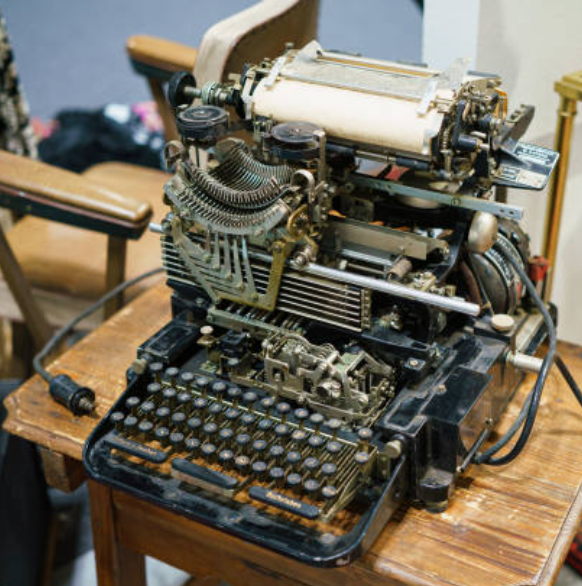
This fascinating machine was described last week as a “second-hand typewriter” and was on display at the Antik Passion Almoneda, an annual antiques, art and collectors fair at IFEMA (Institución Ferial de Madrid) in Spain. It is, I believe, a mid-1930s teletypewriter, a 60lb “Telegraph Lo15” made by C. Lorenz AG. Richard Polt posted on acquiring one these models on his TheTypewriter Revolution blog in January 2014 (he had sold it by last October).


C. Lorenz AG was a German electrical and electronics firm in Berlin which developed products for electric lighting, telegraphy, telephony, radar and radio. Formed as C. Lorenz Telegraphenbauanstalt by Carl Lorenz in 1880, it was acquired by Stamford, Connecticut-based International Telephone & Telegraph in 1930 and became part of Standard Elektrik Lorenz (SEL) Stuttgart in 1958 when it merged with Standard Elektrizitätsgesellschaft and several other smaller companies owned by ITT. In 1987, SEL merged with the French companies Compagnie Générale d'Electricité and Alcatel to form the new Alcatel SEL.


In 1924 C. Lorenz AG acquired a license from the Chicago company Kleinschmidt-Morkrum (from 1928 known as Teletype Corp) to make a 5-bit Baudot type pressure telegraph machine based on Kleinschmidt-Morkrum’s Models 14 and 15 
KSR (keyboard send and receive, the latter above). Production in Germany started in 1929 with developments of the licensing models.


The Morkrum Model 12 typebar page printer (above) was based on Underwood typewriter mechanism. It was produced from 1922-25 under the Morkrum company name, from 1925-29 under the Morkrum-Kleinschmidt name, and from 1929-43 under Teletype Corp. On December 23, 1924, Howard Krum and Sterling Morton filed an application on the 14-type typebar tape printer which matured into patent #1,745,633.


The Teletype Model 15 (above) was a Baudot code page printer, the mainstay of US military communications in World War II. In 1930 Morton, Krum and Edward E. Kleinschmidt filed an application for a US patent covering the commercial form of the Model 15 page printer. This is the Teletype machine that was used by news wire services until the 1970s. About 200,000 were built. The Model 15 remained in production until 1963, 33 years of continuous production. The Model 15, in its “receive only” configuration with no keyboard, was the classic “news Teletype”. Radio stations still use a recording of the sound of these machines as background during news broadcasts.


As for ITT, its chief executive Sosthenes Behn and his German representative, Henry Mann, met with Hitler on August 3, 1933. In Wall Street and the Rise of Hitler, Antony C. Sutton claimed ITT subsidiaries made cash payments to SS leader Heinrich Himmler. ITT, through the subsidiary C. Lorenz AG, owned 25 per cent of Focke-Wulf Flugzeugbau AG, the German aircraft manufacturer, builder of some of the most successful Luftwaffe fighter aircraft. In the 1960s, ITT won $27 million in compensation for damage inflicted on its share of the Focke-Wulf plant by Allied bombing during World War II. Sutton also uncovered that ITT owned shares of Signalbau Huth, which produced for the German Wehrmacht radar equipment and transceivers. While ITT-Focke-Wulf planes bombed Allied ships and ITT lines passed information to German submarines, ITT direction finders were saving other ships from torpedoes. In 1943 ITT became the largest shareholder of Focke-Wulf Flugzeugbau for the remainder of the war, with 29 per cent.

Sticking to the Facts


Given this blog was been going for more than 11 years now, I’m pleasantly surprised - and relieved - that the need for me to decline comments has been a rare. At the same time, almost 10,800 comments have been published. There have been some clumsy attempts at spam from time to time, but the requirement for me to moderate comments on a post that is more than a few days old helps to ensure I can ditch the junk before it appears online. Lately I’ve deleted a few comments from people who have ignored my clear advice: Do not ask me to evaluate typewriters.

I’m also bemused to receive, thankfully only very occasionally, comments from people who have evidently not read the post in question. For example, a woman apparently representing the Australia-Gallipoli Friendship Society wanted to comment on my February 2017 post, “Allāhu akbar! Ice cream cart at the ready for jihadi attack in the Battle of Broken Hill”. She wrote, “according to some, this was a fake and organised so-called a small war ... They weren’t Turk they were poor Afgans ... after this so-called attack Australians hated Turks and enlisted to Army so fast to fight against to the Turks. SO the result was very succesfull on the side of Britania and Australia. However Turkey cant defend themself well then and still”.

If this person had bothered to actually read the post, before attempting to comment on it, she would have found:

a) The post makes it abundantly clear that the incident at Broken Hill on New Year’s Day 1915 involved “Two suicidal Afghan Muslims armed with Snider-Enfield and Martini-Henry rifles, a revolver, 30 rounds of ammunition, a homemade Turkish flag and bandoliers, and an ice cream cart.”  The pair were “self-declared soldiers of Allah”, former cameleers Badsha Mahomed Gül, 39, an Afridi ice-cream vendor, and Mullah Abdullah, 60, a Pathan who acted as an Islamic mullah and halal butcher. They left notes explaining their grievances were connected to the hostilities between the Ottoman and British empires and that they were responding to a call of holy war against “the mortal enemies of Islam”, issued by the Ottoman Sultan Mehmed V, caliph of all Muslims, on November 11, 1914.

 b) It is considered conceiviable by some military historians that the incident at Broken Hill may have helped with recruitment. But it had no impact whatsoever on ANZAC troops being sent to Gallipoli “to fight against the Turks”. That decision was made by Winston Churchill in London, not by anyone in Australia or New Zealand. Churchill had raised the idea of an attack on the Gallipoli Peninsula at a meeting of the British War Council in late November 1914, more than a month before the Broken Hill incident. The continuing stalemate on the Western Front, and developments in the Balkan region, led the council to back Churchill’s plan. In the Balkans, the Ottoman advance northwards into the Caucasus region led Russia to appeal for help to relieve the pressure. Until April 1915, most of the people living on the peninsula were Greek, not Turks. The Ottoman Fifth Army forcibly removed 22,000 Greek civilians from the area two weeks before the Gallipoli landings. The attack on the Dardanelles was approved on January 28, 1915.

As with the case on my post on Shere Hite and the Olivetti advert, I’d suggest to any potential commenter that they are best advised to stick to the facts, to what is known to be absolutely true and demonstrably so. Wild speculation about controversial matters has no place here, but thanks for reading anyway.

Friday, 25 March 2022

One Summer of Sport, with Olivetti Lettera 32 Typewriter: A Pressman's Progress


When I stumbled across this New Yorker cover from November 11, 1939, by the Armenian artist Constantin Ivanovich Alajálov (left, 1898-1987), it stirred in me memories of my own one great and glorious sporting summer, the unforgettable English sporting summer of 1981. On one broadly sweeping assignment, I covered, using an Olivetti Lettera 32 portable typewriter, the Wimbledon Grand Slam tennis championships, the British Open golf championship at Royal St George's in Sandwich, the Royal Henley Regatta international rowing championships, the Royal International Horse Show at Wembley, the Admiral's Cup international yaching regatta off Cowes on the Isle of Wight, the British Grand Prix at Silverstone, the King George VI and Queen Elizabeth Diamond Stakes at Royal Ascot and the Ashes Test cricket series between England and Australia. What made it so special a sporting summer were the historic triumphs and the notable manner in which they were achieved: John McEnroe winning his first Wimbledon by ending 
Björn Borg's reign in four sets, Bill Rogers downing the German Bernhard Langer under the Battle of Britain skies in Kent, the Husky oarsmen from the University of Washington refreshing my recollections of the Nile in the Ladies' Challenge Plate at Henley, the bogus Bond-de Savary America's Cup race on the Solent, with ballast of sacks of 40,000 Krugerrand in gold coin at stake, but most of all Shergar's last, breathtaking race on English soil and Ian Botham's cricketing heroics at Headingley in Leeds. English sporting summers are still the greatest annual two months of sport in the world, but in 1981! What a year to be there.


The wonderful New Yorker cover scene captured by 
Alajálov, of the bread-and-butter bourgeoisie sports writers goggling at high society blow-ins at the National Horse Show at Madison Square Garden in New York City in early November 1939 (the event was, after all, the official start of the formal social season in New York), is not quite how I remember the surroundings when I covered that irascible character Harvey Smith winning the Horse and Hound Cup on San Mar at Wembley 40½ years later. But  Press Tribunes dotted with portable typewriters beside rotary dial telephones with handsets were still our regular work benches.

No Press Tribunes while covering yachting in Cowes.
Travelling light and moving far and fast in a Renault hatchback, often on a daily basis, photographer Rod Taylor and I covered 15 major sporting events, from London to Sandwich, Stoke Mandeville to Sutton Coldfield, Sittingborne to Silverstone, Southampton to Northampton, Cowes and back by ferry on the way to Ascot, and Leeds to the New Forest. Typing stories on the move, finding places to file (while Rod found a means to develop and wire photos), I wrote 37 illustrated feature articles, many dozens of news items and filled more than 60 columns of newsprint (that's almost eight full pages) in West Australian afternoon, morning and weekend newspapers in the space of a 42 days. My Olivetti would have bashed out at least 74,000 words during that period. The only time the pace slowed was when we got caught in a downpour behind a Team Skol van carrying Emerson Fittipaldi's test racing car on a winding country lane outside Oxford. Back home, it was, I can now say quite unashamedly, difficult for me to choose one story to enter the Gilmour Prize for sports writing. The one I picked, about cricketer Ian Botham simultaneously stepping down and being sacked as England captain at Lord's on July 7, 1981, duly won the award, giving me the second of three consecutive prizes (which were to become four in all with my coverage of Ben Johnson's disqualification at the 1988 Seoul Olympic Games). The unsual Botham story was achieveable because, back then, TV networks did not dictate who spoke to the media, when and where - I had free and easy access to players and officials, from the dressing room to the Long Room. It wouldn't be possible to do that today, and sportswriting is all the poorer because of the way journalists are restricted and their raw material is regulated, dependant as it is on press conferences.

Notwithstanding all the pleasing memories that came flooding back upon viewing 
Alajálov's New Yorker cover, I was soon brought crashing back down to earth - and left feeling grossly inadequate - when I looked into the life of the sportswriter whose story in The New Yorker of November 11, 1939, provided Alajálov with the inspiration for his illustration. Thomas Sterling Costigan O'Reilly (left, 1905-1962) had an amazing sportswriting career, mostly in covering horse racing. He was certainly ranked up there with the finest in the business, and by no lesser judge than Red Smith. In a brilliant piece titled “Literati of the Playpen” in The New York Times in March 1975, Smith shot down in flames the claims that Sports Illustrated (1954-) injected “literacy” into sports writing and that Larry Merchant (1931-) started a national trend away from cliche‐ridden hero worship and toward “acerbic, trenchant iconoclastic reportage.” Smith was responding to an essay by David Shaw on sportswriting that “started on the front page of the Los Angeles Times and ran through the paper for 26 miles, 385 yards.” Smith said Shaw had suggested “that sports pages are better than they used to be because they pay less attention to the score than formerly and more to racism, drugs, sex, religion, gambling, psychology, cheating, dress styles and similar matters.” Smith described the marathon read as “tedious and uninformed”. Smith added that “with all due esteem and admiration for Larry Merchant, it must be pointed out that about the time he was learning to spell ‘is’, Stanley Woodward was putting together a staff on the New York Herald Tribune [that was] incomparably the most gifted company ever assembled in one playpen.” “Ruthlessly, Woodward scrubbed his sports section clean of camp and drivel and space‐wasting trash … Not that he originated excellence in sports coverage or was the first to appreciate grace and style and wit in a writer.” After mentioning the like of Paul Gallico and Westbrook Pegler, in his next breath Smith called up the memory of “Tom O'Reilly … Jimmy Cannon, Roger Kahn and the matchless John Lardner.” If Smith's word is not enough, let's add that H. Allen Smith wrote in Low Man on a Totem Pole that O'Reilly was a "superb" sportswriter.

An excerpt from Tom O'Reilly New Yorker story on the 1939 National Horse Show. 

In a tribute to O’Reilly in April 1962, syndicated sports columnist Joe Williams wrote of a conversation he had had with O’Reilly just before O’Reilly died. “I’m writing a book and much of it is going to be about our old sports department," O'Reilly had said. 
“How’s ‘Bedlam to Bellevue’ for a title? … It’ll either discourage all youngsters from ever wanting to be a sportswriter, or it’ll start the damnest stampede this side of Cecil B. De Mille.”  The book was never completed, but happily, by 1962, my mind had already been made up. I was going to join the stampede.

How illustrator Leo Hershfield saw Tom O'Reilly, when O'Reilly
was in the US Merchant Marine in the early years of World War II.

O’Reilly, born in Lancaster, Pennsylvania, on December 13, 1905, died of throat cancer at St Vincent’s Hospital, New York, on my 14th birthday, April 5, 1962. He was aged just 56. Less than three months earlier he had been filing beautiful copy from Caracas, immediately before going into hospital. He was still writing from his death bed, datelining his copy “Pillsville, NY”. By then he'd spent more than 30 years being recognised as, in the words of an obituary, “one of the wittiest and most popular sports writers” in the US. Williams wrote that “Tom O’Reilly brought competence, style and humor to any assignment. Since he had the Irishman’s traditional admiration for the beauty of the show horse and the competitive ardor of the thoroughbred runner, no one could have been surprised that this was the field in which his talent would gleam brightest. Tom professed to be puzzled by his increasing prestige and earnings. ‘This is the same kind of stuff I’ve always written about humans. Yet until I switched to horses, nobody gave me a tumble.’” 
Another tribute, from Kent Hollingsworth in Lexington, Kentucky, said O’Reilly was a “merry man” who “had a knack of arranging words on paper so others could share his lively interest in people and his amusement in their foibles.” Al Abrams, sports editor in Pittsburgh, said O’Reilly was a “big, gregarious, witty Irishman with red hair and a full-blown mustache of the same color [which he grew to cover an upper lip injury suffered in his youth]. O’Reilly wrote about thoroughbreds like a thoroughbred.”

From the 1939 National Horse Show that O’Reilly covered for The New Yorker, O’Reilly began by describing the “customary quota of opening-night mishaps and high spirits. Captain Robert L. Taylor’s Grey Horse Battery upset a caisson in the middle of the ring; Lieutenant David Wagstaff Jr, of Tuxedo Park, slid slowly down the long nose of his chesnut, Enterprise, when the animal changed its mind at the stone-wall jump in the Bowman Cup class; and I saw three gentlemen in top hats get into the Garden on grooms’ tickets.”


Tom O'Reilly was educated at Franklin & Marshall College, a private liberal arts college in Lancaster. After trying to sell soap to grocery stores, wheeling wet concrete from a highway mixer and shaving coconuts in a candy factory, O’Reilly joined his hometown newspaper, the Lancaster Inquirer, under editor Austin McCullough. He also worked for other Lancaster publications, the Sunday News and New Era. In 1931 he moved to New York, at age 25, and joined the then newly merged New York World-Telegram, w
here he worked alongside such outstanding mentors as Heywood Broun and Westbrook Pegler, while the newspaper remained liberal. When Roger Ingersoll set up the liberal-leaning daily PM in 1940, O’Reilly moved to that camp. He was also writing regularly for The New Yorker. PM closed in 1948 and O’Reilly became racing editor of the Morning Telegraph, a paper devoted mostly to theatrical and horse racing news. Just a year before his death, O’Reilly became a racing columnist for the Herald Tribune, working under John Denson. The Herald Tribune’s ad campaign at that time was “Who says a good newspaper has to be dull?” Certainly, O’Reilly’s writing was anything but dull. When the US joined World War II in 1941, O’Reilly volunteered for the Merchant Marine on the American South African Line, sailing from New York to the Suez around  Cape Horn and back under skipper James Hanley Kerr. This experience, with portable typewriter, on what O’Reilly called the Mulligan Stew, led to a delightful book, The Purser’s Pilgrim - The Adventures of a Seagoing Office Boy (1944), illustrated by the incomparable Leo Hershfield. By chance, it includes a character called Featherstonehaugh, and when I worked for The Irish Press in Dublin in the 1970s, we had a very fine racing writer called Brian Featherstonehaugh (it's pronounced “Fanshaw”, by the way). I'd developed an appreciation for the "literarcy" of racing writers years before meeting Brian, but I have to say it was somewhat heightened in Dublin. As it is now, knowing about Tom O'Reilly.