Total Pageviews

Wednesday, 9 November 2011

Two Messages and a Messenger from among my Portable Typewriters


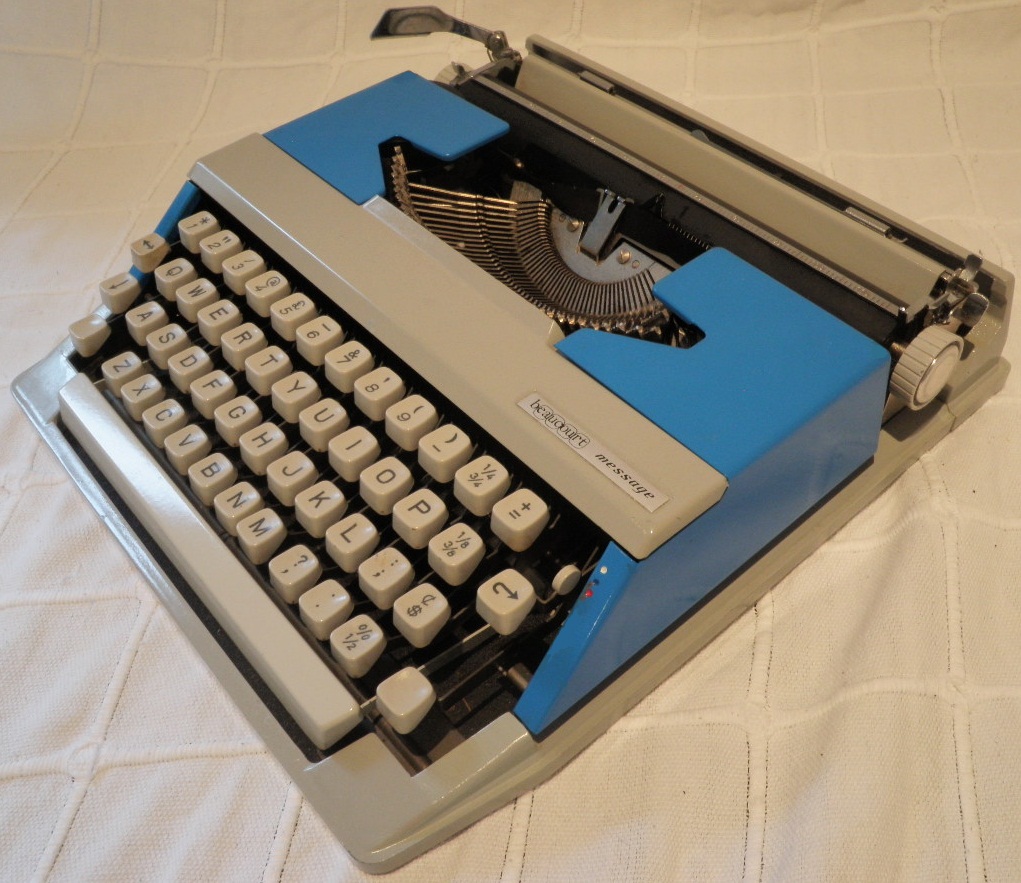
Here we have two portable typewriters from my collection called Message, and one called a Messenger.
The Messages are the Beaucourt (Japy) Message, a French machine of Swiss design, and a recent purchase, the Japanese Nakajima Message 320. The Messenger is the British-made Imperial Messenger T.
Let’s look at the Beaucourt first:

To me it seemed like magic, to linger in the place;
- "Beaucourt Revisited"
- Sir Alan Patrick Herbert (1890-1971), English novelist, playwright and poet.

Beaucourt Revisited is actually a rather harrowing war poem, in which Herbert recalls the losses his battalion suffered during an attack on German lines at Beaucourt in November 1916.
Still, this particular line reminds me of the memorable time, five years ago, when I lingered at what was, at least momentarily, a magic place: the recycling depot of a Canberra rubbish dump. To my utter astonishment, I found buried beneath the rubble a tiny Beaucourt Message portable typewriter in its unusual case, typewriter and case in almost perfect condition. The Beaucourt sat beside a Hermes Baby, in like state.

Beaucourt is a commune in the Territoire de Belfort in north-eastern France, close to the Swiss border. It was once the home of the Japy brand of typewriters.
The Japy company was founded in 1771 by George Frédéric Japy, a pioneer in the industrial production of watches. Frédéric Japy was born in Beaucourt on May 22, 1749, the son of blacksmith Jacques Frédéric Japy (1699-1781) and his wife Mary Margaret Fainot Japy. In 1760 Jacques was appointed mayor of Beaucourt by the Prince of Württemberg, Lord of Montbéliard.
Frédéric Japy (above) was educated in Beaucourt and Montbéliard and from 1768 learned watchmaking in Le Locle, now a part of Switzerland.
In the massive expansion of his business, Japy set the trend for the 20th century Olivetti typewriter makers, Camillo and Adriano, in establishing housing, dining areas and other social amenities for his workers. Like the Olivettis and another typewriter maker who started out as a watchmaker, Halda’s Henning Hammarlund, Japy came to be seen as a father figure for his workforce. He introduced machine tooling before the end of the 18th century.
Japy died at his mill in Badevel in January 23, 1812. The main street of Beaucourt now bears his name and a museum, which includes Japy typewriters,is dedicated to him. Musée Municipal Japy, is at 16 Rue Frédéric Japy.
Before he died, Japy had handed over the running of his company to his sons, and it became known as Japy Frères (Brothers)(mill pictured above).
In 1910, as part of a broad diversification, Japy Frères started making typewriters. It bought the entire assets of the Rem-Sholes Typewriter Co, which had gone bankrupt in 1909, and with Rem-Sholes tooling and dies reproduced the American company’s visible standard machine as the Japy 3X. The parts were made in Beaucourt and assembled at Arcueil, outside Paris.
In 1931 the first Japy portable, the Japy V, was produced. This was not a success and Japy quickly acquired a license to manufacture beautiful Patria typewriters, from the Swiss Perles company, as the Japy model P6, which was produced from 1937 to 1948. It was mechanically a Patria but with a unique and utterly gorgeous Japy casing (see Georg Sommeregger’s site at http://www.typewriters.ch/collection/japy_p6_portable.html).
Over the ensuing years, an intriguing “Euro” family of like typewriters grew, coming from Britain, France, Spain, Italy and Germany. Models included those made by the British Oliver Typewriter Company, as well as the Swissa Piccola and variations of the Voss, Byron and AMC.
After World War II, Japy also began making typewriters under licence from another Swiss company, Hermès Paillard, and in 1971 Hermès took over Japy, moving production of such Hermes-designed Beaucourt models as the Message and the Gazelle (another variation of the Message from the late Tilman Elster's collection and Will Davis site, above) to Switzerland. In turn, Hermes was taken over by Olivetti.
In 1954 the typewriter branch of Japy Frères become the Société de Mécanographie Japy. From 1949 to 1959 Japy made a second Patria design, one which came from Max Bill(1908–1994), the famous Swiss architect, artist, painter, typeface designer, industrial designer and graphic designer. This was called the P68 or Japy Personnel. Slightly altered, it became the Japy Script.
*I am much indebted to typewriter collectors Georg Sommeregger in Switzerland, Will Davis and the late Tilman Elster for much information about the history of the Japy typewriter.
The second Message portable featured here comes from Nakajima in Japan. While there are no markings on it apart from the model name (inside the case it says "Made in Japan"), it is unmistakeably a Nakajima product. Yet it differs in its mechanical design from the more customary and common Nakajima typewriters and is a smaller but superior typing machine.
Nakajima All started making portable typewriters in April 1965. In August 1968 it transferred its typewriter factory to Oaza-Kamigomyo, Sakaki-machi, Hanishina-gun, Nagano Prefecture. Monthly production of typewriters exceeded 15,000 units. In January 1976 it was renamed Nakajima All Precision. In April 1977 a typewriter assembly line enabled monthly production of 50,000 units, and this lifted to 70,000 units in November 1979.
In March 1982 Nakajima started producing electronic typewriters.
The company was established by Nobuyoshi Nakajima in April 1923, to make printing and later sewing machines at Azabu, Minato-ku, Tokyo. In 1931 it was renamed All Lead Mishin Seisakusho and two years later Nakajima All Mishin Seizosho.
In August 1941, Nakajima was taken over by the Japanese Navy to become a munitions factory. In April 1945 it was moved to Sakaki-machi, Hanishinagun, Nagano Prefecture. The Nakajima Aircraft Company, founded in 1918 by Chikuhei Nakajima (1884-1949), was a separate enterprise. After the war this was reborn as Fuji Heavy Industries, maker of Subaru automobiles.
Finally, the Imperial Messenger T, the last Imperial made by the great British typewriter company based in Leicester in the East Midlands of England.
Since both Imperial and Royal were taken over by Litton Industries and production moved to Japan, where the brands became indistinguishable from one another, this is a significant machine.
It a sense it can be likened to the Royal Safari, the last Royal made in the US, but is slightly smaller and lightly. Unlike the Safari, however, the Messenger, for its size, is not a good typer: the little Nakajima Message does a better job. As a typing machine, the Beaucourt Message sits somewhere in between them.
The Imperial Messenger also only came out in the one, bland grey colour. 

Monday, 7 November 2011

Engadine and Primavera portable typewriters: Spring Beauty and The Beast


“How lucky we are who have simple tastes,” declared Rob Bowker the other day, in relation to what, for the vast majority of us, are utterly unattainable items being offered for sale in a Cologne typewriter auction on November 19.
How right Rob is. Still, our simple tastes can sometimes lead to rather expensive blunders. Take my Primavera 2000 for example. Yes, take it, please do. All I wanted was an uplifting Australian spring (primavera) present for myself. What I got was the closest thing I've yet seen to Ettore Sottsass's concept of the typewriter equivalent of a Bic biro: a throwaway.
Still, I couldn’t resist it, especially when it was listed at about 10 euros on eBay Classico, the Italian eBay (http://www.ebay.it/). At the end of the day, however, to have this “typewriter” shipped to Australia from Italy proved a fairly costly folly, based upon the unfounded notion that it just might turn out to be a half-decent typing machine. For anyone else tempted to buy one of these models, be warned: they are a heap of rubbish.
They belong to the family of Italian-Chinese “typewriters” we more commonly know as Rovers, but which incredibly embrace such highly regarded typewriter brand names as Olivetti and Olympia. The Primavera 2000 is even lower down this ladder of late-model “typewriters”: it has no means of adjusting line-spacing, no right-hand margin setter, no ribbon colour switch – and no bell!
Do I hear the name “Ettore Sottsass” ring out? Yes, this Primavera 2000 is surely akin to what Sottsass had in mind when he originally proposed the Valentine to Olivetti, trying to persuade Olivetti to make a “typewriter for the people”.
The Primavera 2000, which can now be bought for under 10 euros ($US13.78, $A13.25), might be described as that, if "the people" want landfill. It types, after a fashion, but I have several cheap plastic toy typewriters which type far better. (Talking of Sottsass and his disillusionment with what the Valentine eventually became: could he possibly have had his hand in the hard-to-find Monpti? I have seen it suggested that he did. Anyone know anything about the Monpti? Maybe it will be my next folly.)
Still, for all that, I have to admit that acquiring the Primavera 2000 was a rather entertaining diversion. I’m not sure how I came across it, not being a regular visitor to eBay Classico (though I have in the past found some treasures there). I think I had probably keyed in a Google word search for “IMC+typewriter”, and up popped “MACCHINA DA SCRIVERE IMC” – “Superb Typewriter IMC model … full-functioning (sic) housing.”
Some cursory research did indicate the company, Industria Meccanica di Chiavenna S.p.A, had continued to exist until being delisted on January 27 last year (2010). And it was obvious that this IMC machine was based on the same design as the 1960s IMC portable, the relatively rare Engadine.
One way or another, I had to have one – if only to check how closely related it was to the Engadine. But there were two problems: the item was only for sale in Italy, and the seller’s English proved to be only marginally better than my Italian. Nonetheless, I appealed for help from my friends Georg Sommeregger in Switzerland and Richard Polt in Cincinnati, and between them they were able to assist me in breaking down the language barrier sufficiently to convince the seller to ship to Australia (not that he seemed to need much convincing; I got the impression he was desperate to offload this item, and understandably so, as it turns out).
Nevertheless the transaction had its scary moments. No sooner had I paid for the Primavera 2000 and postage, and began to feel comfortable that all would be well, than the item was relisted! The seller ignored my demands to know what was going on.
It appears he had more than one of these machines to sell. Indeed, I suspect he might have had a small (leftover?) stock of them. Having bought one, I can now well appreciate that such a stock, no matter how small, would be quite difficult to shift.
Bottom line: the Primavera 2000 is a cheap insult to the names of IMC and Engadine, even inferior - which might seem nigh-on impossible - to the Rover 5000. Outwardly, it is an almost exact plastic replica of the Engadine, but in its workings without any of the Engadine’s  virtues.
So instead of spending any more time on the Primavera 2000, let’s look at the original, the Engadine. The name comes, I believe, from the Romansh Engiadina, meaning garden of the inn. I shall sit back in the spring sunshine and sup of this much finer (and real) typewriter.
Industria Meccanica di Chiavenna S.p.A is something of a mystery typewriter company. Chiavenna, I gather, is a small town in the province of Sondrio in the Italian region of Lombardy, about 60 miles (100km) north of Milan. The area did support some light industry, including IMC’s typewriter manufacturing, but this appears to have needed some propping up from the Italian government in the early 1990s. But by 1993 the end for such industry was in sight, with a media report stating “a number of companies [and many jobs are] already in crisis [including] IMC producing typewriters … "
Long before the end finally came early last year, IMC had, according to Will Davis on his Portable Typewriter Reference Site, “essentially” sold its tooling and designs to Chinese interests – which obviously accounts for the Engadine lookalike Primavera 2000 being a member of the Rover family of “typewriters”.
What isn’t explained anywhere is the continued production of Rover and Olympia typewriters by IMC in Italy, as well as in China - continued, that is, presumably up until the early part of the 21st century. Nor does it reveal why Olivetti wouldn’t have been made there, too. My earlier post on Italian-Chinese machines, http://oztypewriter.blogspot.com/2011/05/china-v-italy-mystery-of-origin-of.html suggested those made [assembled] in Italy were marginally superior to those coming out of China.
Will Davis was able to make the Italian-Chinese link in 2004 through an even more exact Engadine lookalike called a Presentation (below), which was made in Italy (and “a mechanical match” with the Engadine).
Will wrote that it was “very apparently related to both the Chinese-made Rover family and to the older, Italian-made Antares family. It is, mechanically, half-way between the two, including features of both, and obviously between them in age.

“It is the statement on the Shanghai Golden Bay Typewriter Company's page concerning the IMC heritage that allows the identification of this machine and its family members.” Will included among these family members Remingtons “quite common in South America”.
We may never know how all this fully fits together. But I think we can safely say my curiosity with Italian-Chinese "typewriters" is now fully, and expensively, sated. No more Rovers, no more Primaveras. They've got no "spring". From now on, Rob, my simple tastes will be more simply met (the Monpti aside).
This Rover 2000 (above and below) offered on eBay is the same model as the Primavera 2000:
Here are some Engadines which apparently sit somewhere between the original Engadine portable and the Primavera 2000:

Saturday, 5 November 2011

Jean Alfred Hitter's Pocket Typewriter

I was delighted to receive through the real mail yesterday a catalogue from Auction Team Breker in Cologne for its speciality auction a fortnight today, November 19.
The large and colourful catalogue contains listings for 79 beautiful old typewriters, ranging from a starting price of 5000 euros ($US6894.50, $A6646 at today’s rate of exchange for the unsteady euro) for a first model of Byron Alden Brooks’s 1888 Crown index (see below) to 40 euros ($US55.15, $A53.17) for red and green 1931 Everest Mod 90s.
Near the top of my own wish list would be, at a starting price of 3000 euros ($US4136.70,$A3987.60), an extremely rare English index typewriter designed in 1887 by two Yorkshiremen, commercial traveller Arthur Ernest Wynn, of Ilkley (born Beverley, York, England, December 7, 1853) and Henry Dobson, of Hull.
This is the famous miniature pocket typewriter, the Polyglotte, which was manufactured by John Waugh in the Swan Arcade in Bradford, England, and marketed in France by Bonnet and Company, Paris.
It measures 10cm by 7cm and weights 4.4oz (125 grams). The main backer of the enterprise was a Yorkshire wool merchant, Archie Bailey Balfour.
Wynn and Dobson patented their tiny machine in England, Belgium and France in late 1887. Then Wynn alone applied for a patent for improvements to the design of his “type-writing machine” in the United States on February 23, 1889 (issued October 7, 1890).
Although the Wynn and Dobson was possibly the first pocket typewriter produced, Wynn was way behind Jean Alfred Hitter Jr in patenting such a thing in the US.
Hitter was issued with his patent on this day in 1878, 133 years ago today. Bear in mind this was just four years after the Sholes & Glidden appeared, and the year the Remington 2 was produced.(Jean Alfred Hitter was also known as John Alfred Hitter, but most commonly as just Alfred Hitter.)
It seems that at least a prototype of the Hitter pocket typewriter may have been made, since a detailed illustration, not included in the patent application, appeared in the Scientific American on February 15, 1879.
Later that year Hitter patented a printing telegraph. His first invention had been a punch for cutting letters, in January 1878, and in 1884 he patented an apparatus for treating fibrous plants. All three patent illustrations are seen below.
Hitter was born in St Martinville, Louisiana (“Petit Paris”, and the home of Cajun culture)), on November 4, 1848. His father, Sebastian Hitter (1812-1894), was French and his ancestors were said to have been “prominent in the French Revolution”. While Sebastian Hitter was travelling across the Atlantic to America in 1848, cholera broke out among the passengers, and of 28 sufferers he was the only survivor. Hitter’s mother, Marie Louise Geiger Hitter (born 1830), was also French.
At 16, Jean Alfred Hitter became a salesman for a mercantile establishment in New Orleans, then returned to St Martinville in 1868 to start his own mercantile business. He retired in 1882, at the tender age of 34, “embarking in other pursuits, which were attended with better success. He soon accumulated sufficient capital to put up a manufacturing and repairing establishment, where he manufactures and repairs buggies, harness, etc.” (Southwest Louisiana Biographical and Historical, Biographical Section, p336. Edited by William Henry Perrin. Published in 1891, by The Gulf Publishing Company.)
St Martinville is the site of the Evangeline Oak made famous in Henry Wadsworth Longfellow's poem. I don’t know of any Evangeline typewriters, but we will look at an Engadine typewriter tomorrow.