Total Pageviews

Thursday, 27 March 2014

Evolution of World Speed Typing Records - From the Remington 2 to the IBM Electric

This is the John Hay High School Typewriting Team of Cleveland, Ohio, in 1937. Seated on the far left in the middle row is Stella Pajunas (later Mrs Garnand), a then 16-year-old. Nine years after this school yearbook photo was taken, in 1946, Stella became the fastest person - to this day - to use a typewriter. She achieved an average of 216 words a minute on an IBM electric typewriter
I can't help myself, I've got to keep posting on typewriters. It's what gives me the most satisfaction in life. And I can't resist a challenge. Bill MacLaine asked in a comment on my post the other day which had a 1950 film of the Remingtons 1 and 2 in action: "Nice to see the evolution from slow to fast typing. Only one improvement [to the film] would have been if an IBM Selectric was in the clip. I wonder what the top speed was from machine to machine."
I'm sure there's probably someone in Japan who will query this, but my summary would be:
Remington 2
manual standard typewriter
Frank McGurrin
and Mary E.Orr
Late August 1881, McGurrin97 words a minute, Walsh & Ford Law Firm, Grand Rapids, Michigan. See Koichi Yasuoka's post here.
July 25, 1888, McGurrin98.11 average words a minute, Palace Hotel Building, Cincinnati, in winning his contest against Louis Taub (Caligraph No 2).
August 13, 1888, Orr98.7 average words a minute, Convocation Hall, Toronto, Canada, in winning the international championship from McGurrin.
September 4, 1888, McGurrin, 115 average words a minute, First Methodist Church Building, Chicago. (Also reported as 109 words; McGurrin also wrote 125 words in one minute blindfolded).
IBM
electric standard typewriter
Margaret Hamma
and Stella Pajunas
June 20, 1941, Hamma149 average words a minute, Goldbatt's Department Store Auditorium, Chicago, in winning the international championship. She beat into second place Albert Tangora, who typed at an average of 142 words a minute, presumably on a manual typewriter (a Royal?). Hamma was reported to have reached a peak speed of 228 words a minute.
June 19, 1946, Pajunas, 216 average words a minute (average 1080 key strokes a minute), Goldbatt's Department Store Auditorium, Chicago, in winning the international championship (the last one ever held).
Hamma in 1936
 (*The 1909 world champion was Rose Fritz, who was not a male. The 1910-11 world champion was Otis Blaisdell. He was the only male world champion from 1906-1913.)
With the speed typing movie Populaire in mind, here is what a French speed typing champion from the period (1958-61) really looked like (and note the machine she is using - it's an Underwood!):
Taken at the Paris Fair in 1961

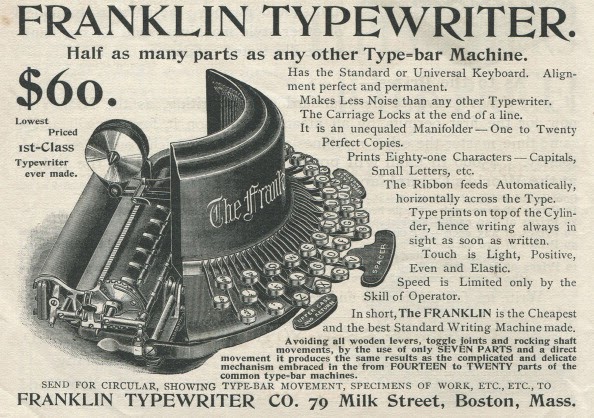
Typewriter Ads, 1888-1892


1888
1889
1890
1891


1892

Typewriters at the Anzio Beachhead, 1944 and 2014

This famous image of American war correspondent Ernie Pyle using a Remington Noiseless portable typewriter was taken on March 18, 1944, while Pyle was covering the Battle of Anzio in Italy.
The 70th anniversary of the Allied landings at Anzio, 32 miles (52km) south of Rome, was marked earlier this year with a reenactment, and typewriters once more appeared:
Typewriters were certainly there in the real battle. American soldiers Charles Garman and O.C. Smith ran a post office out of a small cave at 5th Army headquarters:
Anzio was one of the key battles of World War II. After almost six months of trench warfare, it eventually led to the liberation of Rome.
In the reenactment, soldiers in full battle kit waded on to a beach, fighter planes flew overhead and jeeps filed along the seaside.
Pyle enjoys a can of mush at Anzio.
Pyle returned to the battlefront to cover the Pacific War. He died on April 18, 1945, on Iejima, an island north-west of Okinawa, after being hit by Japanese machine-gun fire.
Operation Shingle was an Allied amphibious landing in the Italian Campaign against German forces in the area of Anzio and Nettuno.
"The forgotten D-Day"?
The operation was commanded by American Major General John P. Lucas and was intended to outflank German forces of the Winter Line and enable an attack on Rome. But Lucas had little confidence in the operation as planned and failed to capitalise on the element of surprise by delaying his advance until he judged his position was sufficiently consolidated and his troops ready. While Lucas consolidated, Field Marshal Albert Kesselring, the German commander in the Italian theatre, moved every spare unit to be found into a ring around the beachhead, where his gunners had a clear view of every Allied position.
Kesselring makes an attack order at Anzio, alongside Field Marshal Baron Wolfram von Richthofen.
The Germans also stopped the drainage pumps and flooded the reclaimed marsh with salt water, planning to entrap the Allies and destroy them by epidemic. For weeks a rain of shells fell on the beach, the marsh, the harbour and on anything else observable from the hills. After a month of heavy but inconclusive fighting, Lucas was relieved and sent home, replaced by Major General Lucian Truscott. 
The Allies finally broke out in May, but instead of striking inland to cut lines of communication of the German Tenth Army's units at Cassino, Truscott, on the orders of Lieutenant General Mark Clark, commander of the US Fifth Army, reluctantly turned his forces north-west towards Rome, which was captured on June 4. As a result, the forces of the German Tenth Army at Cassino were able to rejoin the rest of Kesselring's forces north of Rome, regroup, and make a fighting withdrawal to his next major prepared defensive position on the Gothic Line.
New Zealanders are among those who have never been able to forgive Clark for his unseemly rush to take the glory for liberating Rome. The withdrawn American units were replaced by the New Zealand Corps (2nd New Zealand Division and 4th Indian Division) from the British Eighth Army on the Adriatic front. The New Zealand Corps was commanded by the brilliant Lieutenant General Bernard Freyberg.
 28 Maori Battalion at Cassino
The Allies suffered around 55,000 casualties in the Monte Cassino campaign. Total Allied casualties spanning the period of the four Cassino battles and the Anzio campaign were over 105,000. New Zealand's casualties at Cassino from February 1 to April 10, 1944, totalled a proportionally high 1695. This included a disproportionate number of 28 (Maori) Battalion. In an early attack on the railway in the town, Maori suffered 130 casualties out of the 200 who set out. All so Clark could ride into Rome like a conquering hero.
Clark has been heavily criticised for ignoring the orders of his superior officer, General Harold Alexander, and is to blame for the escape of the German Tenth Army, which he let slip away in his pursuit of being the first to enter Rome - a strategically unimportant city. American military historian Carlo D'Este called Clark's choice to take Rome, rather than focusing on the destruction of the German Tenth Army, "as militarily stupid as it was insubordinate".

Wednesday, 26 March 2014

Hemingway's Corona 3 and the US Congressman

US congressman Jim McGovern, looks at a Corona 3 portable typewriter during a visit to Ernest Hemingway's former home near Havana, on March 17. Presumably it is the same Corona 3 that was given to Hemingway by his first wife, Hadley Richardson, on July 21, 1921, Hemingway's 22nd birthday.
SAN FRANCISCO DE PAULA, Cuba (AP) — US Congressman Jim McGovern visited Ernest Hemingway's former home outside Havana on March 17 to celebrate a joint US-Cuban effort to preserve and digitise the Nobel Prize-winning author's personal effects and writings.
Cuban curators gave the Massachusetts Democrat and a visiting US delegation a rare guided tour inside the modest but graceful Finca Vigia, a hilltop estate that is surrounded by lush tropical fruit trees and boasts panoramic views of the Havana skyline.
Cuba, where Hemingway lived from 1939 to 1960 and wrote much of The Old Man and the Sea and other works, claims the man known affectionately as "Papa" as a favourite son. McGovern said, "Hemingway has always brought people together. He transcends politics, and one of the points that I want to make today is that if Cubans and Americans can come together in a constructive way and do this, to help preserve a house and all its contents, then there's no limit to what we can do if we work together."
Scholars from both countries have been working together for more than a decade to preserve the home and its trove of documents, everything from bar bills and bullfighting tickets to personal notes and recipes. Last month, thousands of digital scans of Hemingway's Cuban papers were made available at the John F. Kennedy Presidential Library and Museum in Boston. The library is home to the world's biggest Hemingway collection, including 90 per cent of his manuscript material.
The collection in Cuba includes items such as the insurance for Hemingway's 1941 Plymouth station wagon, his local firearms license and the telegram notifying him that he had won the 1954 Nobel Prize for Literature.
"We are working to preserve the Hemingway collection for our children's children, and for our grandchildren's grandchildren," said Ada Rosa Alfonso, director of Finca Vigia.
The writer's fourth and last wife, Mary Welsh Hemingway, donated the estate in San Francisco de Paula, about a half-hour drive outside of Havana, to the Cuban government in 1961. This was shortly after Hemingway committed suicide in Ketchum, Idaho.
In recent years the house was in danger of collapse, prompting US and Cuban scholars to launch a restoration project. Historians say they have preserved Finca Vigia more or less just as "Papa" left it.
At least a dozen animal heads are mounted on the walls, a tribute to Hemingway's enthusiasm for trophy hunting. On a living room table sit the same half-full liquor bottles that were there more than five decades ago. Still legible in the bathroom are scribbled notes on a wall where Hemingway kept track of his weight, blood pressure and pulse every day.
"Everyone talks about the documents," said Gladys Rodriguez, former director of Finca Vigia and a leading Cuban expert on Hemingway. "But if we keep in mind that Hemingway wrote on the very walls, the home itself becomes a tremendous document ... It is the testimony of everything Hemingway did."

McGovern listens to the director of Hemingway's Museum, Ada Rosa Alfonso, second from right.

Remingtons 1 and 2, Blickensderfer Seen in Action

Filmed at the Olympia Exhibition and Conference Centre, West Kensington, London. Screened January 16, 1950.
A similar demonstration at the Savoy Hotel in London on October 27, 1948: