Total Pageviews

Showing posts sorted by relevance for query groma kolibri. Sort by date Show all posts

Tuesday, 20 December 2011

Groma Kolibri: The Ultra-Slim Typewriter

Artwork by Rob Bowker
I seldom have cause to regret being the catalyst for somebody acquiring a typewriter. Take for example Tino, of Melbourne, who initially, back in the middle of May, wasn’t sure whether to thank me or blame me for him buying a Groma Kolibri.
Tino read about the Kolibri in my book, The Magnificent 5: And 250 Other Great Things About Portable Typewriters. “You just HAD to mention Groma Kolibris in your book, didn't you?” he mused. “Thanks to that little snippet and a recent viewing of The Lives of Others, I am now the proud (and slightly poorer) owner of a metallic green Groma Kolibri.”
It's a beauty, too (below):
So I doubt if Tino has had any real regrets in the intervening seven months. One can clearly read into his post just how much he loved getting that machine. See http://teeritz.blogspot.com/2011/05/groma-kolibri-man-its-slim-typewriter.html
As well, Tino has had some “Der TypenKasten”-Lives of Others-style fun on his Teeritz Agenda blog. See http://teeritz.blogspot.com/2011/05/der-typenkasten.html
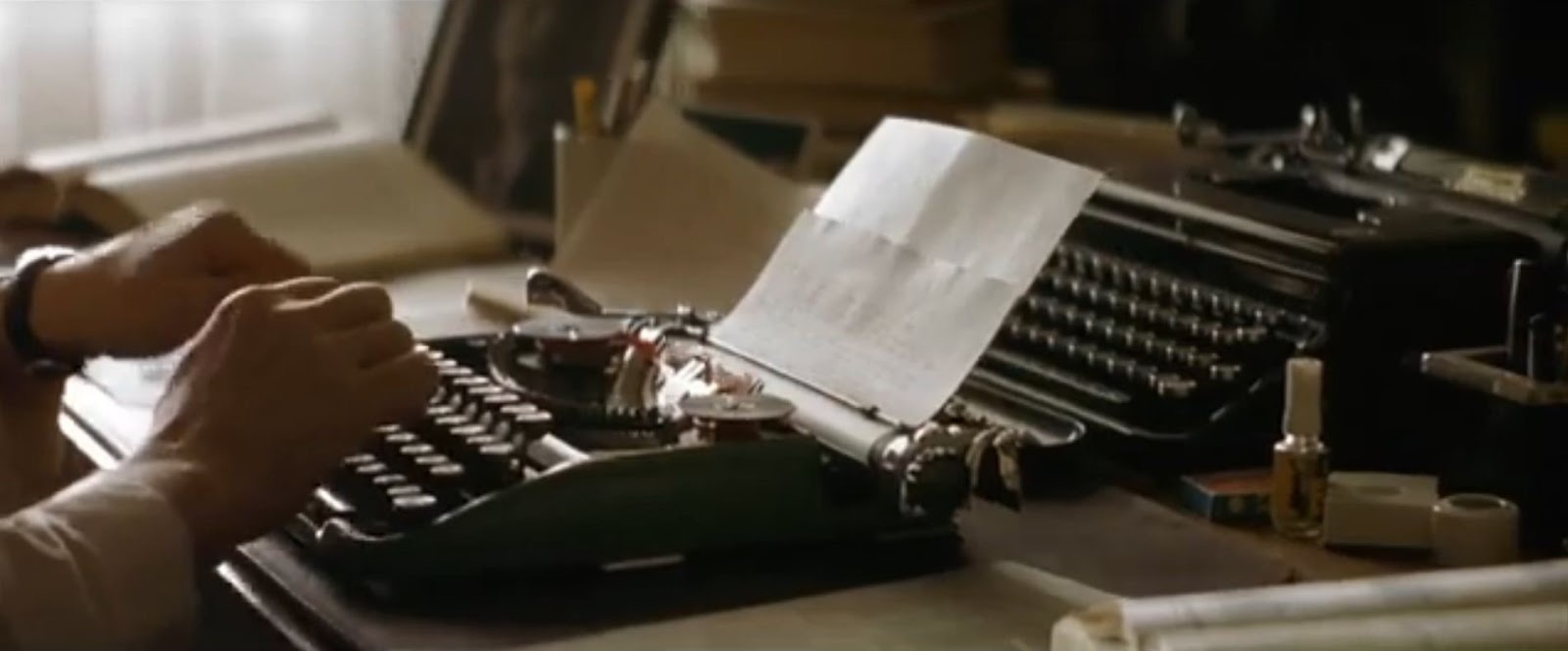
I am not going to go into any detail here about the Kolibri, or the leading role this typewriter plays in that brilliant 2006 German language movie The Lives of Others.
Look how well the manufacturers packed everything in so tightly. And what a dinky little mainspring, right under the carriage!
Instead, I will direct you to Georg Sommeregger’s posts, where he does a magnificent job of covering both machine and movie (including stills of the vital typewriter scenes) - as well as including a YouTube video of the Kolibri in use (and I suspect Georg might well be owner of the deft touch-typing hands).
The posts are at http://sommeregger.blogspot.com/2008/11/groma-kolibri-typewriter.html and http://sommeregger.blogspot.com/2011/10/schreibmaschinen-im-kino-das-leben-der.html
Here is a trailer of the movie:
For those who don’t know, The Lives of Others involves the monitoring of the cultural scene of East Berlin by agents of the Stasi, the GDR's secret police.
It won the Academy Award for Best Foreign Language Film.
As all typewriters owned in East Germany were registered, a playwright uses a Kolibri smuggled in from West Germany, which he hides under the floorboards of a doorway between two rooms of his apartment.
NOT a Kolibri on the cover!
Featured above are two of my Kolibris. The third one, a brown and black two-tone, is still being reassembled. I may have to use it now for other purposes, as one might be able to pick from these typecasts:

The missing "T" typeslug
By the way, in case you're wondering if such a thing exists, I do own an all-red typewriter ribbon!


Saturday, 24 December 2011

Groma Kolibri Typewriter: The Hummingbird Revisited

Who would blame me for wanting to revisit the Groma Kolibri, so soon after my previous post on this ultraslim portable typewriter? (I must admit it feels a little like Duelling Banjos with Georg Sommeregger, with Georg plucking those strings a lot better than I can!).
I also confess it is a little frustrating, as I dearly love all of these small, low-profile post-war European typewriters, but language barriers restrict what I can dig out about their development. Still, I struggle on in my researches, such is my abiding fascination with this range of portables.
I mentioned in my previous Groma post that I had another Kolibri, and here it is. Also, some more close-ups of my other two Kolibris, and a comparison with a normal-size matchbox and an average-size credit-business-library card.
The Kolibri is 6.5 centimetres high, or just over two-and-a-half inches (2.559). I think the original Gossen Tippa is about the same height, but I will check that out when I post on the full range of Tippas, from the Gossen through the Adler to the Litton, all of which are in my collection 
But getting back to the Groma: the brand name comes from combining the original company name, Maschinenfabrik G.F.Grosser, with its home town, Markersdorf, on the river Chemnitz.
The company started making typewriters after Max Paul Pfau (born March 31, 1872, Saxony, Germany) returned to Chemnitz in 1924 from the US, with almost 30 years' experience in typewriter design and manufacturing under his belt.
Pfau had immigrated with his family to the US in 1884, aged 12, and later worked for Remington in New York and Underwood in Hartford, as well as spending time in Woodstock, Illinois, where in 1911-12 he designed typewriters for Emerson. This was soon after Emerson's factory opened in Woodstock. During his time in the US, Pfau remained a citizen of Saxony.
Richard Polt Collection, Richard Uhlig design. Pfau patented improvements.
Back in Germany, Pfau applied his US-gained design expertise to Wanderer typewriters, producing this portable:
The collection of the late Tilman Elster, ex the European Typewriter Project, with Will Davis
Pfau then joined Gustav Friedrich Grosser's sewing machine company (founded 1872). Maschinenfabrik G.F.Grosser GmbH started its production of typewriters in 1924.
In 1934 Pfau was headhunted by Torpedo typewriters.
Richard Polt Collection, Pfau design
Pfau was succeeded as head of design at Groma by Leopold Ferdinand Pascher. Georg tells us Pascher was a Viennese engineer.
In October 1936 Pascher, based in Schweizertal, was issued with a German patent for what would become the first of the Groma ultraslim typewriters, the Gromina.
Thomas Furtig Collection
Pascher's application specifications describe in detail his intention to produce a typewriter "which can be carried in a small envelope".
Pascher made an application for a US patent for the same design in November 1940, 13 months before the US entered the war. The patent was issued on March 7, 1944, but because of the hostilities, it was vested in the Alien Property Custodian. 
Thomas Furtig Collection. Note the gull-wing ribbon covers,
similar to the Hermes Baby and Beaucourt Message
During the war, Pascher's design for the Gromina remained on hold. With Groma's manufacturing restructure in 1951, it was finally made.
Richard Polt Collection: This was the last model of the Gromina, made in 1954
Four years later, the Gromina was followed by the Kolibri.
This later work was apparently taken up by Karl Ronneberger, with VEB Mechanik Groma.
Following the war, as the company was in East Germany, it became known as VEB Mechanik Groma (VEB=Volkseigenen Betrieb, or "state-owned enterprise" of the German Democratic Republic [East Germany]).

I mentioned the Pascher patent in my detailed look at the Rooy ultraslim typewriter in September, which is at http://oztypewriter.blogspot.com/2011/09/on-this-day-in-typewriter-history-cxiii.html
But, being none the wiser then, I speculated that the design may have been for the Kolibri. As Richard Polt rightly pointed out at the time, it was for the Gromina. "The Kolibri used a different system, not involving geared typebars such as these," said Richard. This was possibly the "advance" on Pascher's work made by Ronneberger.
Elsewhere, Richard questioned the accuracy in using the Kolibri in the film The Lives of Others. After all, the Kolibri was made in East Germany.
Georg points out, however, that until Kolibri production ended in 1962, one of the largest customers for Groma was the West German mail-order firm and department store Neckermann. And Adwoa adds that these Groma Kolibris were relabelled as Neckermann Brilliant Juniors. Given, in the film, the typewriter has no ribbon cover (so we can see the all-red ribbon, presumably) it might well have been a Neckermann!?
Adwoa Bagalini Collection
Gromina, Christian Hamman Collection

Sunday, 5 January 2020

The Lives Of Us (And Our Lethal Typewriters)


An early Torpedo 18, the typewriter of choice for East German playwright Georg Dreyman before he acquired a Groma Kolibri in the movie The Lives of Others.
Housebound by blistering heat (111+ degrees, 44 Celsius) and a dense shroud of suffocating bushfire smoke, we have found some brief hiatus in watching DVDs of old movies. First up was the German language The Lives of Others, which I hadn’t seen in more than a decade, since it first appeared on cinema screens. Back then I suspect I was so engrossed by the appearance of the little green Groma Kolibri portable typewriter with a red ribbon – which I had considered to be the true star of the movie - that I missed many of the nuances in this brilliant work of art from Florian Graf Henckel von Donnersmarck. Now, having watched it again and taken in much more of its rich texture, I’ve been looking at reviews which had appeared in 2007. My favourite movie reviewer is Anthony Lane of The New Yorker, and I thought this line of Lane’s - from “Guilty Parties” in the February 12, 2007 issue - especially topical and telling: “This [obligation to write about the terrible suicide rate in East Germany] means smuggling in an untraceable typewriter - more lethal than a gun, in the land of a controlled press - and smuggling out the copy.”
            Some critics had apparently not appreciated the “humanisation” of one of the two lead characters, Stasi Captain Gerd Wiesler (played by Ulrich Mühe). But with the benefit of my much later viewing – the viewing, I might add, of a far calmer, more congenial viewer – I found myself agreeing utterly with Lane’s appraisal: “One of the marvels of Ulrich Mühe’s performance - in its seething stillness, its quality not just of self-denial but of self-haunting - is that he never distills Wiesler into a creature purely of his times. You can imagine him, with his close-cropped hair, as a young Lutheran in the wildfire of the early Reformation, or as a lost soul finding a new cause in the Berlin of 1933.” With 2020 hindsight, it's clear that one could also see Wiesler as a fundamentally decent man in these troubled times, increasingly compelled to resist the forces of blatant political corruption, bastardry and malice.
           Not much has changed in 13 years - perhaps in a unified Germany, but certainly not in the Ukraine and not in the US of A. As Lane went on, “See [Wiesler] crouched in a loft above [Georg] Dreyman’s home with a typewriter, a tape deck, and headphones clamped to his skull. Watch the nothingness on his face as he taps out his report on the couple’s actions … Slowly, the tables turn. Wiesler steals Dreyman’s copy of Brecht and takes it home to read; he starts to omit details in his official account; and, for some fathomless reason - guilt, curiosity, longing - he lets the lives of others run their course.” As part of this engrossing process, Lane might have added Wiesler’s listening to Dreyman’s piano playing, of Sonata for a Good Man from sheet music given to playwright Dreyman (Sebastian Koch) as a 40th birthday gift by the suicidal, blacklisted director Albert Jerska (Volkmar Kleinert).
      The superslim Kolibri
The Lives of Others was released in 2006 and was the feature film debut of Donnersmarck (whose name, Lane wrote, “makes him sound like a lover with a duelling scar on his cheekbone in a 19th-century novel”). The movie went on to win the Oscar for Best Foreign Language Film.  Its ending is one of the best I’ve ever seen in a movie. Lane summed it up well: “Against all odds, though, the best is yet to come: an ending of overwhelming simplicity and force, in which the hopes of the film - as opposed to its fears, which have shivered throughout - come gently to rest. What happens is that a character says, ‘Es ist für mich’ – ‘It’s for me.’ When you see the film, as you must, you will understand why the phrase is like a blessing. To have something bestowed on ‘me’—not on a tool of the state, not on a scapegoat or a sneak, but on me—is a sign that individual liberties have risen from the dead. You might think that The Lives of Others is aimed solely at modern Germans—at all the Wieslers, the Dreymans, and the weeping Christa-Marias. A movie this strong, however, is never parochial, nor is it period drama. Es ist für uns. It’s for us.”

Not only is it for us, but it is also – as I found to my great delight today – a film very much for our times. It speaks to our present-day fears, in a world where political corruption – in just about every major country one can think of – is more rife and strident than ever before. The film unobtrusively signals the demise of the Communist Bloc with a newspaper headline announcing Mikhail Gorbachev’s elevation to Soviet presidency, but the end of the USSR has merely ushered in of new era of extreme Right Wing Fascism and an almost universal undermining of democracy. The Lives of Others is definitely well worth watching all over again. It very much remains timely.
An East German forensic document examiner demonstrates different typewriter fonts to the Stasi.
A.O. Scott wrote in The New York Times on February 9, 2007 (“A Fugue for Good German Men”), Wiesler and Dreyman, as true patriots, needed to commit treason. And treason is exactly what Donald Trump is accusing Democrats of committing in their efforts to impeach him.  Scott said,  “ … as Georg is driven toward actions that implicate him, for the first time, in dissident activity, Wiesler becomes convinced of Georg’s essential innocence and takes steps to protect him. The plot, as it acquires the breathless momentum of a thriller, also takes on the outlines of a dark joke. The poet and the secret policeman - both writers, in their differing fashions - may be the only two true patriots in the whole German Democratic Republic; in other words, the only people who take the Republic’s stated ideals at face value. But since the nation itself functions by means of the wholesale and systematic betrayal of those ideals, the only way Wiesler and Georg can express their loyalty is by committing treason.” How pointed is that in terms of the republic of the United States and its stated ideals, and a “wholesale and systematic betrayal of those ideals” in 2019-20? East Germany and the Stasi may be gone, but their ghosts appear to be living on, at least in Washington DC.