PART 131


Wellington Parker Kidder
Kidder, of course, had long since perfected
the thrust-action typewriter. In April 1894, with the Wellington thrust-action machine still to reach the marketplace (it
would do so the next year, to be followed by the Empire), Kidder moved on
to his next project and applied for
his first patent for a “noiseless
type-writing machine”, one which would employ a “a new toggle-joint
connection for a type-carrier and key-lever”. But over the next 11 years,
Kidder was unable to perfect the machine. So in 1905 he called in help.
Charles Sponsels' one-inch rapid-fire gun

The New York Times, June 14, 1892

The New York Times, April 9, 1893
In Sponsel, he found a highly-skilled
precision engineering partner as he sought to attain his ultimate typewriter
goal. Sponsel had worked for Pratt & Whitney in Hartford, where
he had invented the rapid-fire gun and the rifle magazine, among other things.
After working with Kidder, he turned
his attention to one of the earliest automobile reverse gear mechanisms. Sponsel, who was born to German parents
in Walpole, New Hampshire, in March 1861, died in 1931. Kidder was eight years his senior, having been born on February 19,
1853, in Norridgewock, Maine. 
A younger Charles Carroll Colby
Hitherto, Kidder and his long-standing Canadian
backer Charles Carroll Colby have
been given all the credit for the Noiseless.
Colby had in fact died eight years
before the first Noiseless was made,
in 1915. Only passing reference has been made to Sponsel - in an extensive entry on the Noiseless in The Typewriter:
History & Encyclopedia (1924). Kidder
and Sponsel are among seven men
mentioned as having been contributors in the development of the Noiseless, but the author – so effusive
about the Noiseless it could well
have been Kidder himself – admits
there were others. One name missing from that list of seven is that of Canadian-born
George Gould Going.
George Gould Going demonstrates his Noiseless
typebar mechanism in 1940

Courtesy of Georg Sommeregger. See his Remington Noiseless web page here.

The Going design for Remington Noiseless in 1925
Going was one of the relatively younger men in
the leading group, along with the naturalised Swedish-born Nils Hjalmar Anderson, the one credited by History
& Encyclopedia with inventing in 1912 the typing action which finally
made the Noiseless a feasible
proposition. Going was to invent the
double-headed typeslug arrangement, which Georg
Sommeregger so kindly here demonstrates for us on a Remington Noiseless on his typerwriters.ch web page here.

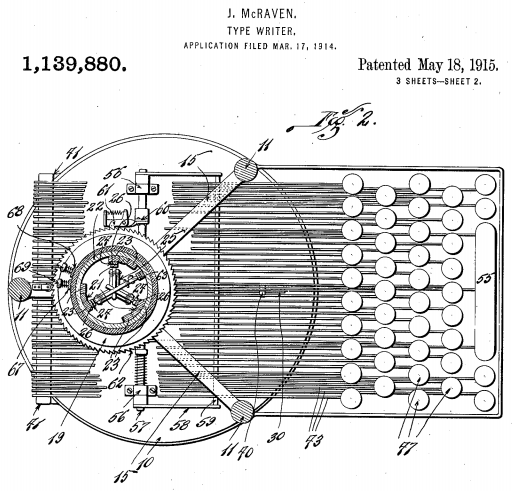
My excuse for running this story is the above Going patent for the Noiseless type action, for which Going filed an application on this day (September 28) in 1923. It was subsequently assigned to Remington Noiseless.
History & Encyclopedia does go on to say Going deserved “Much credit for
improvement in design during the period of the present company [1908-1923]." At
the time of the Noiseless company’s
establishment, Going, then a
36-year-old, was working independently with another leading figure in the
subsequent development of the Noiseless,
John Anderson Ruffin. Ruffin had
been a designer and director with Hammond,
until he became embroiled in a legal dispute with James Bartlett Hammond over Hammond,
thinking he was about to die, issuing a deed trust, handing control of the Hammond company to Ruffin and others. 
The Going-Ruffin typewriter design of 1909
When their own typewriter enterprise failed to produce a
machine, Ruffin and Going joined Noiseless, in 1916. When Noiseless “joined forces” with Remington on January 30, 1924, creating
the Remington Noiseless Corporation,
a subsidiary of Remington, Ruffin was works manager and Going chief engineer of Noiseless.Going held his position in the new corporation and continued to work for it after it sold out to Rand Kardex Bureau on July 11, 1927. Going was still working for Remington Rand into his late 60s, in the early 1940s, by which time his position was “research engineer”.

James H.Rand Jr in 1937
In 1939 Remington Rand boss James Henry Rand Jr decided, with Going’s retirement impending, to press
Dr Karl Taylor Compton, president of
the Massachusetts Institute of
Technology, to recognise Going’s
efforts over almost 30 years – in the form of a National Association of Manufacturers’ long-service certificate. The award, made in February 1940 in Hartford, Connecticut (Going was still working out of
Stamford), honoured Going as a
“modern pioneer on the American frontier of business”. 
Dr Karl T.Compton
At this
point in time, the earlier work of Kidder,
Sponsel, Anderson, Ruffin and others on the Noiseless was quite forgotten. But Going was being given due credit for “two outstanding contributions to the
development of the Noiseless typewriter.
He adapted the noiseless type action to a single shift standard keyboard by a
unique mechanism which permits four characters to be operated on one typebar
connected to two key levers, He also produced the first light portable
noiseless machine with standard keyboard and single shift.” The last claim
refers to the Remington and Underwood Noiseless portables, not the
original Noiseless portable, which is a three-bank and has a double shift - although Going did, according the History & Encyclopedia, develop this
wonderful typewriter as well. (Its invention has been generally credited to
Kidder, but if it was the work of Going, as now seems likely, Going deserves far more kudos than
ever previously afforded him.)
George G.Going's NAM certificate
George
Gould Going was born at Tillsonburg,
Oxford South, Ontario, on June 15, 1872, the son of an Irish-born vicar, the
Reverend Augustus Henry Going and his English-born wife, Clementina Murray
Going. In much later life, when George
Going was claiming to have been New York-born, it was stated that his
father had run a floor mill near Buffalo. This seems highly unlikely to be
true.
George Going
was still living in Ontario in March 1901, at almost 29 years of age. But he
had moved to New York City by March 1909, when he linked up with Ruffin. According to James H.Rand’s
nomination for Going for the NAM
award, Going, “as a boy, observed
effects of vibration in his father’s flour mill and that led to his making
vibration problems a hobby and life study. From boyhood he [was] afflicted with
the ‘itch to make things’. After high school, rejecting his father’s advice to
study medicine, he apprenticed himself to a watchmaker. Self-educated from that
point on, he became a skilled mathematician and versatile engineer.” Rand went
on to say Going abandoned
watchmaking “for the then almost unexplored writing machine field, which
challenged his pioneering instincts. His associates recognise that besides
having mastered control of vibration, and with it control of noise, he has in
many other ways advanced tremendously the utility of writing machine.” Rand
goes on to make claims regarding the socio-economic impact of the Remington Rand Noiseless typewriter,
calling Going an “inventive genius”, a “quiet, brilliant worker with
extraordinary patience”.

Much of
this is rather fanciful stuff which doesn’t match what we know of the reality
of Going’s early life. Nonetheless, that he was a hugely skilled mechanical
engineer is beyond question. In bringing to light Rand’s citation for Going, through his grandson Patrick
Going, ETCetera co-editor Rich
Cincotto (September 2005 issue, No 71), concluded that Going was “quite an instrumental figure in the success of
the Noiseless typewriter … who
deserves a bit of recognition!” But by the time Going died, in Stamford on December 4,
1954, that recognition was far from widespread.

Alan Seaver's Remington Noiseless 6 with the top plate off reveals a normally hidden side of George Going's work.
See Alan's web pages at Machines of Loving Grace.
In his
tribute to Going, Rand touched on an
interesting aspect of the Remington Noiseless’
development. He wrote, “Despite the obvious advantages of noiseless typing,
nearly 20 [years] of pioneering effort [had] failed to make a commercial
success of the early Noiseless
typewriter, because seemingly insurmountable limitations of space made
impossible a four-bank standard keyboard with noiseless typing action. Fortunes
were sunk in engineering and merchandising until George Going came along to demonstrate the first model of the Noiseless with a standard keyboard.” A
United Press wire story about Going’s
award went on, “Thereupon the Remington
Typewriter Company acquired the Noiseless
company, its patents, and the services of Mr Going.”

Making noises with Little Jimmy Rand's Band
Given
Rand’s words about the Noiseless, it
is astonishing that in 1932, Rand himself patented a design “for converting at will a noiseless machine into a noisy
machine, by which means a noiseless machine in its operation
may be made to produce a noise such as is produced in the hammer-blow
typewriting machine when the types strike the platen. In the operation of
noiseless typewriting machines, there is a pronounced psychological effect on some operators,
especially those who have previously operated noisy machines. This is due to
the fact that in operating a noiseless machine the operator hears no noise, and
the ‘touch’ on such machines is usually much lighter than in noisy machines.
Therefore, the operator has the mental attitude that she is not writing or
obtaining any result from the operation of the keys, or that she is not
attaining her usual speed, due almost wholly to the entire absence of the usual clatter to which she is accustomed.
It is difficult in some instances to overcome this purely mental attitude, or
to convince the operator that she is in fact writing at possibly an even
greater speed than she ordinarily attains on a noisy machine, and with the
expenditure of less effort.”

Could be
it that in Rand’s mind, all those expensive and strenuous efforts over the
preceding 38 years, starting with Kidder
in 1894, had been in vain? A complete waste of money, brainpower and time? Or
was it purely a commercially motivated move, enabling Remington to continue to
sell Noiseless typewriters but to have them appeal, at the same time, to people
who wanted the added psychological advantage of noise? Whatever the reason for
Rand’s patent, Thomas A. Russo
points out in his 2002 book Mechanical
Typewriters, “It was common knowledge at Remington Rand that during The Depression of the early 1930s, the Noiseless Typewriter was responsible
for Remington’s survival.”

Noiseless from the Alfred R. Wepf Collection.
Photographed by George Sommeregger
At this point, let’s go back to the
beginning to trace how this machine came to be.

This letter published in The New York Times on June 7, 1908, clearly indicates there was market out there for a Noiseless typewriter. Could it possibly have been written by Kidder?

G.E.Matthews
The
first four of eight Kidder-Sponsel
noiseless typewriter patents were assigned to the Parker Machine Company of Buffalo, one of many typewriter-producing organisations established by Kidder (in this case, one adopting his
middle name). Buffalo was chosen because of Kidder’s association with George
Edward Matthews (1855-1911), of J.N.Matthews Co and Matthews Northrup Works,
owners and publishers of the Buffalo
Express, which used Kidder’s
22-ton rotary web press. Although he leaned toward the Republican side of
politics, Matthews, in turn, was
able to enlist the backing of leading New York financier and Democratic Party member
William Caryl Ely. Yet three years
before Matthews died, aged 56, following
his daughter’s wedding on June 11, 1911, the Parker Machine Company had preceded him, consigned to the grave. Since
the Parker company hadn’t built a factory or expended any working capital, this
was no crippling loss to the enterprise.

W.Caryl Ely, first president of Noiseless
Instead, Kidder had simply established two new
companies to take its place. The first was the Silent Writing Machine Company of 1908, which became the Noiseless Typewriter Company with
incorporation in 1909. Ely was its
president. Ely was described on his
death, on December 15, 1921, aged 63, as the “organiser and builder of railways
and power companies”. Born on February 25, 1856, in Middlefield, New York, Ely graduated from Cornell and
practised law.
The Keating Wheel Company factory
The new
company was based in Middletown,
Connecticut. A factory had been built on Johnston Street, Middletown, by
the Keating Wheel Company in 1896. The plant was taken over by the Eisenhuth
Horseless Vehicle Company in 1901, but had sat idle for 15 months, since March
1907.
The Remington Noiseless factory
Buffalo had
been almost “half-way house” between Kidder
and his principle backer, Charles Carroll
Colby in Stanstead, Quebec. Colby, born in Derby, Vermont, on December
10, 1827, was a lawyer, businessman and politician. He first met Kidder in 1892 and for the next 15 years seemed
to have bottomless pockets when it came to financially supporting Kidder typewriter projects. Kidder and Colby
had settled on the Noiseless undertaking
at a conference in late 1896, more than two years after Kidder had first patented the idea.
A somewhat older C.C.Colby
Kidder devoted the next eight years to
producing models of “a pressure-printing machine which had its structural basis
in toggle-cam action”. In doing this Kidder,
whose earlier interest had been in printing machines, was attempting to align
the typewriter action much closer to
printing techniques. But he encountered
mechanical difficulties, and in desperation called in the services of Sponsel in Hartford. Also, an Italian
citizen, Joseph
Albert Ronchetti, based in Woonsocket,
Rhode Island, was recruited to work on the ribbon mechanism.As well as the mechanical problems, there were mounting financial costs, heavily compounded by Colby’s death in Montreal on January 19, 1907. Kidder and Colby had been among the leading shareholders in the Parker company, which had spent $500,000 by 1909, almost all of it on experimentation. Kidder still had little to show for it, certainly nothing in the way of a typewriter.

Courtesy of Richard Milton. See his Noiseless web page here.
Once the Noiseless company was formed, the existing Kidder-Sponsel patents were assigned to it, along with those of Ronchetti. Indeed, a vast team of
mechanical engineers and designers was assembled to further the initial work of
Kidder and Sponsel. The team was headed by the Swede Nils Hjalmar
Anderson, John Anderson Ruffin and George Gould Going.
Nils Hjalmar Anderson was born in Hagfors, Sweden, on August 31, 1881. He immigrated
to the US in 1892 and became naturalised in 1905. Eighteen of Anderson’s patents for typewriter or typewriter-related
designs were assigned to Noiseless over
a period of 11 years, from 1908-1919. After leaving the employ of Noiseless, Anderson described himself as an unaffiliated machinist and
machine designer. He died on February 9, 1958, aged 76.

Wim Van Rompuy Collection. See his Noiseless web page here.
John Anderson Ruffin (born Memphis, Tennessee, September 1866; died about 1927) had
previously patented typewriter
designs for Hammond and was one of
the Hammond directors and
shareholders sued by James Bartlett
Hammond in June 1910. Hammond
had thought he was about to die and had issued a trust deed handing over 520 of
his company’s 550 shares to directors and staff members. When Hammond realised he wasn’t dying, just
yet, he took legal action to set the deed aside, for the time being, as “causa
mortis”.

Hammond died in 1913, by
which time Ruffin had struck out for
independence with Going (they
designed their own typewriter in 1909). This pair then went on to work for Noiseless, with Ruffin ultimately becoming works manager and Going chief engineer.
Others in the Noiseless team were William Albert Lorenz and Edward Henry Lorenz, Edward J. Sheehan (later sales manager),
Ernest Burke Bishop, Edward Lewis Center Clark, Daniel Bror Westin, Robert S.Blair and yet another Swede, Otto Hultgren.
With the
weight of these men behind it, the Noiseless finally seemed to have been made
ready for the marketplace. And yet, any yet … the cam machine still couldn’t be
produced to Kidder’s satisfaction. So the cams had to go, and to take their
place Nils Anderson in 1912 invented a double toggle (or “momentum accumulator”) type action “which
rendered it possible to eliminate cams wholly from the machine, at the same
time accelerating the speed very greatly and lightening the touch to a marked
degree.”

The New York Times, October 11, 1913
Technical problem solved,
financial problems unsolved. On December 18, 1913, a reorganisation plan of the
bondholders fell through and the company was dissolved and reincorporated itself
with the same name in June 1914. The making of tools started that month and
continued to March 1915. In the last nine
months of 1915 fewer than 500 machines left the production line. But the Noiseless was at last on its way,
albeit somewhat gingerly. In 1916 a larger version was tentatively introduced,
and 10,500 were made. Then at the start of 1917 the No 4 model emerged, the Noiseless in its “first fully
commercial and satisfactory form”. Just 700 were made in that first year, but
the production numbers steadily rose: 4000 in 1918, 7000 in 1919, 11,000 in
1920 and 16,000 in 1921. A Model 5 followed in 1922, with 8000 5s sold until
the end of 1923, along with 7000 4s.

C.W.Colby
By this
stage George Gould Going was chief
engineer, but from 1921 his efforts had been concentrated on the magnificent Noiseless portable, which reached the
market in November that year. With the Noiseless
in both standard and portable sizes on the market, and with Colby’s son, Dr Charles William Colby (1867-1955) at the helm of the company, the
future looked very rosy indeed. In June 1923 that impression seemed to be
confirmed when the Franklin Institute
awarded the 1922 Edward Longstreth Medal
to the Noiseless company “for
inventions and improvements embodied” in the typewriter.

myTypewriter.com
Noiseless’
complexion must have appeared extremely rosy to Remington, too. At the end of 1923 Remington courted Noiseless
and on January 30, 1924, the two companies agreed to join forces. Officially it
was not a takeover, and production remained in Middletown. Yet the new company
became known as the Remington Noiseless
Corporation, and it was mere subsidiary of Remington proper. Remington
Noiseless pretty soon dropped the Noiseless
portable, having other ideas for a noiseless portable, while Noiseless’ No 6 standard model appeared
as the Remington Noiseless. Remington stated the merger had put it in a position of “unquestionable supremacy” in meeting
the typewriter needs of every user
throughout the world.

Wellington Parker Kidder lived to see all this, but his mind was elsewhere, preparing the
last of his eight patent applications for a new portable. In 1919 Kidder
had diverted his attention yet again, this time to the Rochester, one of those would-be typewriter treasures that never saw the light of day. As the Noiseless experience showed, Kidder was not a man to give up on
anything lightly, and with the Rochester
portable he set out to prove the cam type action, which had failed on Noiseless, could still be made to work.
But he had no choice about giving up on
the Rochester – he died at Easton
Town, Bristol, Massachusetts, on October 2, 1924, aged 71.

Noiseless stockholders may have
had to accept the merger with Remington,
but on July 11, 1927, some of them were far less than impressed by the way
their shares had been devalued in Remington’s
decision to sell out to Rand. James Rand Jr's American Kardex Company
had merged with the Rand Company on April 1, 1925, as the Rand Kardex Company.
Three months later Index Visible was merged into the joint organisation.
Another four months on and Rand Kardex Company and Library Bureau merged, to
form the Rand Kardex Bureau. Then on
January 1, 1926, the Safe Cabinet Company was also merged. In 1927, Remington was engulfed into Rand Kardex Bureau Inc, followed by the
Dalton Adding Machine Company and the Powers Accounting Machine Company.
The Noiseless was now the Remington Rand Noiseless.

A 1930 advertisement in The
Saturday Evening Post claimed a Remington
Rand representative had saved another company $17,000 in construction
costs. By using the Remington Rand
Noiseless typewriter, this
latter company had found it could do away with additional interior walls to
block office sound.
Of George Gould Going’s
32 Noiseless typewriter patents –
for standards and portables – six ended up being assigned to the Remington Noiseless company and another
20 to Remington Rand.