Total Pageviews

Showing posts sorted by relevance for query smith-corona skyriter. Sort by date Show all posts

Thursday, 13 January 2022

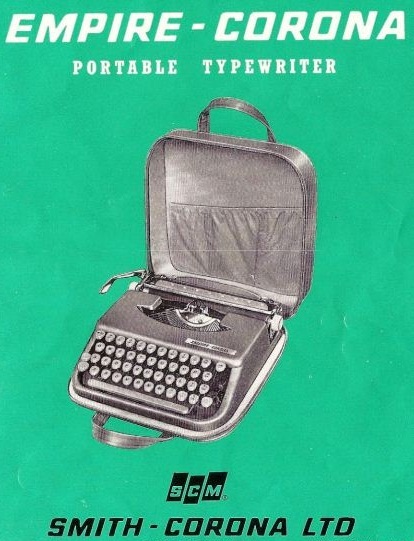
The Empire Corona Portable Typewriter

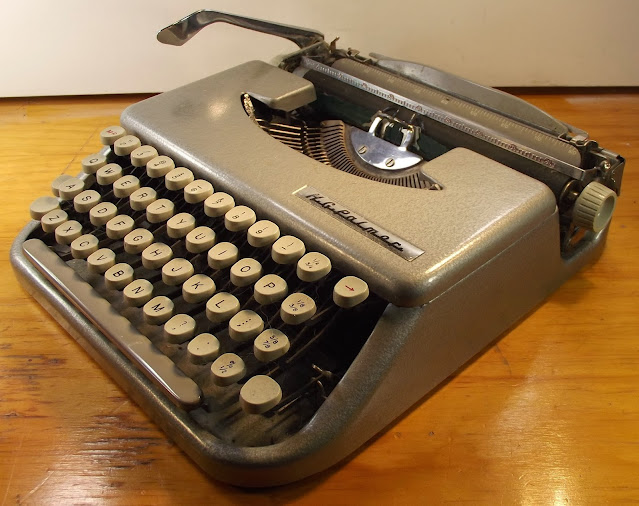
Relabelled again and sold in Australia through the H.G. Palmer department stores.

I was rather surprised yesterday to find that at the end of July 2007 I had not alone made an inventory of my typewriter collection, such as it was back then, but the inventory was still in existence. At that time, 14½ years ago, not many of my 193 typewriters were what could be called truly vintage. As the collection grew, by almost five times the number of machines I then owned, that situation very much changed. And with an emphasis on much older models, I naturally started to lose interest in those 1950s and ’60s machines which had once so fascinated me.
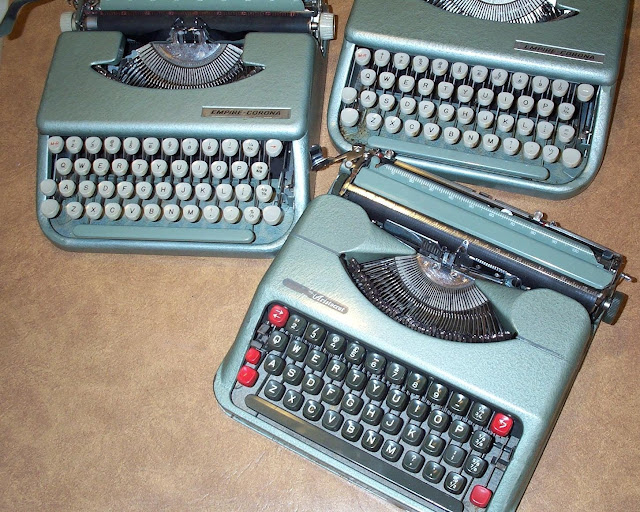

Near the top of the inventory, for example, were two metallic green Empire Coronas. Goodness knows where they are now. They were no more than relabeled Smith-Corona Skyriters,  of course, but back in my earliest days of typewriter history research I was intrigued by how an American machine could be sold as a British-made Empire Corona. (Bearing in mind my 2007 collection also included such little mysteries as a Czech-made Norwood and Japanese-made Pinnocks.) The Empire Corona had me scratching my head about things that had been going on in the typewriter world at the time I first started using a typewriter.

Rob Bowker's Empire Corona

In September 2007 I contacted Will Davis with some information I’d gathered for Will’s Portable Typewriter Reference Site. Will was almost as puzzled as I was by these Empire Coronas. “Here are a couple of interesting typewriters,” he wrote in a caption beside an Empire Corona with an Empire Aristocrat.  “Both were built in West Bromwich, England, in the same factory but at different times. Very rarely you will see a machine of the Hermes pattern with Corona or SCM labeling, made during a short period of ‘running down the stocks’.”
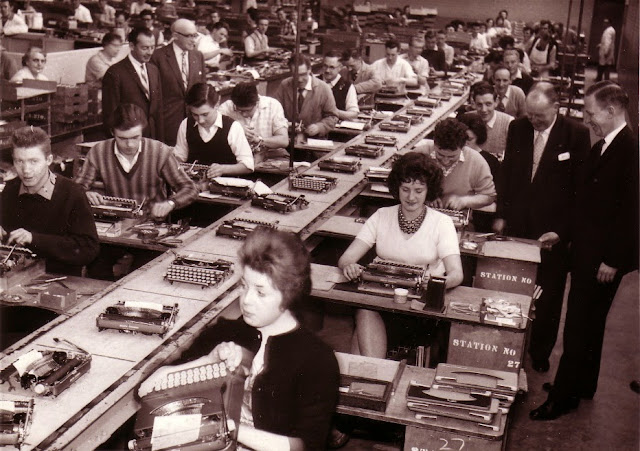
Assembling Skyriters and turning them into Empires

All would become clear to me in the next few years. But, reminded yesterday of my Empire Coronas, I was still interested in revisiting the events which led to Smith-Corona-Marchant taking over the old Salter typewriter plant in West Bromwich outside Birmingham in England.
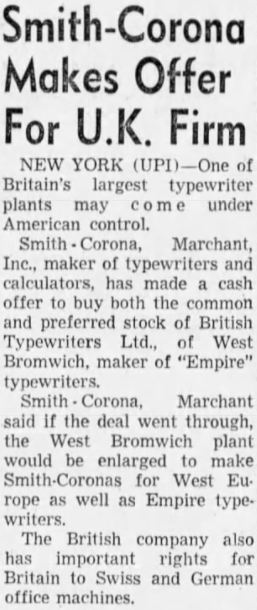

SCM’s cash offer for all outstanding 33,000 common shares and 39,267 preferred shares in British Typewriters Ltd of West Bromwich was announced on July 27, 1958, by SCM president Elwyn Smith, with a deadline for acceptance set at September 1. By August 26 the deal was done. (Elwyn Lawrence ‘Tump’ Smith, 1894-1979, was a son of Wilbert Lewis Smith and nephew of Lyman Cornelius Smith.)
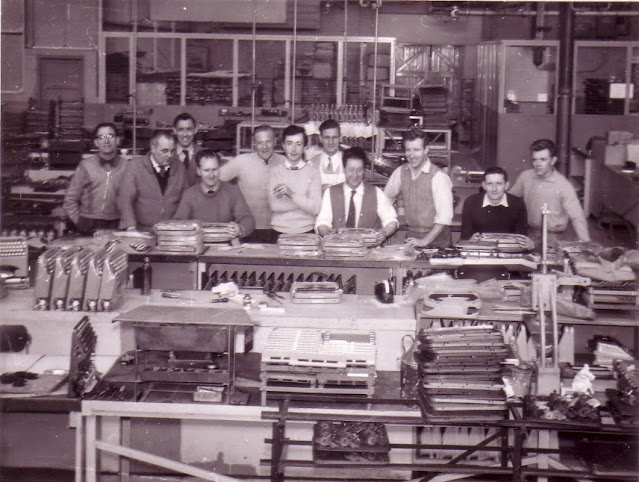

British Typewriters had gained the rights from E. Paillard & Cie in Yverdon, Switzerland, to make Hermes Featherweights as Empire portable typewriters, soon after the Featherweight was launched in 1935. Smith said SCM planned to enlarge the West Bromwich factory to make Corona Skyriter portables as well as the Empire. As it turned out, however, in its first year in Britain the American company merely assembled and relabeled the Skyriter. Still, rocky times lay ahead.
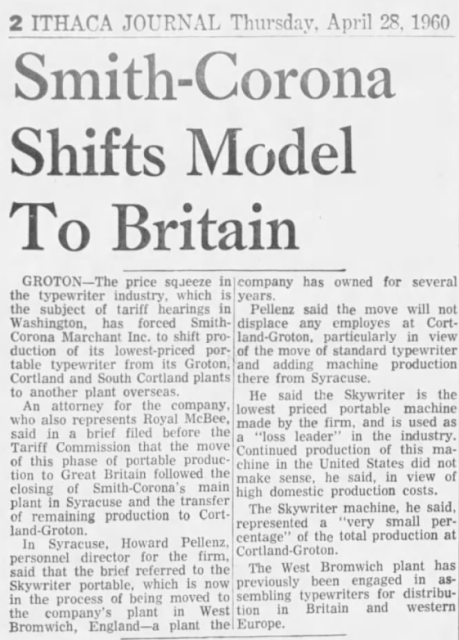

On September 17, 1959, British Typewriters and Smith-Corona dropped the prices of some models. At the end of April 1960, SCM said the price squeeze in the US typewriter market, the subject of tariff hearings in Washington DC, had forced the American company to move production of all of its portables from Groton, Cortland and South Cortland to West Bromwich.
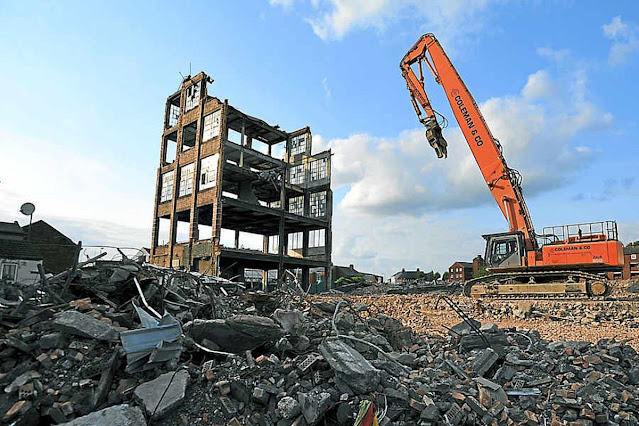
The Salter factory was levelled in June 2013.

A brief filed before the Tariff Commission said the move followed the closing of SCM’s main plant in Syracuse, with production first moved to Groton and Cortland then Britain. This, explained SCM’s Syracuse personnel director Howard Pellenz, referred only to the Skyriter, with standard size machines still to be made in the US. Pellenz called the Skyriter a “loss leader” in the industry. A loss leader is a pricing strategy in which a product is sold at a price below its market cost to stimulate other sales of more profitable goods. With this sales promotion-marketing strategy, a “leader” is any popular article sold at a normal price. Continued production of the Skyriter in the US “did not make sense in view of high domestic production costs”.
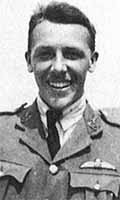

British Typewriters had taken over the old Salter plant in West Bromwich in 1936, soon after the company’s founder, former Imperial sales manager and Royal Flying Corps pilot Bill Mawle (above, 1897-1971), had acquired the rights to make a variant of the Hermes Featherweight portable. The plant was hit by German bombers in World War II and a rebuild was completed by 1954.


As part of SCM’s takeover offer, Mawle and his works manager J.C. Holdship, both of whom had been with British Typewriters since 1936, were retained in their positions. Mawle stepped down from the managing directorship in January 1962 and was succeeded by Holdship. At the end of 1974 SCM expanded the West Bromwich factory as well as opening a plant in Singapore. The West Bromwich factory was closed on February 5, 1981, with the lose of 230 jobs. Cortland was closed in 1993 and production moved to Mexico. SCM went bust in 1995.

Monday, 14 March 2011

Courier: Font and Typewriter

Courier, the font you see before your very eyes, has been called the world’s best-known typeface. For some, most especially those of us who grew up using manual typewriters, it is also - as one enduring vestige of our younger age - perhaps the best-loved. Wikipedia points out this “monospaced slab serif font was specifically designed to resemble the output from a strike-on typewriter”.


Courier was created for IBM in 1955 by Howard G. “Bud” Kettler (above), originally for typebar typewriters, but later - by shortening some serifs and narrowing numerals - adapted for the golfball in IBM Selectrics. Since IBM didn’t ensure its exclusive rights to the font, it was imitated by other typewriter makers and became what has been described as “an early version of shareware”. And in its widespread present-day use, from Word Document to blogging and beyond, the Courier font - along with the QWERTY keyboard – helps to maintain some sort of link between the typewriter and the computer. Like the keyboard, the font is an element which comes packaged with every electronic operating system.
Kettler (born 1919, died September 1999) had served in the US Navy during World War II and signed on with IBM in 1952 from a background in small town newspapers and printing. He had owned a print shop, had used typewriters and had operated linotype machines to typeset copy. He knew typography like the back of his hand. One of his former IBM colleagues described Courier as a “crystal goblet type design” and as “the most successful of all” – he said Kettler believed the reader should see just words and not be conscious of characters.
Many typewriter lovers believe if they must use this modern technology, writing in Courier might at least give them something which approximates to the look of the right type of type. Understandably, this has proved insufficient for many typewriter enthusiasts, and in the past few years, technology has allowed a rise in the “fontification” of actual typewriter typefaces, along with a passion for “typecasting”. I consider Richard Polt something of a crusader in both of these areas, and to the uninitiated reader I thoroughly recommend they visit Richard’s website, The Classic Typewriter Page (http://site.xavier.edu/polt/typewriters/) , on which he offers free downloads of typewriter fonts, or his blog, The Writing Ball (http://writingball.blogspot.com/) , which is typecast.
But back to Courier. Given its heritage, Kettler’s font cuts close to a personal bone. In its prototype phase, Courier was called Messenger, but Kettler decided, “A letter can be just an ordinary messenger, or it can be the courier, which radiates dignity, prestige and stability.” (Courier has Old French and Latin roots and connotations with diplomatic and secret services.) Such a shame! I’m no ordinary Messenger, I’m proud to say, and I’m equally proud to say there is at least is one typewriter called a Messenger (a latter-day Imperial) and one called a Message (Beaucourt). But we’ll come to those later.
There’s something a bit unusual about typewriters called Couriers. While, as I mentioned in an earlier post, Monarch (by Remington) and Zephyr and Skyriter (by Smith-Corona) are brand names recycled by the one manufacturer, Courier was used by at least three of the more famous makers: by Oliver - in both its first (American) life and in its later (British) life – as well as by Smith-Corona and by Olivetti.
Will Davis has written extensively on the various reincarnations of Monarch typewriters. From such a glorious beginning, the Monarch name was eventually, in 1959, attached to Dutch-made Remington portables. Smith-Corona morphed the Zephyr of 1938 into the Skyriter some 20 years later, then used both names on British-made portables in the late 60s-early 70s. As you will see from Alan Seaver’s Machines of Loving Grace website (http://machinesoflovinggrace.com/), there are many variants of Smith-Corona Sterlings.
Smith-Corona also called one of its British-made portables a Courier: this is an attractive cross between a Skyriter and a Silent-Super. Olivetti named one of the early Glasgow-made versions of the Lettera 22 a Scribe, then had a very distinct variation made in Mexico and sold in the US through Sears Roebuck as a Courier. Unlike other Olivetti portables, this one had a rust-red crinkle surface and white keytops. Tina Fey posed with one of these in a cover story of the spring 2004 edition of Bust magazine.
The subject of renaming models for Sears Roebuck consumption is broad and interesting enough for a post all of its own, and would embrace a vast number of machines, including the Rem-Blick, Smith Coronas masquerading as Towers and Sears’ 1955 $176.000 deal with Jack Tramiel to assemble Czech-made Consuls in Canada, which I have touched on in an earlier post.
Perhaps the most interesting use of Courier was on the Austrian-made Oliver (the paperplate here is from Georg Sommeregger’s website, http://translate.google.com/translate?hl=en&sl=de&tl=en&u=http%3A%2F%2Ftypewriters.ch%2F
Somehow this attachment of the Courier name to Olivers was extended through to the post-World War II period, when Oliver portables were still being made in England. The one at the top of the post is from my own collection:
This portable is, of course, part of that very extensive “Euro” family which includes not just Olivers made in Britain and in Italy (see current Australian eBay listing above), but Voss, Patria, Swissa, Byron, AMC and Japy/Beaucourt models as well. Although Richard Polt put together an excellent family tree in the March 2010 edition of ETCetera, this range still seems worth looking at as a future post. But mention of Japy/Beaucourt brings me back to the Imperial Messenger (sadly, a un-Messenger-like dull grey; but made in Britain, not Japan, I'm happy to say), and the Beaucourt Message (seen here as a Gazelle on Will Davis’s European Typewriter project site, http://machinesoflovinggrace.com/ptf/EuropeanTypewriters.html from the late Tilman Elster’s collection – my model is in light blue and grey):

Wednesday, 21 March 2018

Orinoco Flow with a Smith-Corona Skyriter

A 1950s Grumman canoe built in Marathon, NY
Alan Seaver's Smith-Corona Skyriter
Henry Whiting Ferris Jr 
Almost four years ago I posted about George Ely Russell, who in May 1919 set off from Seattle in an 18-foot long, canvas-covered Peterborough canoe to paddle 1000 miles to Juneau, Alaska. Russell took with him a Corona 3 folding portable typewriter (serial number 84165) he had used on the battlefronts of France in World War I. About one third of the way into his epic voyage, while approaching the Heiltsuk First Nation Reserve village of Bella Bella on the east coast of Campbell Island in British Columbia, 98 nautical miles north of Port Hardy on Vancouver Island, Russell dropped his typewriter into seven feet of water. Unable to fetch the Corona 3 off the bay floor with a salmon hook, Russell stripped off, dived in and rescued the portable from a salty grave. He wiped it off with an old rag, dried it in front of his night fire ... and went on to write one quarter of a million words with it! These were incorporated into a book called Eighty Days in the Wilderness: Seattle to Alaska by Canoe. 
Russell's great and justified faith in his Corona 3 was replicated 36 years later, when two young American ex-servicemen, the 5ft 8in, 10st 5lb Henry Whiting Ferris Jr (1931-) and John Alexander Thomson (1928-, not Thompson or Thomason, as often reported) took a 9lb Smith-Corona Skyriter with them on a trailblazing, year-long 7000-mile journey canoeing from Venezuela through Brazil and Paraguay to Uruguay and Argentina via those three mighty South American river systems, the Orinoco, the Amazon and the Plate. Later hailed by his local newspaper, the Ithaca Journal, as a modern-day Ulysses,"Whitey" Ferris was a 1952 Yale graduate in psychology and sociology and Thomson a 1954 UCLA arts (geography) graduate, although Thomson gave his home town as Portsmouth, Ohio. The pair bought the $69.50 portable typewriter, the sturdiest lightweight machine they could find, at Rudolph's in Ithaca just before departing for Philadelphia and on to Venezuela. Ferris and Thomson had a similar experience to Russell's, in that they lost one of two 16mm movie cameras and both of their 35mm still cameras when tides swamped their canoes in the early part of the adventure. The cameras were sent back to Caracas for repair. But, as with Russell, the Corona portable survived unscathed - only to be left behind in Buenos Aires in late October 1956. 
The Orinoco is the fourth largest river in the world by discharge volume of water. and the river and its tributaries are the major transportation system for eastern and interior Venezuela and the llanos of Colombia. Its source, 3455 feet above sea level near the Venezuelan–Brazilian border, at the Cerro Delgado-Chalbaud in the Parima Range, was not explored until 1951. Three hundred and fifty-six years earlier, Sir Walter Raleigh had sailed down part of the river in search of the fabled city of El Dorado.
Ferris was the grandson of Dr Harry Burr Ferris (1865-1940), professor of anatomy at Yale from 1895-1933 and a pioneer in the study of cancer, and the son of New York pathologist and director of the Tompkins County laboratory Henry Whiting Ferris Sr (1895-1985), a US Navy captain in World War II. Henry Jr served as a field medical aid with the Second Infantry Division and as a psychologist with the Eight Army Psychiatric Department in the Korean War. Thomson served in Japan and Korea in a fleet squadron and on escort carriers as a US Navy pilot after World War II.
Ferris and Thomson had been tutored at the American Institute for Foreign Trade (now the Thunderbird School of Global Management) in Phoenix, Arizona, by economic historian Professor William Lytle Schurz (right, 1886-1962), the institute's president from 1950 and its director of Latin American studies. The two young men, attending AIFT on the GI Bill, were fascinated by Schurz's assertion that the Orinoco journey was feasible. Schulz, in the immediate aftermath of the conquest of Everest, called the South American canoe venture, "One of the few feats requiring comparable courage and stamina remaining on the globe". Schurz had spent many years in Central and South America with the US Department of State, and he helped Ferris and Thomson plan their trip. Schurz taught at a number of academic institutions, including the University of California, of Wyoming and of Michigan and was US commercial attaché to Brazil during the Hoover administration. In 1922 he coined the phrase "The Spanish Lake" and his The Manila Gallion (1939) was a landmark study on the Spanish empire’s trans-Pacific commerce between 1561 and 1815.
Ferris and Thomson began preparations in June 1955, including making a sail out of an old army parachute, and left on a Swedish oil carrier from Morrisville, Pennsylvania, on October 1. Twenty-five days later, at 2am, their joined 59lb, 17-foot Marathon NY-made Grumman aluminium canoes were lowered into the waters at the mouth of the Orinoco in Venezuela. One year and one day later they arrived in Buenos Aires, Argentina. After some weeks of paddling, they branched off on to the Casiquiare, a distributary of the upper Orinoco flowing southward into the Rio Negro, in Venezuela. This forms a unique natural canal between the Orinoco and Amazon river systems. It is the world's largest river of the kind that links two major river systems, a so-called bifurcation. The area forms a water divide, more dramatically at regional flood stage. From the Casiquiare the pair traversed the Negro, Amazon, Tapajós and Juruena rivers, followed by 20 miles by truck and a final 2000-mile stretch of canoeing down the Cuiabá, San Lorenzo and Paraguay rivers to the Plate. 
Having achieved the longest inland water journey on record, at least from north to south in South America, Ferris and Thomson crossed the Plate to Montevideo and made their way back to Florida by train to Brazil (where they had their canoes sent from Buenos Aires to be swapped for parcels of land) and plane to Bolivia, Peru and the US. There had been a contract with New York publishers E.P. Dutton for an illustrated book but, perhaps because of the damage to the cameras, it does not appear to have seen the light of day. Instead, Ferris and Thomson gave talks about the trip to various groups back in the US, as well as in Paraguay.

Saturday, 19 March 2016

Empire-Corona Portable Typewriter Offers Vital Clue in Mystery of Netaji Subhas Chandra Bose

Gumnami Baba's Empire-Corona portable typewriter
The West Bromwich-made Empire-Corona portable typewriter belonging to English Typospherian Rob Bowker ("Typewriter Heaven").
An Empire-Corona portable typewriter is among items which belonged to the mysterious "saint", Gumnami Baba - believed by many Indians to have been in truth famed freedom fighter Netaji Subhash Chandra Bose - and which were this week revealed by the Faizabad District Treasury in Uttar Pradesh.
Indian National Army (Azad Hind Fauj) leader Subhas Chandra Bose was thought to have died from third-degree burns on August 18, 1945, after his overloaded Japanese plane crashed in Japanese-occupied Formosa (now Taiwan).
A vital clue apparently overlooked by Indian authorities in this latest mystery about the real identity of the ascetic Gumnami Baba (alias Bhagwanji) is that his Empire-Corona portable typewriter could not possibly have been made until at least 15 years after the apparent death of Subhas Chandra Bose.
Bill Mawle's British Typewriters Ltd factory in West Bromwich, England, was taken over by Smith-Corona-Marchant in 1960, after which SCM began to produce the Empire-Corona, a clone of the Smith-Corona Skyriter (and even that did not emerge, as an update of the Smith-Corona Zephyr, until after Subhas Chandra Bose's supposed death).
Many of  Subhas Chandra Bose's followers, especially in Bengal, refused to believe either the fact or the circumstances of his alleged death. Conspiracy theories quickly appeared. Subhas Chandra Bose, born at Cuttack, Orissa, in the Bengal on January 23, 1897, was known for his defiant patriotism, making him a hero in India. His attempt during World War II to rid India of British rule with the help of Nazi Germany (he met with Hitler) and Imperial Japan left a troubled legacy. The honorific Netaji (Hindustani: "Respected Leader") was first applied in early 1942 in Germany by the Indian soldiers of the Indische Legion and by the German and Indian officials in the Special Bureau for India in Berlin.
Among items revealed this week by the Faizabad District Treasury were a photo of Netaji's parents Jankinath Bose and Prabhawati Bose, and a portrait of the Bose family. They were apparently found in trunks in Ram Bhawan, where the sage Gumnami Baba spent his final years from 1982-85.  
Questions are now being asked about about why, or how, the hermit seer Gumnami Baba owned 27 boxes containing imported items such as the Empire-Corona and German military-issue World War II binoculars.

Friday, 15 June 2012

Made in England (and the US): SCM Portable Typewriters of the 1960s

The 1960-62 Smith-Corona
Galaxie and Corsair designs
of David O.Chase
and Philip H.Stevens
The “Corsair Series” Smith-Corona-Marchant plastic portable typewriters made at Kenrick Way, West Bromwich, in England from 1964-80 were designed by a team comprising esteemed New York industrial designers David Oscar Chase and Philip H. Stevens and Groton-raised design engineer Robert S. Metzner.
It was some team effort – and what a team! Essentially, this was the last “new look” for small, lightweight Corona portables. And if the design was intended to last, it did: the best part of 20 years. In that regard, I suppose, it deserves to rank up there with the first Corona “look”, the Corona 3, which stayed pretty much the same from 1912-1941.
There is a major difference, of course. The “Corsair” series of plastic machines was designed to be made as cheaply as possible, in a last-ditched effort by SCM to hold its market share. When the Corsair first appeared, in 1964, the just-launched Olivetti Lettera 32 was proving to be enormously popular, the market was starting to be flooded by Japanese portables, and Remington and Royal were mounting rearguard actions from Holland. Remember, Royal still did almost $114 million in typewriter business the year before Litton took it over.
In addition, well-made machines were emerging from behind the Iron Curtain into many Western countries, notably from Bulgaria and Czechoslovakia. The portable typewriter market had never been so competitive – and price, not quality, was to be the deciding factor.
With the West Bromwich plant under persistent pressure from chain stores such as Woolworths to get the Corsair’s production cost down as low as possible, SCM did well to stay abreast with the like of Brother and especially Nakajima, which had the advantage of cheaper materials and much cheaper labour. Like Brother and Nakajima, SCM had one basic design and stuck with it through thick and thin.
English-made Corsair series SCMs are, therefore, still very common today. Despite the cheap plastic look and loose typing feel of the basic Corsair model, these typewriters, like the Japanese machines, have proved to be surprisingly durable.
On the SCMs, problems with such things as the ribbon vibrator have, however, often occurred with age. For today’s typewriter collectors, the smaller-sized ribbon spools might also be a drawback.
Pride-Line
Still, today I noted two for sale on Etsy, one for $400 and the other for $300. In 1978, these sold for $75, and even at that super-low price, Australian consumer magazine Choice still rated their quality as “poor”.
How to date these models? Well, to start with, their serial numbers invariably begin with “6Y”. Earlier “5Y” West Bromwich-made metal models (the Empire Corona De Luxe), which Wilf Beeching dates from  1961, continued until at least 1967, so there is an overlap. The basic Corsair will just have “6Y” before a six-digit number. A “Z” after the number will usually represent Zephyr. The Corsair DeLuxe and the Zephyr, which are essentially identical and significantly better versions of the Corsair, will have a “C” after the “6Y”. Other variations include the Cougar and the Skyriter. There are many more.
Cougar
Skyriter
By the way, this “Y” coding started with the 1938 Zephyr DeLuxe (designated “1Y”; the basic model was “1Z”). Then came “2Y” with the 1949 Skyriter (“2 Series”), which is a post-war upgrade of the original Zephyr. It became “3Y” (the “3 Series”) in 1956. The much larger Joe Barkdoll-designed portables which were introduced in 1949 alongside the Skyriter are the “5 Series”. In that series, “A” after the numeral stood for the Sterling, “C” for the Clipper”, “S” for Silent and “T” for the Silent-Super and “TE” for the Silent-Super Electric. This sequence continued for American-made Coronas. The serial numbers for the Chase-Stevens designed, US-made "Galaxie Series" start with the figure 6.
H.G.Palmer, Richard Amery Collection
Bear in mind that English-made SCMs have a slightly different serial number sequence. The West Bromwich factory, which had started out making Salter typewriters in the late 19th century, was taken over by British Typewriters in the mid-1930s. This company produced Empire portables under licence from Paillard (Hermes) in Switzerland.
Initially, when SCM took over the West Bromwich plant in 1960, it produced a metal variation of the Skyriter called an Empire Corona (“4Y”), which succeeded the Empire Aristocrat (a Hermes Baby lookalike). After this came the "5Y" series, also sold in Australia as a H.G.Palmer.
SCM Empire
Then in 1964, the Empire line numbering sequence continued with the Chase-Stevens-Metzner designed Corsair series SCMs. Generally, “B” and “C” after the “Y” represent machines made in West Bromwich.
Take, for example, this Courier made by SCM in England for Golden Shield in the US: it’s an adaption of the Barkdoll “5 Series” yet its coding is “C4Y”.
On the other hand, this Sears Citation was made in the US by SCM and has the prefix “S [for Sears] 6V”.
But getting back to the 1960-63 designs for the Corsair. 
The Sears Tudor version of the Corsair series
Industrial designers Chase and Stevens worked together from 1957-70 at Stevens-Chase Design Associates at Camillus and Skaneateles, New York. Metzner was a Groton-raised design engineer. Between them they designed at least six typewriters for SCM, with Metzner’s work continuing right through the 1970s and up to 1983.
David Oscar Chase was born in Syracuse, New York, on January 13, 1930. He received a bachelor's degree in industrial design from Syracuse University in 1954. Three years later he and Stevens established their industrial design partnership.
In 1970 Chase became chairman of Chase Design, which was in the mid-1990s named one of the top 10 industrial design firms in the US by the Association of Professional Design. Some of Chase’s designs were exhibited by the Museum of Modern Art and the Smithsonian Institution.
Chase is perhaps more famous for his polo playing than his typewriter designing. He started playing polo in 1966 and travelled the world to compete. Chase played on polo fields in Hong Kong. Mexico City and Dusseldorf. He played in more than 30 national USPA tournaments.
Chase was the captain of the US team which competed in an exhibition event at the 1976 Olympic Games in Montreal. He continued as top senior polo player into the 1990s, winning the US polo national seniors tournament five years in a row.
Chase died on March 7, 1995, aged 65, at Lake Worth, Palm Beach, Florida.
Philip H. Stevens was born on January 18, 1924, in Groton, New York. Syracuse University’s College of Visual and Performing Arts has an award named in his honour. In 1970 the industrial designer became president of Philip Stevens Associates in Skaneateles.
Stevens graduated from VPA with honours with a bachelor of fine arts degree in industrial design in 1951, after serving in World War II with the 10th Mountain Division. He enlisted in the Army on April 13, 1943, aged 19, and during the Italian Campaign was wounded on Riva Ridge on February 20, 1945. This wound left him with only partial use of his left arm. After being discharged in April 1946, he became an aircraft design engineer on the B-36 high-altitude strategic bomber with Convair at  Fort Worth, Texas. Stevens returned to Syracuse in 1955 to start his own design firm and two years later formed a partnership with Chase.
For his service to the Industrial Designers Society of America and his excellence in industrial design, Stevens was made a fellow of the society in 1975. He has also served as vice-president of IDSA. He received two Master Design Awards, and his firm’s work has been exhibited in the Museum of Modern Art in New York City, the Roberson Museum in Binghamton, New York, and the Hanover Fair in Germany.
Stevens retired in 1997 and wrote Industrial Design: A Practicing Professional (2002), a guide for professional designers and text for industrial design students.
Robert S. Metzner was born in Illinois in 1925 and moved to Groton with his family at a very young age.
In 1960 Chase and Stevens designed the well-known and much-liked SCM Galaxie, also known as the Sterling, Super-Sterling and the Deville, among other model names. This design marks the beginning of the US-made Smith-Corona “Series 6” typewriter, both manual and electric:
Alan Seaver Collection
This design was taken by Karl Tillman Baughman in 1965 and adapted for Sears for its equally popular Citation, made by SCM in the US.

Baughman was full of "new" ideas and this model came with a spare key device and an unusual cartridge ribbon:
Baughman (below) was born in Rockford, Illinois, on August 21, 1930. He passed away at Lake Forest, Illinois, on November 10, 2009.
In 1970, the Metzner-designed mechanics of the Corsair series SCMs were used in the English-made Ghia-designed Super G. The case and machine mask for this were the work of Tom Tjaarda and Alejandro de Tomaso, much more famous as car designers.
Finally, in 1978, John E. Jolliffe, of Manlius, New York, designed for SCM the SCM Smith-Corona Courier and Courier C/T. My understanding is that these were made in the US: