Total Pageviews

Showing posts sorted by date for query olivetti praxis 48. Sort by relevance Show all posts

Saturday, 16 January 2021

Different People, Different Typewriters

Given this is an English language blog, the vast majority of images on it of journalists, writers, entertainment people and politicians using typewriters are bound to show machines made by the leading American brands: Corona, Remington, Royal and Underwood. Which means, of course, that typewriters from the world’s next largest producer, Germany, and other countries such as Japan, Italy, Spain and Brazil, tend to be neglected. Here’s a small effort to redress that imbalance, a few photos showing people using machines other than US typewriters.

Alpina
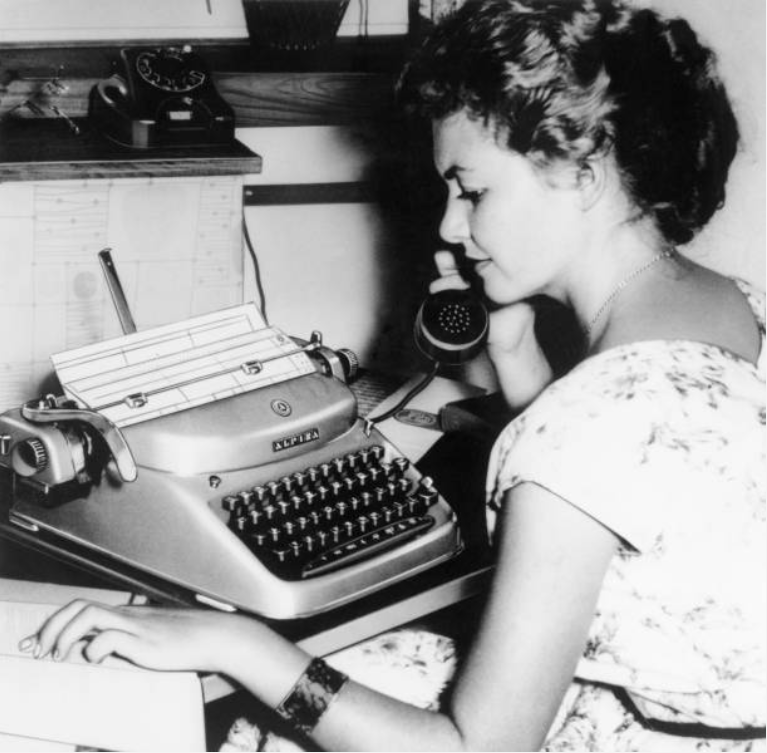

An unnamed lady in an office (perhaps a promotional picture for the brand).


Erich Helmensdorfer (1920-2017), a German journalist and television presenter in his Munich office.


French-born actress Isabelle Huppert (1953-) in the 1991 movie Malina with German actor  Mathieu Carrière (1950-).

Orga-Privat


Hans Fallada’s letter to publishing house Rowohlt-Verlag Berlin. Fallada (1893-1947, born Rudolf Wilhelm Friedrich Ditzen) was a German writer.  The typewriter was photographed in his former house in Carwitzetzt.

Triumph
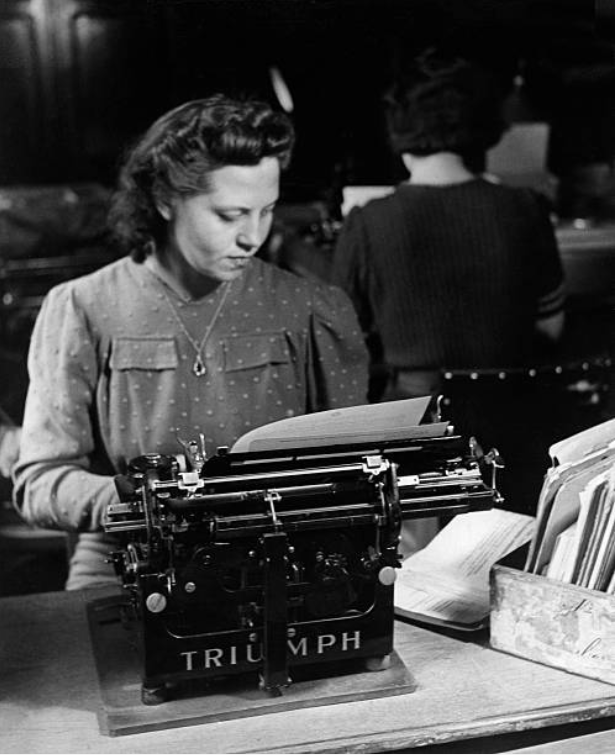

A woman at a typewriter in 1941.


Secretary Liselotte Schmidt, in 1954.


Esther Margareta Vilar (1935-, born Esther Margareta Katzen) is an Argentine-born German writer. Photo taken in 1972.


Lonny Kellner (1930-2003) was a German singer and actress and the wife of comedian, radio and television personality Peter Frankenfeld.

Siemag


Alfons Bauer (1920-1997 ) was a German composer and zither player. This photo was taken in Hamburg in 1955.

Gossen Tippa


Hugo Andreas Hartung (1902-1972) was a German writer, radio play author and occasional screenwriter. Seen here in 1962.

Adler Tippa S


Isla Werner (1921-2005) was a German actress. Photo taken in 1991.

Adler


Liselotte (“Lilo”) Pulver (1929-) was a Swiss actress who played James Cagney's attractive secretary “Fräulein Ingeborg” in Billy Wilder's comedy One, Two, Three (1961).

Erika Model 14


Sarah Kirsch (1935-2013) was a German poet. She was born Ingrid Bernstein in Limlingerode, Prussian Saxony. Photo taken in 1972.

Silver-Seiko


Curd Jürgens (1915-1982, born Curd Gustav Andreas Gottlieb Franz Jürgens) was a German-Austrian stage and film actor. He was usually billed in English-speaking films as Curt Jurgens. Photo taken in 1976.
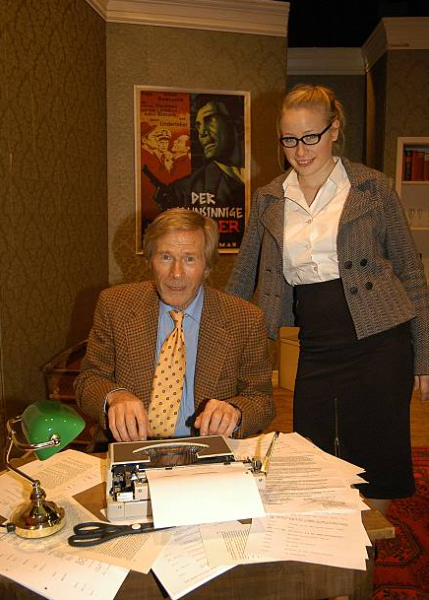

Horst Janson (1935-), a German actor, seen here with his daughter Sarah-Jane in Grafing, Munich, in 2006.

Olivetti Dora


German actors Horst Werner Buchholz (above, 1933-2003) and Hardy Krüger (below, 1928-, born Franz Eberhard August Krüger). Buchholz in Munich, Krüger in Los Angeles.

Olivetti Lettera 35


Maria Ilva Biolcati (1939-) is an Italian singer, stage and film actress, and television personality. Photo taken in 1985.

Princess
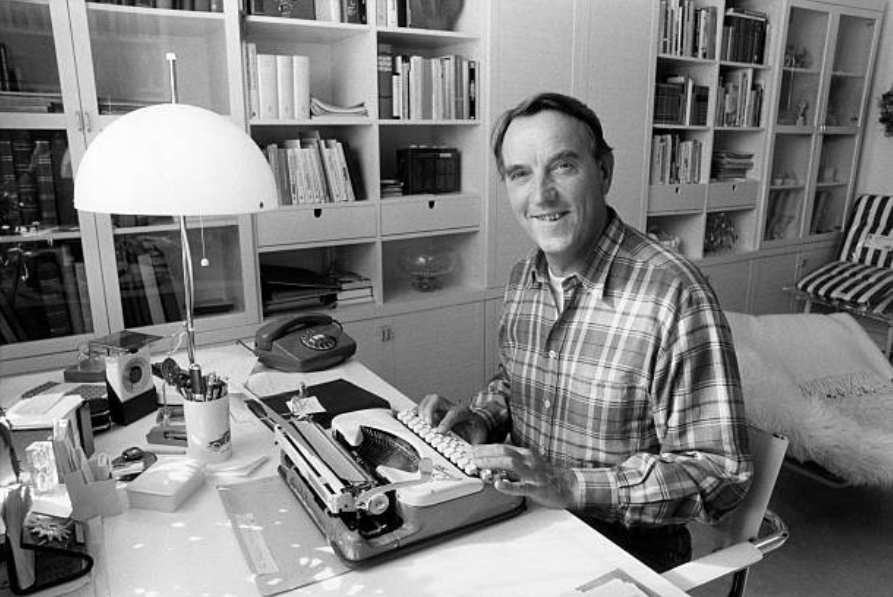

Klaus Huebner (1924-) is a former German politician and police officer. Photo taken in 1987.

Olivetti Valentine


Alexander May (1927-2008) was an actor and writer as well as a director, editor, producer and poet.

Olympia SG1


French singer Johnny Grey.

Olympia Monica de Luxe

and Olympia International


Helmut Rellergerd (1945-) is a German author. Under the pseudonym “Jason Dark” he brought the character of ghost hunter John Sinclair into being. First image taken in Bergisch Gladbach in 1997.

Rheinmetall


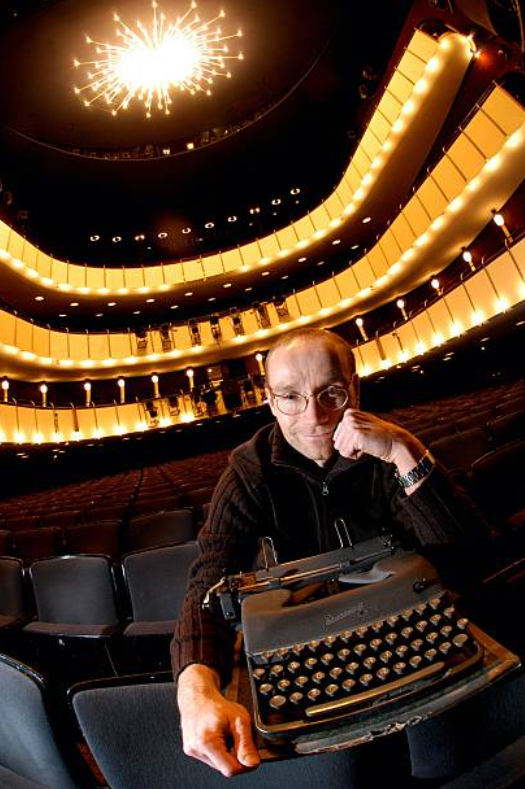
John von Düffel (1966-) is a German dramaturge and writer. Pictured in the Thalia Theatre, Hamburg

Hermes Baby
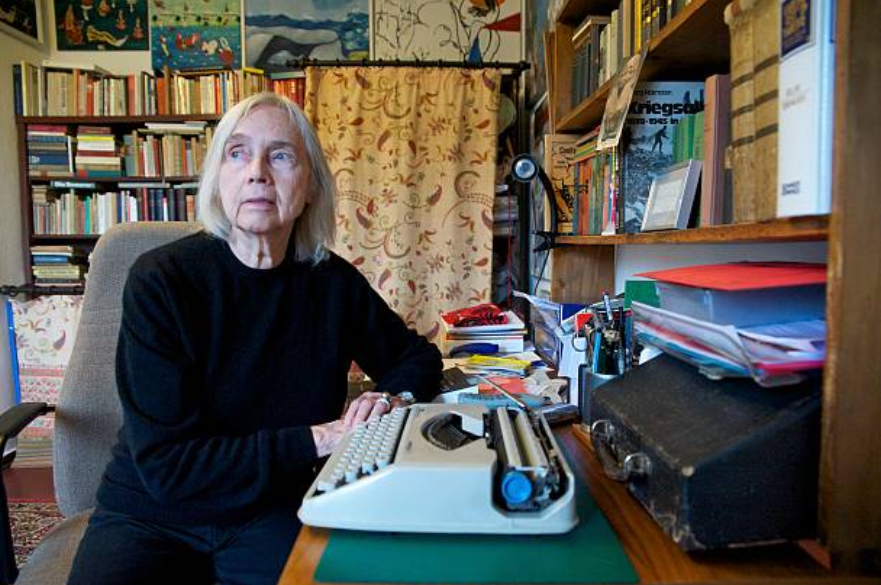

Aldona Gustas (1932-) is a Lithuanian-born German poet and illustrator.

Continental


Arno Hellmis (1901-1940) was a German sports reporter during the Nazi era.

Brother


Ottfried ‘Otti’ Fischer (1953-) in the TV film The Bestseller. With him is his co-star, Nina Proll (1974-), an Austrian actress.

Olivetti Praxis 48


Singer and actor Roy Black (1943-1991, born Gerhard Höllerich) with his brother Walter Höllerich in Munich in 1977.

Adler Gabriele 12

Manfred Krug (1937-2016) was a German actor, singer and author. Photographed in 1980 in Berlin.

Olympia

Alfred Weidenmann (1916-2000) was a German film director, screenwriter and author of children's books.

Sunday, 13 September 2020

The Hite Report and the Lies About the Olivetti Typewriter Ads


Shere Hite appeared in "Olivetti Girls" ads to help her pay college fees
while at Columbia University in 1971.
Now that Shere Hite, sex educator and feminist and author of 1976’s The Hite Report: A Nationwide Study of Female Sexuality, has passed away, it’s time to bury the false story about the Olivetti typewriter advertisement which allegedly propelled Hite toward the women’s movement.
The story relates to Hite being one of the models who appeared in the “Olivetti Girls” series of ads, which appeared in US newspapers from February 1972 and in magazines such as LIFE and New York in March and April that year. The ads were part of Olivetti’s drive to break into an office electric typewriter market dominated by IBM with the Olivetti Editor series and the Praxis 48. (Ironically, Hite herself used an IBM.)
More than 10 years later, in November-December 1982, a series of newspaper articles about Hite claimed that the tagline in the 1972 Olivetti ads contained the words, “The typewriter is so smart she [that is, the Olivetti Girl] doesn't have to be.” This was simply untrue, as the ads said nothing of the sort. Yet in obituaries which have appeared for Hite around the world this weekend, the false claim has been repeated ad nauseam, unchecked and unsubstantiated. A few minutes’ research would have confirmed the truth. Surprisingly, the supposed fact-checking New York Times is among the many guilty parties.
What the ads really said were words to the effect that the Olivetti Girl was someone about whom “people [are] saying terribly nice things”,  because she typed mistake-free copy as a result of using a typewriter with a “brain” – a machine which could “actually think for itself”. “She may  be prettier than other typists, but she’s not necessarily brainier.” She was “sharper, looser, never uptight” and could have fun. The typewriter eliminated common mistakes such as “flying caps”, improper spacing, “shading or ghosting” and “crowding or piling”.
Now, no matter which way one interprets these words, or thinks of them as seeming to be condescending, they do NOT state that the typist did not have to be smart. Nor is there any suggestion the models used in the ads are “leggy dumb blondes”, as so many articles would have us believe. That is purely a personal interpretation, and not the stated view of the advertiser. The whole premise of Hite’s argument for becoming a feminist fails. At best she has exaggerated what the Olivetti ads said, or worst she lied. Just because Hite said the story was true doesn’t make it true.
The false story (some versions of which stray so far from the truth as to claim the ads appeared in Playboy magazine), dates back to at least 1977. In its May 9 issue of that year, German news magazine Der Spiegel said, “Just a few years ago, Shere Hite from New York could be seen as a two-legged office machine in the canyons of Manhattan. At that time, the young woman had to play the part of a typist in a TV commercial: As ‘Olivetti Woman’ [sic] it was her job to ‘introduce a typewriter that was so smart that the user could easily appear a bit stupid’. The mimodrama was the trigger for the sex world bestseller of the 70s and made the former Columbia doctoral student a star guest on American talk shows. Because New York feminists who protested the Olivetti commercial convinced Hite that their strip was typical of the role played by many women in the United States - a silent majority of sexual objects ‘whose feelings are suppressed and exploited’. Hite began to be interested in the attitudes of her sex comrades on the subject of sexuality and sent out the first questionnaires. Four years later (and $35,000 in debt) she submitted the Hite Report - a work that summarises the statements of 3019 women on the subject of sexuality and appeared on seller lists almost overnight.”
Hite died from the rare neurological disorder corticobasal degeneration last Wednesday in North London, England, aged 77. She was born Shirley Diana Gregory in Saint Joseph, Missouri, on November 2, 1942. 

Saturday, 2 April 2016

The Brother 1413-Remington 713 'Compact' Electric Typewriter

A 1969 Brother 1413 electric "compact" masquerading as a Remington 713. Why? Remington closed its Glasgow typewriter factory in February 1968 and, faced with an urgent need to meet a new market demand in 1969, had to come to an arrangement with Brother to rebrand Japanese "compact" electrics that were already on the US market. The reason? A strike shut down its Calcutta factory for six months from April 1969 and 1550 of Remington's Elmira, New York, machinists walked off the job on June 16. They picketed the plant, stopping thousands of typewriters from being shipped out, including those electrics assembled in Toronto, and they stayed out for four months. The solution? Simple! Buy Brothers at $110 and resell them under a Remington badge for $179.
The 11-inch carriage variation advertised in 1972. 
The price had gone up $80-$120.
The Brother 1400 series advertised in 1969
When the Ettore Sottsass-designed Olivetti Praxis 48 reached the United States market in mid-January 1968 (as an Olivetti Underwood, of course; it reached the Australian market as an Olivetti in November that year), it sparked panic in the ranks of rival US and German typewriter companies. During the next five years, a plethora of competitors emerged in what was fallaciously called a "compact" electric typewriter field. 
Cincinnati Enquirer, 1970
Predictably, none of Olivetti's opponents emerged with a design which came within a bull's roar of the timeless Sottsass classic (though they almost all copied the Praxis' high, square front). But the challenge was more about price than looks.
This was an attempt to create a new office machine niche in a market which had become so completely dominated by IBM (full-size, 46lb) that IBM sales were advancing at the rate Remington's, SCM's and Royal's were declining - and that's their combined losses! These new machines were also variously described as "intermediate" and "light duty and lower cost". Whatever might have been the case for their duties, they were certainly not cheap - many buyers would have got very little change out of $400, as some were not all that much cheaper than the 15in carriage IBM. Nor could it be said that they were in any way lightweight. The Remington 713 weighs a whopping 28lb, just six pounds lighter than a Remington 10!
The last model to make its entry into this new field, in late June 1973, was the Adler MX:
The other brands and models mentioned in this advertising blurb for the Adler MX were:
The Singapore-made Smith-Corona
Secretarial 300 of September 1972
The November 1969 Royal 560
 The Olympia 35 of late April 1969
And the "Remington" 713 of May 1969
But ahead of the pack were the Brother 1400 series electrics, which reached the American market - at less than half the price of the Praxis 48 - in early April 1969. Nagoya mechanical engineers Yukio Hishida and Toshio Nakai had begun to apply for US patents for components for their typewriter in November 1968. 
Thus the Remington 713, costing $69-$78 more than the Brother 1400s (the price rose by another $120 by 1972), was made in Nagoya by Brother:
The Remington 713 reached Australia in November 1969, a year after the Praxis 48:
Last month Steve Kuterescz posed the question on his writelephant blog, "[What is] The smallest 'electric' (non-electronic) typewriter?" David Lawrence in Auckland responded by saying the Olympia Monica portable is the smallest package. For the record, I ran the tape over a couple of my machines and put them on the scales:
Remington 317: 28lb, 17 1/2 inches knob to knob, 6in high, 14in long.
Olympia Reporter: 17lb, 15 1/2 inches knob-to-knob, 5in high, 13 1/2 inches long.
Eighteen months ago I wrote about a Facit 9401 electronic typewriter masquerading as a Remstar 2001. It came to me from the estate of a leading Australian public servant who, on May 7, 1987, paid a staggering $1525 for it. With the purchase, he traded in a Remington 713 for $350. I wonder if it's the trade-in I found at a recycling centre a few weeks ago?