Total Pageviews

Tuesday, 11 November 2014

Back to the Garden at Woodstock: Celebrating an American Beauty, the Oliver Typewriter

By the time we got to Woodstock
We were fourteen hundred strong
And everywhere there was song and celebration
And I dreamed I saw the typers
Riding those typebars in an arch
As they turned them into butterflies
Above our Olivers
And we've got to get ourselves
Back to the garden
- with apologies to Joni Mitchell
1907 was a big year for the Oliver Typewriter Company, with the opening of the Dearborn Street building in Chicago on May 1, the new No 5 model, and improvements to its Woodstock, Illinois, factory (opened in 1896).
The distinctive reliefs were made by the American Terra Cotta and Ceramics Company from $1 a ton clay shipped to Crystal Lake. The designs were by Karl Schneider.
Mounting department
1902 baseball team
 In 1909, Fred F. Main, of Columbus, Ohio, even designed a pneumatic carriage return for the Oliver. Sadly, instead he sold the rights to Underwood (which didn't produce it anyway).
 Oliver nonetheless forged ahead to one million typewriters by 1922, the year it launched its No 11 "Speedster"
But the Woodstock plant closed in 1928

Monday, 10 November 2014

Finding a Typewriter's Serial Number

In the past week or so two readers have asked for directions in finding the serial numbers on their typewriters, a later model Imperial Good Companion portable and an L.C.Smith No 8 14-inch carriage standard. By chance, while looking for something else entirely, I came across this page from Wilf Beeching's Century of the Typewriter (1974 edition). It's not a complete guide by any means, but it may help some. For example, later model Imperial portables don't have the serial number where Beeching points to, but underneath the left side ribbon capstan. I hope this helps John, who owns the L.C.Smith seen below. John wrote, "The serial number has eluded me. I have flipped it on all sides, slid the platen to both the extreme right and left and snooped around with a bright flashlight - all to no avail." Don't feel alone, John, I am very familiar with that sense of frustration!

Friday, 7 November 2014

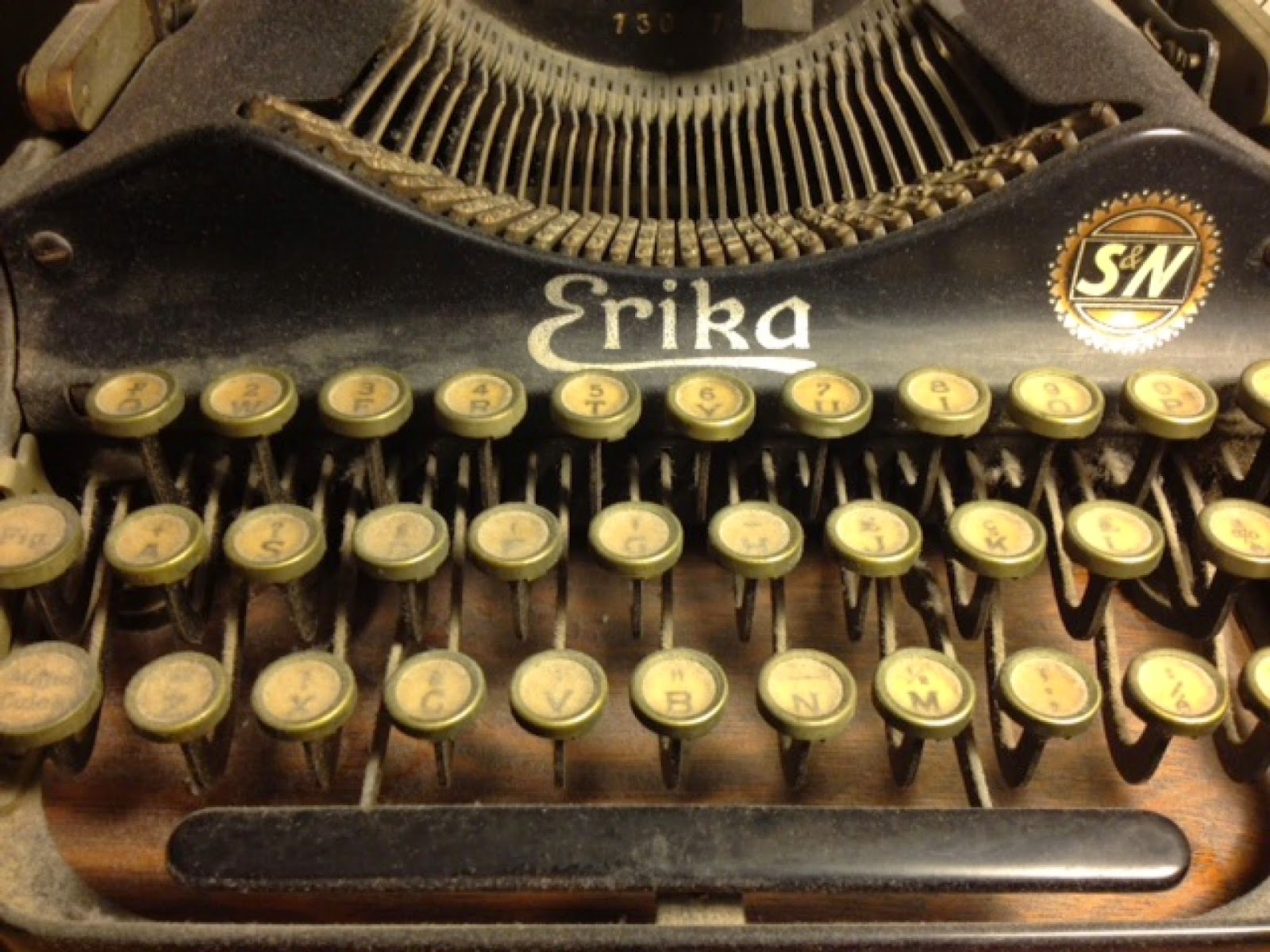
Ernest Hemingway and the Erika Folding Portable Typewriter

Ernest Hemingway's Erika 3 Folding Portable Typewriter
The young Ernest Hemingway
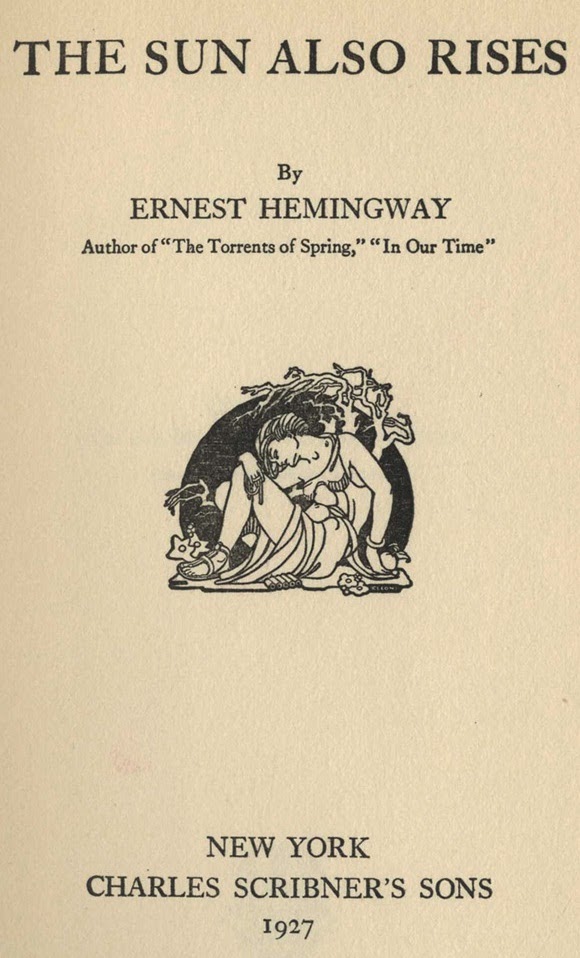
American writer Jeffrey Robinson emailed me overnight, saying he owns this Erika folding portable typewriter upon which Ernest Hemingway wrote his brilliant 1926 novel The Sun Also Rises. It's almost too good to believe, that one of my all-time favourite novels was written on one of my all-time favourite typewriters (my own version is the Bijou folding, see below).
Jeffrey Robinson
I am generally quite cynical about such claims, but have every reason to believe this email and its contents are genuine.
Quite aside from Robinson's possession of the Erika, it reveals details about Hemingway and his first two typewriters, and the one used to write The Sun Also Rises, which - to the best of my knowledge, anyway - have hitherto remained unpublished in print or online.
It is well known that Hemingway's first typewriter, a Corona 3 folding portable, was given to him on July 12, 1921, as a 22nd birthday present, by Elizabeth Hadley Richardson (1891-1979), who would become Hemingway's first wife. (She thought it was a 23rd birthday gift, believing Hemingway to be a year older than he was.) The couple were married in Horton Bay, Michigan, on September 2, 1921, and two months later left for Paris. Letters written home to his mother Grace in February 1922 confirm Hemingway was using the Corona 3 there at that time. See my post on the subject here. Also the Vanity Fair article here.
Later, Hemingway also used a range of Royal portable models, including an Arrow, as well as an Underwood Noiseless 77 and even, as some claims would have it, a Halda Model P. But his purchase of an Erika folding to write The Sun Also Rises is a revelation, at least to me.
Jeffrey Robinson wrote to me after stumbling across my post on Hemingway's Corona 3. He explained:
"I ... thought you might like to know the rest of the story. I got this information from [Hemingway biographer] Carlos Baker (1909-1987) when he was at Princeton.
"Hemingway was on his way to Pamplona for the first time [in July 1922]. He took a taxi to the Gare de Lyons (I think that's right) and got into a fight (probably about the fare) with the cab driver. In those days, luggage sat in an open space next to the driver and not in the back with the passenger. As the two argued, the driver got so frustrated that he tossed Hemingway's luggage out onto the street, including the bag (box?) with the Corona. It smashed.
"As soon as he got back to Paris, he bought a used Erika (photo attached) on which he wrote The Sun Also Rises.
Sylvia Beach
With a wounded Hem
Jeanine de Goldschmidt
Pierre Restany with Arman
"When he left Paris, he gave the Erika to Sylvia Beach, of Shakespeare and Company bookshop fame. She eventually gave it to an antique dealer friend, whose daughter [Jeanine de Goldschmidt-Rothschild?] married the French art critic Pierre Restany. The daughter inherited the typewriter. 
"Restany was friends with the French-born American artist Arman who, among other things, used to slice up objects and remount them. He called them 'Colères' and was famous for doing this with violins, for instance.
Arman's 1962 work, Infinity of Typewriters. It's a Corona 3 second from left, top row, not an Erika.
Arman's 1997 Heroic Times
"Arman owned the Erika for many years. It sat on a shelf in his Riviera studio. He never used it for one of his works because he didn't have an emotional relationship with it, the way he did with musical instruments.
"In 1975, or so, he gave the Erika to me, knowing that I'd appreciate it and take good care of it. I do and have. It sits in my office, under glass, on my desk, not far from a Hemingway-era Corona and my old, ever-faithful 1944 Royal
"Sometimes, not often but sometimes, I feel sorry for young writers who will never know the joy of hearing their words click onto paper."
Jeffrey Robinson was born in Long Beach, New York, in 1945 and graduated from Temple University in Philadelphia in 1967. He served four years as an officer in the United States Air Force and at the end of 1970 moved to a small village in the south of France. He settled in Britain in 1982 and in 2007 returned to New York.

Wednesday, 5 November 2014

The Typewritten Letter That Will Change a Nation

It's a black day for Australia. In an hour, Australia will bid farewell to its once visionary leader, former Prime Minister Gough Whitlam, at a state memorial service in Sydney. At 11am, the nation will pause to mourn the loss of perhaps its greatest ever statesman. Whitlam died, aged 98, on October 21.
It strikes me as somehow appropriate that this memorial service should take place on Guy Fawkes Day, the annual commemoration of the day in 1605 when Guy Fawkes was arrested while guarding explosives that the Gunpowder Plotters had placed beneath House of Lords in London.
On the eve of Whitlam's service, a signed copy of the typewritten letter which dismissed him as Prime Minister, on November 11, 1975, has emerged. In 2004, Whitlam wrote on the letter words which, at a time of political morass in this country, should resonate for all Australians.
"The Constitution of the Commonwealth of Australia must be altered to set out the duties of a President as Head of State," Whitlam declared.
The original letter was signed by a perpetually pickled, pompous git, a juiced-up Judas called Kerr, who at the time was the Governor-General of Australia. This cur, allowed to act on behalf of the monarch of a foreign land, had taken it upon himself to sack the democratically, lawfully elected government of this country. This was not, of course, the doing of the Queen of England, who remains blameless in the whole sordid affair, yet at the time her representative in Australia had the power to change a government. Thankfully, it can never happen again.
The cur Kerr
Nonetheless, Australia remains a constitutional monarchy, in theory at least ruled from Buckingham Palace, and with a Queen's representative, a Governor-General, still residing in Government House. It's a shameful situation, and Whitlam's 2004 note, added to the end of his 1975 "pink slip", clearly spells out the need for a president as our head of state, as the head of an Australian republic.
Perhaps Whitlam's death, today's memorial service, and the revelation of this note (described as his "last will and testament to the men and women of Australia"), will hasten the day when Australia will truly mature into nationhood and be prepared to stand upon its own two feet, to wipe the Union Jack from its flag and become fully independent of Buck House.
One might grasp how I can draw analogies with Guy FawkesI grew up unwittingly celebrating Guy Fawkes' capture, when, on each November 5, his effigy was burned on a bonfire. Although, originally, this annual event commemorated the 1605 survival of James I as the Protestant King of England, over the centuries Guy Fawkes came to symbolise not evil but rebellion. And rebellion, more than ever, is what is needed Down Under right now.
There's a surviving sense among some Australians, Australians of a certain age and a certain political bent, that had Whitlam been allowed to remain Prime Minister, an Australian republic would inevitably have been on his agenda. As it was, the federal election which followed his dismissal merely served to confirm that the vast majority of Australians were far too short-sighted and insular to grasp the real implications of Kerr's action. That vote should have been an out-and-out protest against British influence in Australia. Instead, it was a reassurance to Britain that Australians wanted to continue to be ruled from 10,000 miles away.
Today, Whitlam will yet again be lauded for his sweeping cultural, social and economic reforms, including granting land rights to indigenous Australians. His state memorial service is shaping as the biggest in living memory. Tens of thousands are expected to assemble outside Centennial Hall - the so-called "Temple of Democracy" - in Sydney's CBD, as the country gathers to make its final, formal salute to the man who dominated a large part of Australian politics during the lives of most of its citizens. 
But the most fitting tribute of all would be, of course, the dismissal of the Governor-General. Long may Australians rule Australia! We think we already do, but the truth is we don't, not so long as the Union Jack remains on our flag and loudly states where we truly stand.

Tuesday, 4 November 2014

Headliners Good and Bad. Good - Varityper; Bad - Chicago Sun-Times

I have been asked by a lady in Melbourne about finding a good home for this Varityper Headliner 820. It is listed on eBay at $1 but has failed to attract any interest. As much as I would be keen to try it out, I am downsizing my collection and the cost of transport to Canberra might be excessive. If anyone is interested in it, please contact me.
It was owned by an editor and engineer at the CSIRO. The Varityper comes complete with 14 typesetting discs and operator's manual. It was made in New Jersey. Images below are not of the actual items on offer:
This operator's manual doesn't contain geography lessons, which is what headline writers at the Chicago Sun-Times urgently need. After the New Zealand All Blacks beat the United States 74-6 in a rugby union Test match at Soldier Field in Chicago on Saturday, the Sun-Times ran this subhead:
In fairness to the editor of the Sun-Times, he has since apologised for this gross show of ignorance. One does have to wonder what American kids are taught about the world in their schools! Do they think the world begins at the redwood forest and ends at the Gulf Stream waters? Or perhaps they think those places are in Canada.
The image above shows the All Blacks performing the pre-match haka. The haka comes from Māori culture. The Māori are native to New Zealand. New Zealand is across the other side of the Tasman Sea from Australia. It's a different country. Different flag, different government, different people, different culture. Gettit? 
What I really did appreciate was that before the match, the Chicago Tribute got its dance writer, Laura Molzahn, to write a lengthy piece about the haka, in which she described it as more ballet than war dance. Ten out of 10 for the Tribute for this brilliant bit of thinking, minus 10 for the Sun-Times for not thinking at all!