Total Pageviews

Sunday, 28 April 2013

Typewriter on the Kon-Tiki

Thor Heyerdahl using a Hermes Featherweight portable typewriter on the 1947 Kon-Tiki voyage.
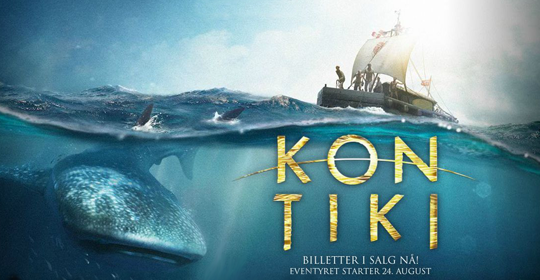
I went to see the new Kon-Tiki movie last night. I really enjoyed it - I thought it an excellent production: well made, well acted and well directed. Of course, it's always a bonus to go to a movie that features a typewriter.
But as with any movie of this kind - the cinematic recreation of a very well-known historical event - I like to check the details afterwards, to see just how accurate the movie is. I'd actually seen a first edition of Thor Heyerdahl's book The Kon-Tiki Expedition in a bric-a-brac store in Hokitika when I was New Zealand earlier this month, for just $4. Knowing I would be seeing the movie a few weeks later, I thought to buy it, but conscious of over-loading for my return journey (a regular fault of mine on overseas travel) I passed on it. I regret that know. I'd like to read the book.
The typewriter in the movie raises some interesting questions. It is a Remington-Rand portable. But photographs taken on the Kon-Tiki during its 1947 voyage from Peru to Polynesia suggest the typewriter on board was actually a Hermes Featherweight. (Indeed, the Remington-Rand in the movie most likely appeared after this year).
These three images are from Ton's I Dream Lo-Tech blog post on Typewriters at Sea. See the link to this post below.
The Hermes Featherweight is being used by Heyerdahl in the image at the top of this post, but Heyerdahl's book suggests the Hermes Featherweight actually belonged to Knut Haugland (more on him later). What's more, it seems Heyerdahl myself didn't like using typewriters, as he claimed the noise of a typewriter disrupted his thinking while writing. The Kon-Tiki Expedition was apparently handwritten, yet in an exhibition run by the Kon-Tiki Museum (Oslo) and the  village of Stugudal in Tydal (where Heyerdahl wrote Kon-Tikiis an Olivetti Studio 42 which Heyerdahl is said to have used in writing the book.
(As an aside here, it is staggering to recall that after his great feat, one which attracted worldwide attention, Heyerdahl struggled to get his book published. One publisher said that since no one had drowned, the story wouldn’t be very interesting. In 1953, after 20 rejections, Kon-Tiki finally found a publisher. The book is now available in 66 languages.)
Many of the scenes in the Kon-Tiki movie are based very squarely on images of Heyerdahl taken earlier in his life and during the Kon-Tiki expedition.
The drawing above, showing Heyerdahl typing two-fingered, is from Kon-Tiki and I, written and illustrated by another Kon-Tiki crew member, Heyerdahl's childhood friend Erik Hesselberg.
One of Hesselberg's three daughters,  Anne Karin, lives in Brisbane, Australia.
Real life
The movie
But back to the movie, which I would thoroughly recommend. Ton S (I Dream Lo-Tech) reviewed Kon-Tiki back in February in his Typewriter at Sea post in his Typewriters in the Cinema series. Ton said parallels with Life of Pi were "unavoidable", and my friend Elizabeth said the same thing when we left the movie last night. Ton added that he thought Kon-Tiki the better movie. Both have one really big storm-at-sea scene, lots of weird creatures floating around under the raft/lifeboat, magnificent open ocean shots and ultimately survivors with incredible stories to tell. But of course these are totally different stories: one fictional and so fantastically surreal it has confused many viewers with its true meaning,  the other (mostly) based on fact.
Both are such good movies that the 118 minutes (as in the case of Kon-Tiki) and 127 minutes (in the case of Life of Pi) pass by smoothly. What I especially liked about Kon-Tiki was that the drama was not overplayed. Directors Joachim Rønning and Espen Sandberg clearly grasped that in telling a true story such as this, there was no need to gild the lily, as it were. I was therefore astonished to read that Michael Nordine of LA Weekly thought the movie "could have used a bit more [shark-attracting] blood in the water". How little Nordine understands the needs of a movie-goer. Kon-Tiki contains precisely the right amount of blood in the water. Another reviewer, Hollywood Reporter's Sheri Linden, said the "visual effects ... are convincing, if sometimes ostentatious". Far from being "ostentatious", these provide some of the movie's most memorable and astonishing scenes. They do marvellously convey the crew's "vulnerability to the elements". The US surely deserves better movie reviewers! Can Ton not write the movie reviews for one of these Californian rags? Please?
Nordine and Linden all at sea trying to capture a movie's essence.
Kon-Tiki was nominated for the Best Foreign Language Oscar but lost out to French film Amour. 
The typewriter aside, Kon-Tiki's directors went to extraordinary lengths to cast actors who looked so much like the Kon-Tiki crew members, led by Pål Sverre Valheim Hagen as Heyerdahl. (Thank goodness it was Pål Hagen and not someone like Paul Hogan!).
The Kon-Tiki crew, from left: Thor Heyerdahl, Bengt Danielsson, Erik Hesselberg, Torstein Raaby, Herman Watzinger and Knut Haugland.
From left: Knut Haugland, Bengt Danielsson, Thor Heyerdahl, Erik Hesselberg, Torstein Raaby and Herman Watzinger.
During the movie, however, I had a feeling that some of the crew members were much more interesting people in their own right than the movie would have us believe. At least in the case of Knut Haugland, I was right.
Knut Haugland
Tobias Santelmann as Knut Haugland
Haugland,  who was born in Rjukan, Telemark, was the World War II resistance fighter who was one of the real-life heroes in the raid which inspired the 1963 movie The Heroes of Telemark. This told the story of the 1943 sabotage of the heavy water-producing Norsk Hydro Rjukan plant at Vemork, a nuclear energy project.
Haugland was twice awarded Norway's highest decoration for military gallantry, the War Cross with sword. In addition, he was awarded the Distinguished Service Order and the Military Medal by the British. The United States decorated him with the Medal of Freedom with bronze palm. Haugland was director of the Kon-Tiki Museum from its start in 1947 to 1990 and was chairman of the museum in 1991. Haugland died on Christmas Day 2009, the last living crew member of the Kon-Tiki expedition.

Sydney Opera House: 'Olivetti Lettera 22 Typewriter Stuffed With Oyster Shells'

+
=
Oh yes, I can see it now!
(See Australian writer Clive James quoted in Lonely Planet below)
It was very kind of Will Davis, Richard Polt, Miguel Ángel Chávez Silva, Tony Mindling and Scott Kernaghan to take the time and trouble to comment so positively on my previous post, on Olivetti Lettera 22 portable typewriter adverts.
Like Richard, I have been pronouncing "Lettera" since 1965 as "Let-er-ah", but Richard has now got me wondering whether it is more correctly "Let-tera". Anyone know for sure? Scott in his comment mentioned John Lavery, who worked for Olivetti. Maybe John knows?
Scott also mentioned that the Lettera 22 is his favourite Olivetti machine - thus far. "At least from a design perspective."
There is an oft-repeated story about how highly the Olivetti Lettera 22 rated among designs in a survey in the United States in 1958. In looking for Lettera 22 ads last night, I came across a more detailed reference to this in a book called Twentieth Century Designs, and thought it worthwhile re-publishing the full story. Here it is:
At the other end of this scale, perhaps, is the controversial 1957 design, by Danish architect Jørn Utzon, for the Sydney Opera House. When I first saw the Opera House, in 1969, I immediately described it as looking like copulating turtles, a description later repeated by others. I was amused, however, to see in an Australian guide by Lonely Planet (for which Richard Polt was once a contributor) the following words:
I can say here without fear of contradiction that the first person to dance in the Sydney Opera House was my then partner Frances Houlihan. Fran was a ballerina who was approached by a Sydney TV station to perform a part of Swan Lake so that cameramen and technicians could set up their equipment for a coming visit to Sydney by Dame Margot Fonteyn. Fonteyn said she was going to have no time to rehearse for the benefit of the TV people, so a Fonteyn stand-in had to go through the steps instead. Fran was the Fonteyn stand-in. To add to this notable achievement, because the Opera House was then still incomplete, Fran had to dance Swan Lake in blocks and a tutu wearing a hard hat!
I would have written that story on an Olivetti Lettera 32.
So back to typewriters .... Having researched thoroughly for Olivetti Lettera 22 literature, I also can say without fear of contradiction that no other typewriter has been mentioned as often in novels, biographies, memoirs, travel guides and magazines as this lovely portable.