Total Pageviews

Showing posts sorted by relevance for query erika. Sort by date Show all posts

Sunday, 2 June 2013

Why I Love My 'Go-To' Typewriter

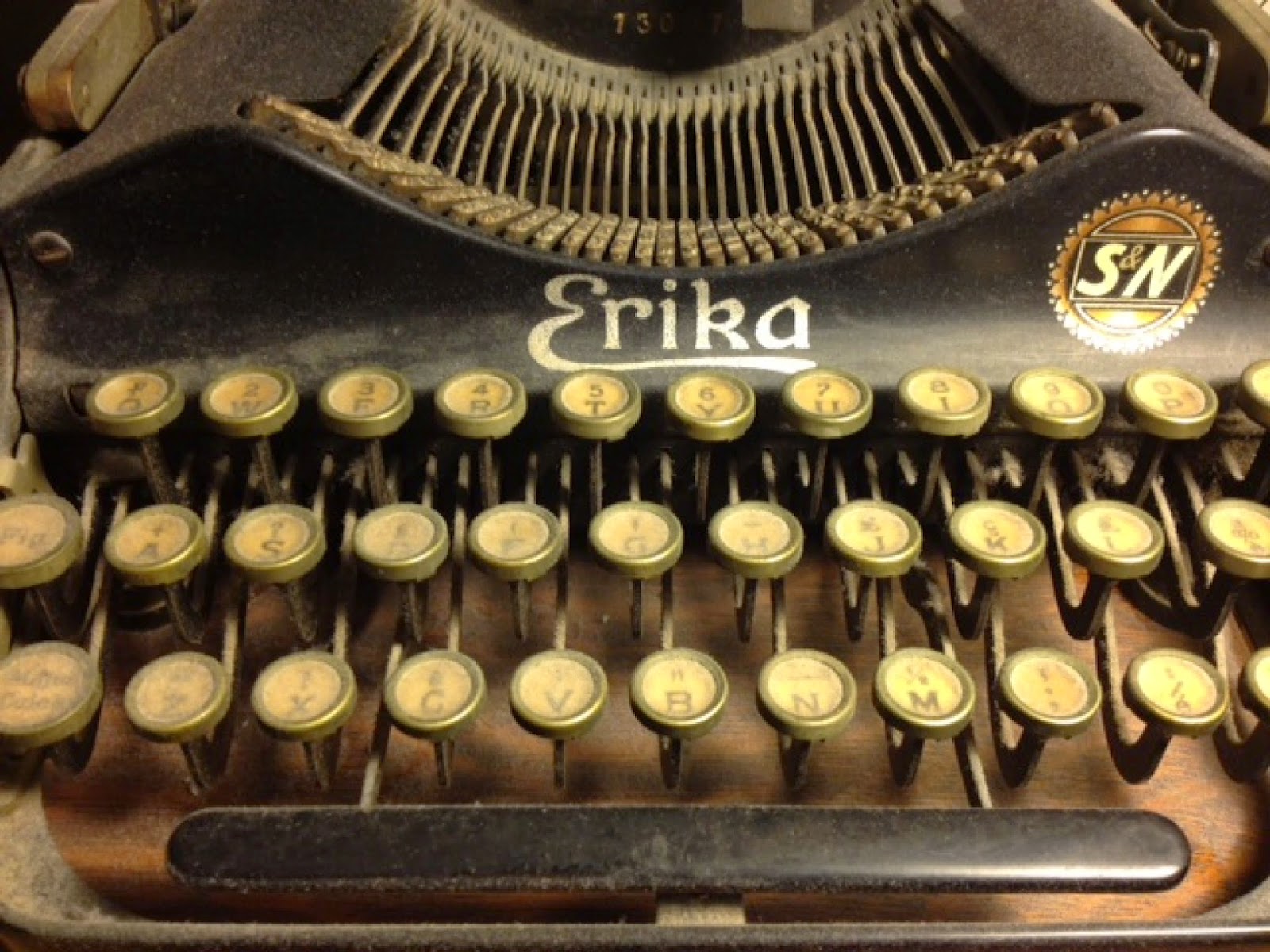
Do you have a "go-to" typewriter? I do. It's a Bijou (Erika) four-bank portable, made by Seidel & Naumann in Dresden in about 1929. I say "about 1929" because its serial number is 121444, and 1929 is the best estimate I can put on it. Like so many pre-World War II German typewriters, the sequence of model and serial numbers for these Erika-Bijou three- and four-bank portables can be most confusing. But more on that later ...
Two things constantly astonish me about my "go-to" Bijou typewriter: first, that I still consistently "go-to" it before all others, after almost five years of using it on an almost daily basis; second, that I do so despite the fact the machine is at least 84 years old, and still has its original blue ribbon. I could "go-to" many much sturdier and more modern machines, ones with carriage levers, but I don't.
There's just something about the Bijou (like Mary, but at least the Bijou never has me pulling my hair out). I cannot put my finger on what that magical "something" is. The Bijou just "suits me". And I like it. A lot.
The latest addition to my collection. Serial #187456 (1933).
I like it so much I decided to buy another one. I was genuinely concerned I was over-using the Bijou, and I wanted it to last forever. But when I went on to German eBay looking for a second model, I decided that, for a change, I would get one labelled an Erika, instead of another Bijou. I naturally figured there wouldn't be any difference just because of the name - after all, Bijou is simply an export name for Erika typewriters.
Well, the Erika turned up last Friday and I was initially delighted. It looked exactly like my Bijou, in the same really excellent condition, and a cursory early test type indicated it typed very well too. But when I typecast with the two machines today, I found there was a vast difference between them. Unfortunately for it, I suppose, the Bijou must now press on as my "go-to" typewriter, while the Erika, as nice as it is looks, must go back into the pack, well, well back ... Talk about two typewriters in the exact same line being like chalk and cheese! But then, I guess, we're talking about the difference between the sublime and the no better than "very good".
As to what model number my "go-to" Bijou typewriter is, or what year it was made in, I am unable to say with any degree of certainty. According to Ernst Martin's Die Schreibmaschine und ihre Entwicklungsgeschichte, it is a Model 2 and belongs to a range first released in 1927. It is very clear from a lengthy analysis of what he calls the Model 2 that Martin is describing this very machine, not a shadow of a doubt about it. He only mentions a Model 5 as a typewriter produced from 1932.
Martin calls this the Model 2
One point Martin makes about what he calls the Model 2 - taking a line from early advertising for the Underwood three-bank, when it went up against the Corona 3 in 1919 - is that it is "ready to use" once one opens the case; in other words, no need to unfold the carriage, as with the Erika-Bijou three-bank. (German historians sometimes refer to the Erika three-bank as a "Standard Folding".)
The fore and aft feed rollers, as shown in Martin's book
Käppler's 1926 designs
Martin also draws attention to "front and rear paper guide rollers ... which is usually true only for standard machines".
He goes into detail about the typing action, which I find so utterly superb. This, along with the rest of the machine, right down to the feed rollers and paper support, was designed by Paul Käppler (1883-), of Dresden. Käppler patented his designs in Germany in November-December 1926, and applied for US patents in October-November the following year. These were issued between 1929-31.
The typing action as shown in Martin's book
Käppler's 1926 designs
I believe this typing action might, when all is said and done, be the core reason I am so enormously fond of my "go-to" Bijou. Subconsciously,  I suspect I "go-to" it simply because it just types so beautifully.
Despite all these fine features, Martin concludes, the machine still weighs a mere 3.8 kg (8.4 pounds). This light weight is most definitely one of the reasons my Bijou remains my "go-to" typewriter.
Martin says this model came with 43 or 44 keys and in the case of my Bijou it has 43 keys. Martin says that from 1932 Erika produced  the Model S ("the simplified machine with 43 ​​keys"), Model 5 ("the normal machine with 43 keys, two-colour ribbon") and Model 6 with 44 keys.
One of my Erika 5s (it clearly says so) with 44 keys! Duh? Serial #664267 (1937).
Now this is where it starts to get really confusing, because most of us know the Erika 5 as a markedly different machine - slightly larger, with the ribbon spools set lower, and significantly heavier. And, of course, the Erika 5 has "5" written on it.
Identified as the Erika 5 in Dingwerth
Indeed, Leonhard Dingwerth in his Die Geschichte der deutschen Schreibmaschinen-Fabriken Band 1 says that in 1927 Seidel & Naumann "came out with the Erika 5 ... entirely redesigned, now a four-row small typewriter." Dingwerth says that "more advanced" versions of the three-bank folding portable were the Models 2-4, the Model 2 emerging in 1911, the Model 3 in 1923 and the Model 4 in 1926. This set of figures is at odds with Dirk Schumann's Typewriter Database serial numbers, which lists the Models 1 and 2 from 1910, the Model 3 from 1911, the Model 4 from 1925 and the Model 5 from 1928. Dirk's sources are Fabriknummernverzeichnis ("Factory number listing"), published by Johannes Meyer Verlag, Pappenheim, 1941, and Fabrikationsdaten von Schreibmaschinen, 1935 and 1942, published by Carl Teege Verlag, Hamburg.
From Dingwerth
The Erika that arrived here on Friday was listed on eBay in Germany as a Model S, and yes it does have only 43 keys, as does my Bijou, so I must assume it is the "simplified" version. In mentioning "simplification", I might add my Bijou has no carriage return lever - it is not missing, it never had one. It was made like that. In the engravings of the Model 2 in Martin's book and the Model 5 in Dingwerth's book, there are carriage levers. My "new" Erika also has a carriage lever. (I must say the lack of a carriage lever on the Bijou has not proved a handicap when I have used it for major typing jobs.)
The Palestinian banking Bijou 5 that I gave to Scott Kernaghan also has 44 keys.
Georg Sommeregger on his webpage on these models has both variations as Model 5s. Perhaps, like the Torpedo 14, there were two, quite different versions under the same model number. Here is my Model 5, with the bilingual keyboard and 44 keys, not 43! Did I say this was confusing?
Typing on the Bijou at a Paris railway station, 1929.
How long have I been using this machine?

Thursday, 1 August 2013

Under a Rock With a Presumptuous Troll, Over The Moon With The Unprepossessing Yet Holy Grail Erika 9 Portable Typewriter

*Since writing this, I have become aware that the Erika Model 9 is available in a shiny black finish. I believe Georg Sommeregger has one. One (dated 1949) sold just a fortnight ago on eBay (from Germany) for $US191, after 45 bids (see bottom of post). I can well understand why. I will keep my eye out for one in shiny black for myself, now that I know how good the Model 9 is. But of course I will be very interested to know if its typing quality differs in any way from my 'horrid' gray one.
Also, in my typecast, I referred to a Model 8 when I meant a Model 5 as the Erika I have most frequently used in the past. The Model 8 Erika is the Model 9 with a tabulator (which I never use anyway).
A rough translation of Leonhard Dingwerth's description of the immediate post-war activities with Erika is this: "And yet, in the scanty remains of the once thriving company, work started in late May 1945, with the makeshift repair of some factory premises and facilities. A little later work was started in a modest way with the whole assembly of typewriters. The dismantling of the plant in the fall of 1945 and spring of 1946, as part of reparations, hampered the reconstruction until the summer of 1946. But already in the late autumn of that same year there was again talk of a regulated (?) pre-war model of Erika. 
"Meanwhile, the company Seidel & Naumann was expropriated and on 30 October 1945 was passed to the administration of the government of Saxony. A trustee continued the business. Through a referendum on 30 June 1946, the operation had become public property. The name was first Mechanik formerly Seidel & Naumann VEB. On 1 September 1951, the plant of VEB Mechanik formerly Clemens Müller [makers of Urania, Perkeo] was merged and was dubbed VEB Typewriter Works Dresden. In 1954, after the production of sewing machines (Clemens Müller) was significantly increased, it became VEB Writing and Sewing Machine Works Dresden. A year earlier it had the Saxon typewriters typeslugs factory Wilhelm Neumann incorporated as a unit, but the operation had to close in 1954 due to fire protection reasons (?).
In the autumn 1947 there were 890 employees at the plant, including design engineers, who had the task of developing a new Erika [portable typewriter]. In 1949 a new Erika could be put on the market, Model 8 with tabulator, shortly after the Erika 9 with no tab. And for the Oriental (?) writings a Erika 90 was developed.


Sold on eBay last month:

Friday, 7 November 2014

Ernest Hemingway and the Erika Folding Portable Typewriter

Ernest Hemingway's Erika 3 Folding Portable Typewriter
The young Ernest Hemingway
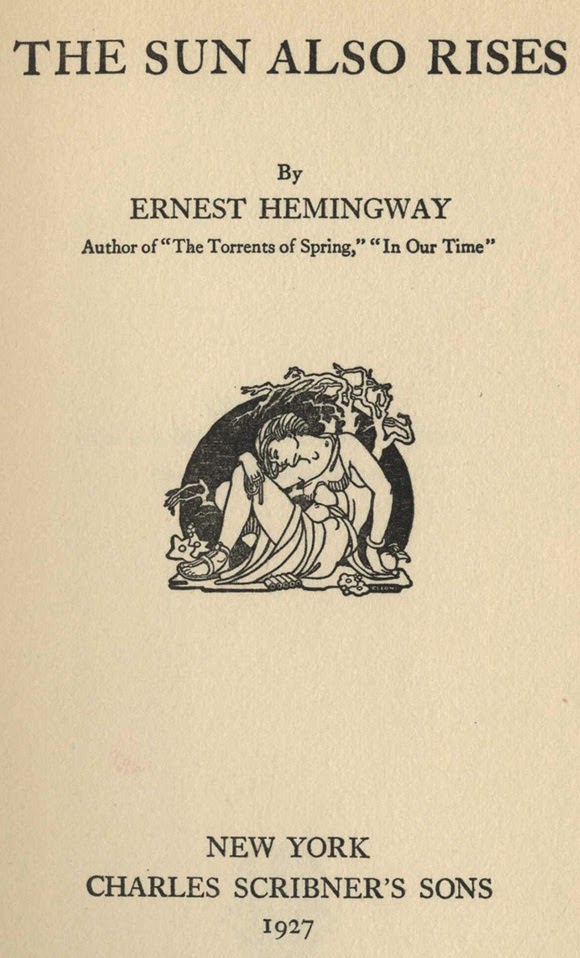
American writer Jeffrey Robinson emailed me overnight, saying he owns this Erika folding portable typewriter upon which Ernest Hemingway wrote his brilliant 1926 novel The Sun Also Rises. It's almost too good to believe, that one of my all-time favourite novels was written on one of my all-time favourite typewriters (my own version is the Bijou folding, see below).
Jeffrey Robinson
I am generally quite cynical about such claims, but have every reason to believe this email and its contents are genuine.
Quite aside from Robinson's possession of the Erika, it reveals details about Hemingway and his first two typewriters, and the one used to write The Sun Also Rises, which - to the best of my knowledge, anyway - have hitherto remained unpublished in print or online.
It is well known that Hemingway's first typewriter, a Corona 3 folding portable, was given to him on July 12, 1921, as a 22nd birthday present, by Elizabeth Hadley Richardson (1891-1979), who would become Hemingway's first wife. (She thought it was a 23rd birthday gift, believing Hemingway to be a year older than he was.) The couple were married in Horton Bay, Michigan, on September 2, 1921, and two months later left for Paris. Letters written home to his mother Grace in February 1922 confirm Hemingway was using the Corona 3 there at that time. See my post on the subject here. Also the Vanity Fair article here.
Later, Hemingway also used a range of Royal portable models, including an Arrow, as well as an Underwood Noiseless 77 and even, as some claims would have it, a Halda Model P. But his purchase of an Erika folding to write The Sun Also Rises is a revelation, at least to me.
Jeffrey Robinson wrote to me after stumbling across my post on Hemingway's Corona 3. He explained:
"I ... thought you might like to know the rest of the story. I got this information from [Hemingway biographer] Carlos Baker (1909-1987) when he was at Princeton.
"Hemingway was on his way to Pamplona for the first time [in July 1922]. He took a taxi to the Gare de Lyons (I think that's right) and got into a fight (probably about the fare) with the cab driver. In those days, luggage sat in an open space next to the driver and not in the back with the passenger. As the two argued, the driver got so frustrated that he tossed Hemingway's luggage out onto the street, including the bag (box?) with the Corona. It smashed.
"As soon as he got back to Paris, he bought a used Erika (photo attached) on which he wrote The Sun Also Rises.
Sylvia Beach
With a wounded Hem
Jeanine de Goldschmidt
Pierre Restany with Arman
"When he left Paris, he gave the Erika to Sylvia Beach, of Shakespeare and Company bookshop fame. She eventually gave it to an antique dealer friend, whose daughter [Jeanine de Goldschmidt-Rothschild?] married the French art critic Pierre Restany. The daughter inherited the typewriter. 
"Restany was friends with the French-born American artist Arman who, among other things, used to slice up objects and remount them. He called them 'Colères' and was famous for doing this with violins, for instance.
Arman's 1962 work, Infinity of Typewriters. It's a Corona 3 second from left, top row, not an Erika.
Arman's 1997 Heroic Times
"Arman owned the Erika for many years. It sat on a shelf in his Riviera studio. He never used it for one of his works because he didn't have an emotional relationship with it, the way he did with musical instruments.
"In 1975, or so, he gave the Erika to me, knowing that I'd appreciate it and take good care of it. I do and have. It sits in my office, under glass, on my desk, not far from a Hemingway-era Corona and my old, ever-faithful 1944 Royal. 
"Sometimes, not often but sometimes, I feel sorry for young writers who will never know the joy of hearing their words click onto paper."
Jeffrey Robinson was born in Long Beach, New York, in 1945 and graduated from Temple University in Philadelphia in 1967. He served four years as an officer in the United States Air Force and at the end of 1970 moved to a small village in the south of France. He settled in Britain in 1982 and in 2007 returned to New York.