Giuseppe Prezioso and Joseph Barkdoll were two great typewriter
designers whose careers straddled the 1939-45 war and reached on into the 1960s:
Prezioso working for E.Paillard in Yverdon, Switzerland, and Barkdoll for
Smith-Corona in Groton, New York.
It’s a delicious thought to ponder them getting together to
merge two their most significant post-war projects: Prezioso electrifying the
carriage of his Hermes Ambassador, Barkdoll electrifying the keyboard of his
Smith-Corona 5 Series.
In 1957 Barkdoll adapted his 5 Series portable typewriter so
that the typebars were electrically powered. Smith-Corona promoted the 5TE as
the world’s first electric portable typewriter. It is certainly one of the best
typing machines I have ever used.
At least 14 years earlier, in 1943, Prezioso had been working on
a power-driven carriage for the Hermes standard-size typewriter. An induction or asynchronous motor was developed to be fitted to the Hermes Ambassador,
which Prezioso designed in 1948.
Georg Sommeregger Collection
I have just in the past week introduced myself to the full array
of 56 devices on this utterly amazing typewriter, which, like the 5TE, is a
truly magnificent typing machine.
Among its devices are:
1.
Typebar dejammer.
2.
Optional motor for carriage return and line spacing.
3.
Two ribbon vibrators, one for use by a normal ribbon and one for
a carbon ribbon. The adjustment from normal to carbon ribbon is done with the
colour selector.
4.
Magic margins.
5.
Switches to flick back card holder shields from the platen.
6.
Stencil supports.
7.
Handle for speed introduction of paper.
8.
The tallest paper support structure you’ve ever seen!
9.
Removable platen.
10. Copy or notebook holder.
I have taken the liberty of using a diagram of the Ambassador's features scanned in by Georg Sommeregger, because the one in my manual is too heavily marked to be scanned. The list is from my manual, so I hope the numbers are compatible.
Like most other Typospherians, I resist electric typewriters and
try to limit the standard-sized machines in my collection (for very obvious
space reasons). There must always be exceptions to the rules, however, and the
experience of using my two Ambassadors made it well worth breaking away from standard
practise.
Both of my Ambassadors were made in 1963. The one with the motor
and the full bank of decimal tabulation keys has the serial number 937715 and
the one without the motor has the serial number 938766.
(In my researches on the Ambassador, I came across an image from
Elizabeth Herreid [littleflowerpetals] of her later model Hermes Ambassador on
flickr, posted more than three years ago now. In the comments, Mike Clemens
made some extremely interesting observations about using a very large standard
typewriter such as this vis-à-vis a portable. His comparisons are well worth
reading.)
I should point out that the Ambassador weighs 45 pounds (without
the motor) and the base is 14½ inches wide (20 inches including the carriage
lever, 19½ inches from knob to knob), 17 inches in depth and 9½ inches high
(15½ inches taking in the massive structure of the paper holder). This is one
BIG typewriter.
*Regardless of how great I found these two Ambassadors, THEY HAVE TO
GO! I simply cannot keep two typewriters of this size. So anyone out there who
wants one (or both) and is prepared to pay for shipping, let me know and one or
either of the machines is yours for free.
Charles Gu at myTypewriter.com lists a later model for $995. He
says of the machine: “This is the one manual typewriter designed to make crisp,
distinguished work of any and all jobs a manual could be asked to perform. It
has the most complete features that lend themselves to easy, fast and accurate
operation in its class. Designed for the office with a heavy typing load, the
Hermes Ambassador is the beyond-the-call-of duty-typewriter. Note: In addition
to the regular ink ribbon, this machine also accepts carbon ribbon, which is
discontinued.”
Georg Sommeregger Collection
I should explain how I came to have two Ambassadors. Well, in
the case of the first one, the non-electric, I have absolutely no idea where it
came from – or when it came into my possession, or from whom. All I know is
that it was for some years in my large storage unit at Fyshwick, jutting out
from an “aisle” that was supposed to let me get to the back of the unit.
Every time I went to get a typewriter from the back, I had to hurdle this
monster. I just kept saying to myself, “One day I’ll summons the energy to
clear this aisle, and lift that giant and give it a test type.”

Not so long ago, I started looking at Prezioso patents. Although
I had seen the 1948 one for the Ambassador before, I hadn’t previously noted
that at the back of it was a power socket. “Oh, oh,” I thought, when I finally
did spot it. “That Ambassador I have in storage has no power cord.” I hadn’t
even bothered to look at the back of it, to see if it had the same power
socket. As it turns out it doesn’t, it’s a manual.
Having given this matter no further thought, or mentally listing
it as an urgent task, on Tuesday the Ambassador popped back into my mind. This
was a huge day, which included a school typewriter presentation and a visit
from Scott Kernaghan. Scott was interested in a later model plastic French-made
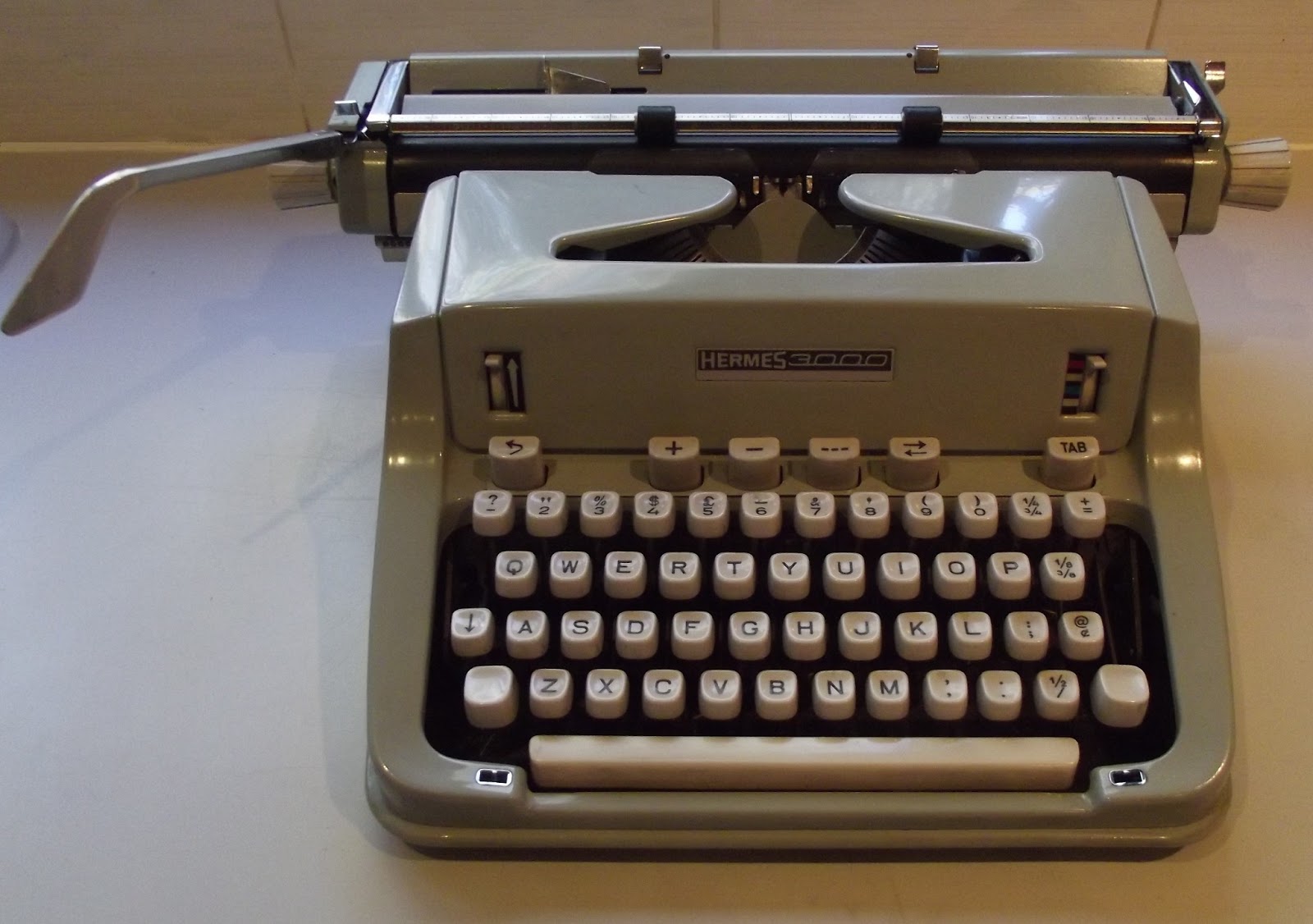
Hermes 3000, and as I dug around looking for one for him, I noted I still
hadn’t “got” to the Ambassador, now back in my house from storage but still
buried beneath other machines. “Must get to that machine one of these days,” I
yet again muttered.
Lo and behold, that same night I got a call from a woman looking
for “a good home” for a typewriter. Her mother-in-law, aged 91, had just died. The
old lady had used the typewriter right up until the time of her death. It was a
Hermes Ambassador. Two thoughts immediately entered my head: 1, How could a
lady of 91 handle an Ambassador? 2. Damn, I already own an Ambassador, a
seriously neglected one at that. What would I do with another?
Nonetheless I agreed to pick up the Ambassador the next morning.
It was on a front doorstep, with an IBM plastic cover over it. The first thing
I noticed when I took off the cover and lifted the Ambassador was that it had a
power cord. Not one with both male and female ends, but one that ran in under
the typewriter. “Now that’s VERY interesting,” I thought.
I took it home, immediately plugged it in, heard no sound, saw
no on-off switch, and looked around for a “return” key. That’s when I saw the
large keytop with the lightning bolt symbol on it. “This must be it.”
I hit it. Then I just about jumped right out of my skin. “Come
and have a look at this,” I yelled to son Danny. He, too, was flabbergasted.
Thus began an odyssey of more than 48 hours of utterly fascinating discovery about the
attributes of my two Hermes Ambassadors, including filming them for this post. It
was interrupted by the olive green Oliver portable arriving and some rugby. My,
oh my – what incredibly intriguing things typewriters can be. So much to write
about, so little time.
So much more to find out.
Anyway, back to Prezioso, who in Switzerland led the way in powering up the back end of a
typewriter while in the United States Barkdoll was still thinking of powering
up the front end.
It can be seen from this 1943 US patent application for a line
spacing device that Prezioso had by then already incorporated the arm used for
the motor adaption in the Ambassador.
Prezioso’s original 1948 design for the Ambassador shows a
machine that was in fact made as the Hermes Regent, with the switches for the Perspex
card holder shields on top of the ribbon cover, but without the decimal
tabulation keys and the copy holder in front. In June last year, Richard Polt
looked at the Regent on his Writing Ball blog.
The mysterious Hermes Regent from Richard Polt's blog Writing Ball
Prezioso had help in this work, notably from Jacques de Raemy
with the magnetic motor and from Enzo Asoli and Eric Bacher with some of the other
devices on the Ambassador.
Through these contributions, the Ambassador developed into a
multi-purpose typewriter. In a manual for the Hermes 3000, a PDF of which
Richard Polt has kindly made available online here, the manufacturers plug other Hermes models and say of the
Ambassador, “The office typewriter of great efficiency: automatic introduction
of the paper, note-book holder, intermediate paper table, electric carriage
return and line spacing (also available without motor).”
With motor
Without motor
With motor arm
Without motor arm
The Ambassador’s design allowed for the asynchronous motor to be
fitted into the back section – and without that addition the Ambassador is
fully manual. Also,
notably, the Ambassador has two ribbon vibrators and by simply turning the
colour selector it can be switched from carbon ribbon typing to normal cotton
or nylon ribbon typing.
Among my favourite features are the knobs which push
the Perspex card holder shields back from the platen, especially for cleaning
purposes (Oh, if only all typewriters fitted with Perspex card holders had this
device – particularly those on which the typist has used liquid paper).
With decimal tabulation keys
Without decimal tabulation keys
Scott Kernaghan has pointed out that my typing style is a fast
two-fingered method, and given this, the button which readily disengages
typeslugs jammed at the printing point is an absolute gem of an invention.
Among other things it is called a “dejammer” and an “unstick” button.
Other Typospherians have sung the praises of the Ambassador. In
late 2010, Tom Furrier (Cambridge Typewriter Co, Life in a Typewriter Shop) apparently refurbished one for Matt (Adventures in Typewriterdom). Matt loved the machine, and variously described it as “Godzilla”, a
“wildebeest”, the typewriter equivalent of a Boeing 747 and the Titanic. Matt
said with the Ambassador’s typing touch it would “wipe the floor” with the
Olympia SG1 – it’s in “another Universe”, a “Hermes 3000 on steroids, and then
some”. Matt called the Ambassador “the smoothest typewriter ever built” and the
one with “the most features”.
I would not challenge any of Matt’s assertions. I don’t think he
is exaggerating in the least.
Adwoa Bagalini spotted one of these for sale in its native
country, in Geneva, and described it as a “flawless mechanical beast”, a
“marvel to behold” and “brobdingnagian” (Brobdingnag is a fictional land in
Jonathan Swift's satirical novel Gulliver's
Travels occupied by giants.). Others have called the Ambassador “gigantic”,
“huge”, “gargantuan” and a “behemoth” with the “smoothest carriage return”. One
claim is that the Ambassador is “the best typewriter ever made” and one
response was “I could almost like an electric if it’s that effortless”. All of
these seem fair comments.

As Richard Polt pointed out in a comment on Matt’s post, a
number of body styles for the Ambassador can be seen on Martin Elster’s site
plustytpe.de here. These machines are from the vast collection of the late Tilman
Elster, Martin’s father. On the European Typewriter Project put together by Tilman Elster and Will Davis, the Ambassador
is described as a “Highly advanced office machine introduced in 1948 with a
number of novel features. The flat front is intended to hold copy for the
typist, and function keys are arranged conveniently in a new pattern.”
Three years ago Dan Norton-Middaugh also acquired one of these
monsters and on the online typewriter forum at Yahoo pointed out it has “some features
I've never seen before … First, this is a manual office machine, but it sports
two ribbons – a standard fabric ribbon, and a thin film ribbon (like the later
model IBM typebar machines). I've never even heard of a manual with a film
ribbon! Second, the platen pops out by pulling on two tabs, one on each platen
knob. I've run across some platens that were easily removed, but this removes
the platen without the knobs, so you could just pop it out and send it off to
be recovered without doing anything else. Third, the clear card holders retract
by twisting little knobs set [positioned] up by the cloth ribbon reels. Every other
system I've seen just uses springs (if anything). The whole thing is remarkably
over-engineered, and quite beautiful for it!
“It has a paper injector that you can set to pull the paper in from two to 32 lines;
the back space button is huge (3/4" by 1&1/8" - the same size as
the tab key); the carriage assembly is held on by two 9mm nuts; it weighs about
32lbs; and it's silky smooth to type on.”
In July this year Ryan Adney at Magic Margin showed a non-electric Ambassador stripped of its outer casing,
revealing a breathtaking inner design – one with all the hallmarks of
Prezioso’s genius with typewriter framework.
Martin A.Rice Jr at the Johnstown Type-Writer Conservatory amusingly describes
the Ambassador as “the monstrous, the mythical, the fabled Hermes Ambassador,
45lbs of Swiss engineered steel … If you
can only have one type-writer (because your wife won't let you have more), make
it a Hermes (or, file for divorce)!
FOOTNOTE: For those who may be interested in such
information, the Australian importer and distributor of the Hermes Ambassador
was Dataprint, which had branches in Sydney, Melbourne, Canberra, Brisbane,
Albury and Perth. The company went out of business in 1973. It seems Dataprint
was licensed to fit the motor to the Ambassador, and to service the machines.
Here are some YouTube demonstrations of the Ambassador's features from Scott:
Size comparisons:
Remington 16
Remington International
Adler Universal 20 (also MUST GO!)
Olivetti Lettera 82 (same as last model Hermes Baby)
Underwood 3