Total Pageviews

Showing posts sorted by relevance for query smith-corona silent. Sort by date Show all posts

Tuesday, 19 July 2011

On This Day in Typewriter History (LIX)

JULY 18
JOE BARKDOLL and
I am unashamedly enamoured with the Smith-Corona 5TE. OK, it’s electric. But it has a special place in typewriter history, as the world’s first electric portable. And it’s just such a beautiful machine to write with. Given that it combines the already wonderful typing action of the Silent-Super with an electrified keyboard, the lightness of its touch is hardly surprising.
Wherever I take my 5TE (it’s pictured above in Melbourne in February this year), I can’t resist inviting others to “just have a type with it”. Invariably, those who jump at the invitation agree: what a fantastic typing machine!
It’s a little quirk of mine, but I simply love knowing the names of the people who designed my favourite typewriters. Happily, I have now found that one Joseph P. Barkdoll was the man behind the 5TE.
Barkdoll was a long-serving Smith-Corona design engineer, based in Groton, New York. He also had much to do with that brilliant line of typewriters introduced by Smith-Corona at Christmas 1949. These included the Clipper, Sterling, Silent, Super and, of course, the Silent-Super.
Barkdoll (born Ohio, April 1895) started work for what was then L.C.Smith-Corona in the late 1920s and continued to patent designs for the company until 1969, by which time it had become the SCM Corporation. And by that time Barkdoll, 74, had gone into “semi-retirement” and had moved to Sun City Center, Florida.
During his 30 years of service to Smith-Corona, Barkdoll assigned at least 23 patents to the company in its various guises.
Most of his designs relate to portables, although he did work on an SCM office machine as late as 1967. Barkdoll’s patents cover almost every aspect of the portable typewriter – from typebar operation to carriage control, line and back spacing, case shift and margin adjustment. They even extend down to the distinctive folding paper support arms, which he designed in 1941.
In his earlier days at Smith-Corona, Barkdoll worked closely with Henry Allen ‘Al’ Avery, Smith-Corona’s veteran designer who had been with the company since Corona started in Groton in 1909. By November 28, 1953, when Avery turned 65, he was “chief general and development engineer” at Groton.
We honour Joseph P. Barkdoll today because it was on this day in 1961 that updated patents for the “power operated instrumentalities” of his 5TE were issued. The designs had originally been submitted in 1957, the year the 5TE first came out.
Barkdoll specified that the “Objects of the invention are to provide improved means for effecting key controlled power operation of the typebars and other instrumentalities of a typewriter at high typing speeds and with minimum wear and noise; to provide improved means for operating such instrumentalities characterized by simplicity, compactness, low cost of manufacture and ease of assembly and servicing; and to provide an efficient system of key controlled and power operated typebar actions requiring very little power for their effective operation and permitting their incorporation in a very small and low typewriter of lightweight which is easily portable.
“A specific object of the invention is to provide power means for actuating the type bars and certain other instrumentalities of the known ‘Smith-Corona’ key-operated portable typewriter without materially increasing the size of that typewriter.”
When Smith-Corona launched the 5TE the advertising campaign stressed, “Just touch the keys and you get perfect letters - electrically!”
As British typewriter historian and collector Richard Milton points out on his Portable Typewriters website, on a page devoted to the 5TE, http://www.portabletypewriters.co.uk/corona_electric.htm
“The possibility of putting an electric motor into a portable typewriter was high on the development agenda of every manufacturer since the 1930s, but the same factor had deterred them every time the subject came up for discussion in the boardroom - cost. Electrifying the typewriter would confer little real benefit but would make the machine heavier and much more expensive.”
Richard says Smith-Corona “decided to bite the bullet” in 1957 and “the buying public welcomed the electric portable, just as they had welcomed the folding portable 40 years earlier … within a few years, every major manufacturer had followed Smith-Corona's lead by introducing their own electric portables. Although manual portables continued to be made in numbers for a decade or more, it was the beginning of the end.”
“One final irony is that while the first portables, the Blick Featherweight of 1909 and Standard Folding of 1908, weighed only five pounds and could be held in one hand, the Smith-Corona electric portable weighed a whopping 24 pounds - more than desk typewriters made from cast iron… “
Here is a wonderful British Pathe film clip about the introduction of the 5TE, comparing its light typing touch with that of a Lambert!
http://www.britishpathe.com/record.php?id=791
Here is a YouTube clip of someone using an 5TE
http://www.youtube.com/watch?v=QfyfhuohdJk
In his patent application for the 5TE, Barkdoll acknowledged earlier efforts to electrify typewriters, starting with this highly elaborate 1929 design from Burnham Coos Stickney, which incorporates an external electric motor. Stickney assigned it to Underwood Elliott Fisher:
In 1936, Walter J. Pasinski of Detroit patented this typewriter with an internal drive mechanism and assigned his design to the Burroughs Adding Machine Company.
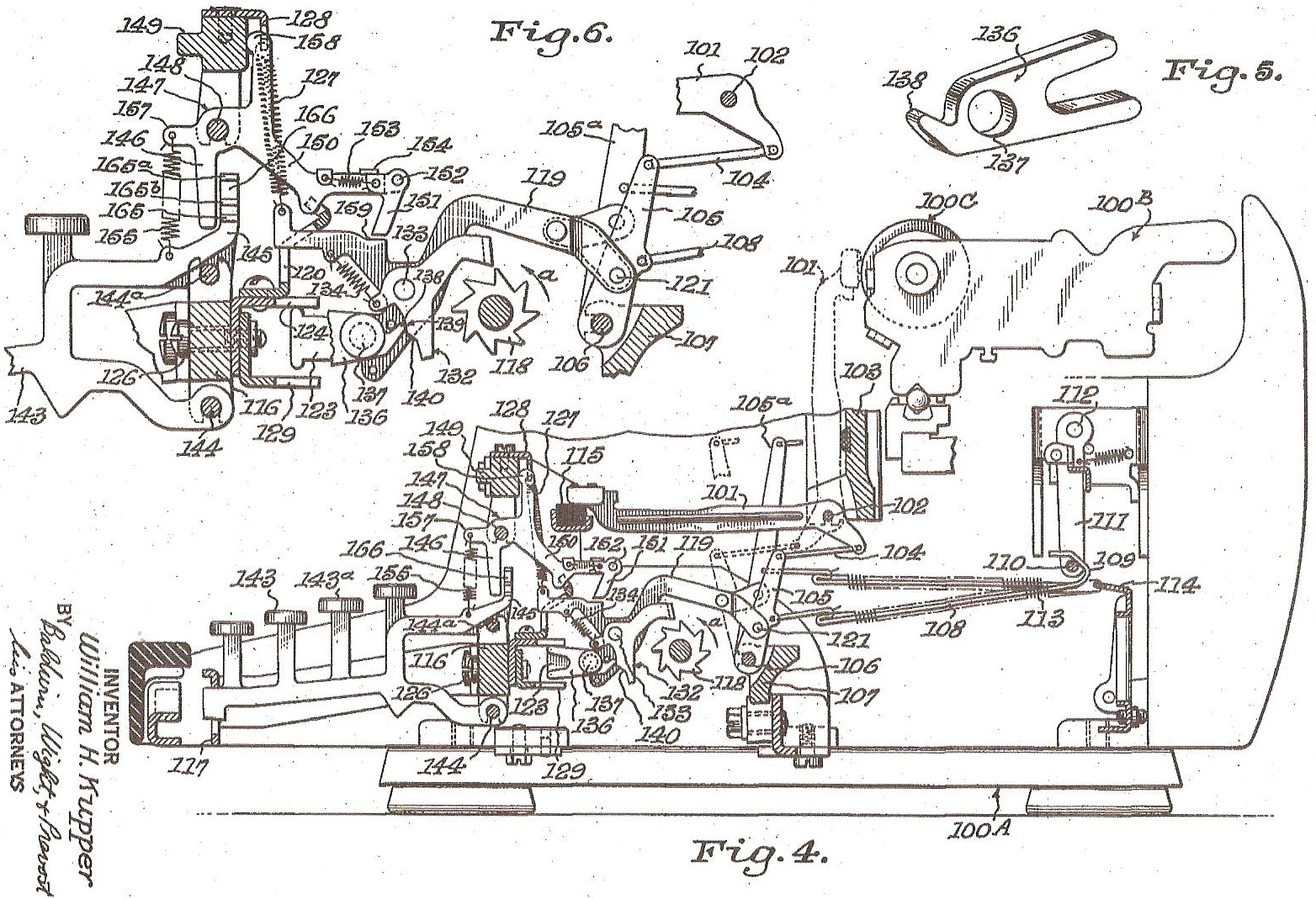
The move toward electrifying the keyboard and other “instrumentalities” started with the 1948 design by William H. Kupper of West Hartford for the Royal desktop. It was issued and assigned to Royal in 1951, when this model was first produced.
In 1957, Barkdoll had also patented his design for the electric drive mechanism for the 5TE:

On this day in 1925, Adolf Hitler published his personal manifesto Mein Kampf. Hitler borrowed the German keyboard Remington Model 1 of Deutsche Bank president Emil Georg von Stauss, a long-time business associate of the Rothschilds. Hitler dictated his work to typists Rudolf Hess and Emil Maurice.
On this day in 1937, “Gonzo” journalist and author Hunter Stockton Thompson was born in Louisville, Kentucky. He suicided at Owl Farm, Woody Creek, Colorado, on February 20, 2005, aged 67.


Monday, 10 September 2012

Corona Standard Speedline Portable Typewriter


Richard Polt was right when he said there would be a rewarding upside to moving hundreds of typewriters. Inevitably, at least one absolute beauty will emerge from the bottom of the pile.
On the first of five visits to the larger of two storage units in Fyshwick, to clean it out of all typewriters and their cases, just such a thing happened.
Earlier in the year, I well recall wondering, for one reason or another, whether I had a “Speedline” Smith-Corona in my collection.
After moving the first 15 or 16 typewriters, there it was, a real black beauty, a 1938 Corona Standard.
Once I got it home, there was of course an irresistible urge to type with it. I grabbed the first ribbon that came to hand. 
Unfortunately, the day before, someone had given me six pale blue plastic boxes containing “Mastertype black film ribbon” – and I happened to put one of those in the old Corona. Not a good idea. The Corona’s razor sharp typeslugs bit into and spat out pieces of “film ribbon” like ravenous lions.
It’s clear from the typecast that bits of ribbon were flying in all directions. Still, I think it scans OK. Regardless of it not being the most suitable ribbon, the Corona typed magnificently.
The L.C.Smith & Corona “Speedline” series, designed by Al Avery, was introduced in 1938. Corona’s conversion of its Syracuse and Groton factories to armaments-making in late 1942 meant typewriters were put on hold. But after the war Corona resumed full production of the "Speedline" series, before it was superseded at the end of 1949 by the 5 Series.
In March 1942 the US Government stopped the sale and delivery of typewriters, and in October of that year production ended. It resumed at Syracuse in February 1944. In the meantime, Corona had many models assembled at its  Canadian “branch plant”.
Corona established the “branch plant” in Toronto in 1929, just three years after the merger of L.C.Smith and Corona.
The Toronto plant was initially an assembly point, with parts shipped across the border. The idea was to beat import restrictions in other parts of what was then known as the British Empire, including Australia and New Zealand. In Australia, Remington did the same thing at the same time, starting a "branch plant" in Sydney.
Many Corona portable typewriters continued to be labelled “Made in Canada” until well into the 1950s, before Corona eventually moved production to West Bromwich in England in the early 60s. The Toronto company was known as “L.C.Smith & Corona Typewriters of Canada Limited”.
My Corona Standard has the serial number 2C188473, which means it was made in 1938. This was the year A.O.Dawson took over as vice-president of Corona's Canadian operation - he became president in 1952.
The Typewriter Age Guide states the Corona Standard 2C line went to  2C198000 in 1938 and to 2C202000 in 1939. It adds that the Standard then became the Clipper. However, Dirk Shumann's Typewriter Database gives slighter higher figures: 2C200284 in 1938 and 2C223542 in 1939. The database numbers of this series, including the Standard (and Clipper?), Silent and Sterling, are given below,
Alan Seaver describes the “Speedline” design as “somewhat belatedly reflecting the futuristic, organic Art Nouveau style that had begun to move from architecture into industrial products in the 1930s.”
Alan Seaver Collection, 2A40715
Alan says his Speedline Sterling (above) is “one of my favourite typers, both to look at and to use”.
Here is Richard Polt's similar Speedline Sterling:
Richard Polt Collection, 2A51871

Corona Standard ("C") (Floating Shift)
2C-Series
To 2C 200284 1938
2C 223542 1939
2C 250439 1940 (Clipper?)
2C 251475 1941
3C-Series
3C 242600 1940
3C 269927 1941
3C 282618 1942
3C 300600 1943
3C 318300 1944
3C 348593 1945
4C-Series
4C 112627 1945
4C 142253 1946
4C 188264 1947
4C 241798 1948
Corona Silent ("S") (Floating Shift)
2S 71813 1939
2S 79519 1939
2S 83687 1940
3S 90045 1940
2S 83999 1941
3S 98577 1941
3S 102148 1942
3S 102159 1944
4S 101500 1945
4S 119969 1946
4S 151433 1947
4S 195646 1948
4S 209057 1949
Corona Sterling ("A") (Floating Shift)
2A-Series
2A 50694 1938
2A 52335 1939
2A 72812 1940
2A 73257 1941
3A-Series
3A 74288 1940
3A 97291 1941
3A 107499 1942
3A 107506 1945
4A-Series
4A 106881 1945
4A 161854 1946
4A 227084 1947
4A 292044 1948
4A 307060 1949