Total Pageviews

Showing posts sorted by date for query royal diana. Sort by relevance Show all posts

Wednesday, 4 November 2020

Que? ‘The Mystery of Henri Pick’ The Best Typewriter Movie Yet!

Bill MacLane's Hermes 3000 is the same model as the one used in Le Mystère Henri Pick.
We saw the 2019 French comedy-drama Le Mystère Henri Pick on Sunday and afterwards couldn’t stop talking about what a good movie it is. Perhaps because of the key part played by a Hermes 3000 semi-portable typewriter, I thought it more dramatic than comedic. After all, it’s a ‘whodunit’ of a very different kind, without the blood and the gore. The only deaths I recall are those of pizza chef Pick himself (and that has occurred two years before the action in the movie begins) and the similarly posthumous Jean-Pierre Gourvec, founder of the Library of Rejected Books in the village of Crozon in Finistère in western Brittany (what a fabulous concept, based on a Richard Brautigan idea).

Richard Brautigan and Royal.
Given my leaning toward the typewriter-related histrionics, Fabrice Luchini played the lead role of literary critic Jean-Michel Rouche with a little too much levity for my liking, more impish than intentful. I notice some critics consider Luchini was perfectly cast, but I would have preferred someone with the flair of David Suchet playing Hercule Poirot. And The Hollywood News did describe The Mystery of Henri Pick as a “delectable Agatha Christie caper”. ScreenDaily added the character Rouche was a “pompous windbag”. Still, I didn’t let my impression spoil an otherwise excellent afternoon’s entertainment.

The scene in which the late Henry Pick's daughter Joséphine and her son
Melville find the Hermes 3000 in Henri's basement.

I’d rate The Mystery of Henri Pick as probably the best typewriter movie I’ve ever seen, for reasons I’d not normally expect to be applying to a movie with a typewriter (or many typewriters) in it. For one thing, I’ve no doubt whatsoever that the Hermes 3000 in Henry Pick is absolutely pivotal to the story - even more so than, say, the Groma Kolibri in the 2006 German film The Lives of Others. It’s not a movie full of typewriters, and one doesn’t see the Hermes 3000 all that often. Indeed, it’s only seen in use twice, and then fleetingly, before becoming the centrepiece in a shrine. Unlike The Lives of Others, the typewriter doesn’t get its rightful place in the movie posters, the trailers or the reviews. Yet from the moment young Parisienne publisher Daphné Despero (played by the gorgeous Alice Isaaz) wanders into the Library of Rejected Books and opens the unpublished typescript of The Last Hours of a Love Story by Henri Pick, one just knows a typewriter is going to be central to the plot. And it is, with spades. Not long afterwards, Pick’s bookworm daughter Joséphine (played charmingly by Camille Cottin) and her son Melville (named, no doubt after Herman) find the Hermes 3000 in a cardboard box in the late Henri’s cellar. The moment the pair make their discovery, a typewriter carriage bell makes a highly symbolic ding. Then comes the real clanger, when on his live book review TV show, Rouche casts doubt on whether Pick is the real author of the best-selling The Last Hours of a Love Story. Odd as it may initially seem, Joséphine Pick and Rouche become allies in the quest for the truth, despite the firm conviction of Joséphine’s mother Maedeline (Josiane Stoléru) that her late husband did write the novel, for her.

Typewriter purists - and those who use typewriters to write manuscripts - will be wondering from this point onwards why a forensic document examiner isn’t called in. I was certainly thinking along those lines. But finally, in the denouement, all becomes quite clear. Even after Rouche tracks down the Hermes 3000, his amateurish typeslug forensics can only take him so far; there’s much more to the mystery than the diagonal lower leg of the letter “K” being chipped off. I love a movie with lots of typewriters being used as much as the next Typospherian, but I also love a genuine, gripping mystery story. And the unravelling of the reality about the writing of The Last Hours of a Love Story kept us spellbound right to the end.

The movie is based on a 2016 novel by David Foenkinos (above, 1974-). I have no idea whether Foenkinos uses, or has used a typewriter in his 19-year writing career, but my guess - based on the evidence of The Mystery of Henri Pick – is that he has a deep appreciation of these wonderful machines. He has singled out the Hermes 3000, though in the movie it’s not the more common version which Larry McMurtry thanked when receiving his Golden Globe for his adaptation, with Diana Ossana, of the screenplay for 2005’s Brokeback Mountain. McMurtry said at the time that the Hermes 3000 was “surely one of the noblest instruments of European genius”. Foenkinos’s Henri Pick story will only further enhance that well-earned reputation, and not just in Europe. The Mystery of Henri Pick is a book that should be read, and the movie watched, by all those who love typewriters, wherever they may be. Typewriters and who used them, and for what purpose, was the theme of The Lives of Others, but this is a very different kettle of fish, a movie about a typewritten manuscript and the ability of a Breton village pizza chef to typewrite a brilliant novel. As Rouche asks on his TV show, before being sacked for asking, if Pick didn’t write The Last Hours of a Love Story, who did? And if Pick did write it, how?

Monday, 11 May 2015

Q: What Links a Pommy Princess with a Portland Pub? A: An Aristocratic Typewriter, of course!

In the first week of May, a royal princess was born in England and a typewriter-festooned hotel opened in Portland, Maine. The baby is called Charlotte Elizabeth Diana Mountbatten-Windsor, and the hotel is called the Press, because the building 


is the former home of the The Portland Press Herald newspaper. In the first week of May 1949, this Maine newspaper ran the following item at the top centre of page 6:
"Little Prince Charles" is still, 66 years later, Prince Charles, but he's now old enough to be the grandfather of Princess Charlotte. "Some day" has yet to come. The "Princess Elizabeth" in this story has at least since stepped up one rung on the royal ladder, and has been since 1952 the Queen, Charlotte's great-grandmother.
The gold-plated portable typewriter in question was an Empire Aristocrat, made by the British Typewriters Company in West Bromwich, England. The model had been launched the previous year. Here is how The Sydney Morning Herald covered the story, on the same day (May 6) as the The Portland Press Herald. Note Charles's mother thought giving the typewriter to a five-month-old to learn the alphabet was "a good idea". Well, he was a week off turning six-months-old!
Jim (at typewriter): "Let's make big moolah by converting an old
newspaper building into a hotel and decorating it with typewriters."
Charlie: "I love it!"
From The Portland Press Herald, 1949
Typewriters (though not, it seems, an Empire Aristocrat) are mounted to a wall in the main lobby area of the Press Hotel and typewriter cases adorn another wall near the entrance. The "soaring assemblage of antique typewriters" (sic) was created by students at the Maine College of Art, which is one of the hotel’s partners. Developer Jim Brady has "branded" the history of the Portland Press Herald and newspaper journalism throughout the hotel.
Standing at the corner of Exchange and Congress streets in Portland’s Old Port neighbourhood, the 1923 building was empty for two years. After the newspaper relocated in 2010, an interim owner gutted the seven-story brick building, leaving its plastered ceilings and long staircases intact. Brady bought the building and spent $10 million converting it from an empty landmark to a 110-room boutique hotel.
The Portland Press Herald was founded in 1862 on Congress Street. Its most famous journalist was the widely-travelled columnist and political writer May Craig. By coincidence, although Craig is photographed at her home below with a Royal 10 standard typewriter, it was with the Empire Aristocrat's mother machine, the Hermes Baby portable, that she so extensively globetrotted, filing columns for the Press Herald from parts far and wide in the late 1940s.
Elisabeth May Adams Craig (born December 19, 1889, at Coosaw Mines, South Carolina; died July 15, 1975, in Silver Spring, Maryland) covered World War II and the Korean War as well as US politics. She wrote her "Inside Washington" column for almost 50 years. She took on leadership roles within the Women's National Press Club and Eleanor Roosevelt's Press Conference Association, both organisations supporting women in journalism. 
Given typewriters have now been returned to the Press Herald building, it is interesting to see how often typewriters were mentioned in the newspaper's pages in 1949, when Prince Charles was given his Empire Aristocrat:
Henry Alston Milliken (1907-) was a lifelong Mainer and avid hunter. He wrote stories ranging from a description of his first lessons in ruffed grouse hunting all the way to pursuing deer in the deep woods of Maine as an experienced hunter. He was born and raised in the Hancock County area of Downeast Maine. His father was a farmer and woodsman, as well as an avid hunter. It appears that Milliken spent much of his adult life in the Freeport, Maine area, taking regular forays into the woods to hunt. He hunted grouse, woodcock, pheasants, deer, bear, bobcats, raccoons and other game.
Portland Press Herald newsrooms:
Maine typewriter cartoons:
And one for Mother's Day:

Thursday, 9 April 2015

Then & Now: The Restored Smith-Corona Model 88

 Less than a week ago it looked like this. Now it doesn't ...
It's actually taken only four days to transform it. Two days were washed out. To be honest, these photos don't do it justice. I just had another look at it - it is a real transformation.
Gone are the mountains of rust, the forests of leaves and twigs, the jungle of giant wasp nests, the spider webs and bird poo (plus the tabulation system, I readily confess).
I will detail the final stages of the repainting and reassembly ASAP. For the time being I'm enjoying having a nice looking, sweet working (and sweet smelling) Smith-Corona Model 88. 
Right now there are a few minor adjustment still to be made. For one thing, the replacement shift key (off a spare parts Royal Diana) isn't blending in so well, but fortunately I have left myself another option there.

Monday, 17 November 2014

Graduating with Honours: Singer Portable Typewriters (Made by Royal in Holland)

The Singer Graduate portable typewriter, a relabelled Royalite made for Singer by Royal in Leiden in Holland, arrived in Australia in September 1963 and was sold for 39 guineas (close to £41). By the time Australia switched to decimal currency in February 1966, that would have been close to, if not more than, $100.
In September 1963, Singer was selling vacuum cleaners at 47 guineas, motor mowers at 49 guineas, transistor radios at 29 guineas and sewing machines at 65 guineas, so I guess the 39 guineas for such a neat and reliable little typewriter was pretty reasonable. 
At about the time Brian Sarno asked me about Remington portables made in Den Bosch in Holland, a Canberra lady brought over her Singer Graduate for me to service. She had bought it for a mere $10 and was assured by the previous owner that it "hadn't been used for many, many years". The signs of some neglect were there, all right.
Once I had taken it apart and cleaned the flora and fauna off the base plate and out of the mechanics, then cleared decades of hardened gunk from the segment slots, I was able to test type with the Graduate.
And I was quickly reminded of how much superior the Leiden machines are to the Den Bosch portables.
Factoring in size, weight and sturdiness, the quality of the materials used, the workmanship and the excellent mechanical (Halberg) and mask (Laird Fortune Covey) designs, and finally the typeability, the Dutch Royals are far, far better value for money than the Dutch Remingtons of the same period.
From time to time one can run into minor problems with the Royalites, such as the tight-fitting typebar clipping or getting stuck under the front part of the mask, and I have also encountered carriage lever breakage. But those were freak things which resulted from a lack of care by owners, not the manufacturers. All in all, it's hardly surprisingly these Royalites sold so well - as they also did for Nippo as the Atlas. The keytops are close together, but at least they don't wobble around like the Remington keys.
The history of the Singer Corporation and typewriters stretches back to the earliest days of typewriters in the mid-1870s, when Remington, lacking an established foreign sales network to match that of Singer, approached Singer to sell the typewriter overseas. Singer refused.
Almost 85 years later, in mid-October 1961, Singer started to sell its own typewriters in the United States - its own, that is, but made by Remington and Royal in Holland. The first Singer Graduate, which reached the US market in November 1962 at a cost of $79.95, was a Remington, and a very good, solid one too. It's the later, plastic Dutch Remingtons which are a problem, not this model, which started out in 1961 as the Monarch or Envoy:
The earliest Royal Singer models had come out 13 months earlier, and were the first-model Royalite, which had been around since the mid-50s, with a raised top plate on the Singer to distinguish it from the same Royal machine. They were sold as the Singer Scholastic:
Given that at this time the Royal Diana was selling for the same price, at $49.95, a flimsy Dutch Remington or a solid little Czech Consul sold for $39.88 in the US, the then new Royal Futura 800 was $99.50 and Olivetti-Underwood portables ranged from $68-$98, the price of the Singer might have been seen as being slightly on the high side. 
After Litton took over Royal, Singer had its portables made more cheaply by Silver-Seiko in Kashiwazaki, Japan, and by Smith-Corona-Marchant in West Bromwich, England. (There was also a Royal Safari-style Singer, which in 1967 sold for $88.)
The SCMs, also Scholastics, are simply awful - their prices reflected undue pressure placed on the manufacturers to reduce production costs to match Japanese prices, and a lack of quality control. 
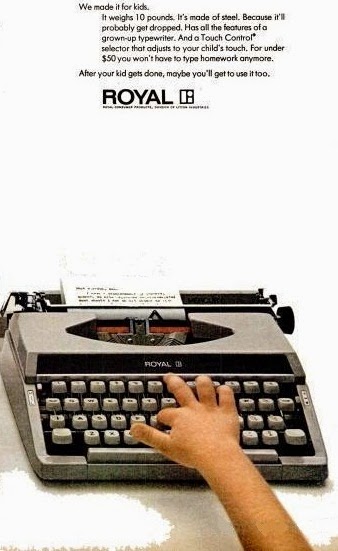
The Silver-Seiko Singer reached Australia for Christmas 1979 and sold for $99. It was the same model which had sold as a Royal Mercury in the US - aimed at a pre-high school market - for under $50 in 1967.
But in the late 70s in Australia, a Nakajima KMart sold for $55 and an Olivetti Lettera 32 for $135.
By early 1980 the price had dropped by $14 and the target market was, as in the US 12 years earlier, school children.
Silver-Seiko
Silver-Seiko
Nakajima