Total Pageviews

Showing posts sorted by date for query smith-corona skyriter. Sort by relevance Show all posts

Thursday, 13 January 2022

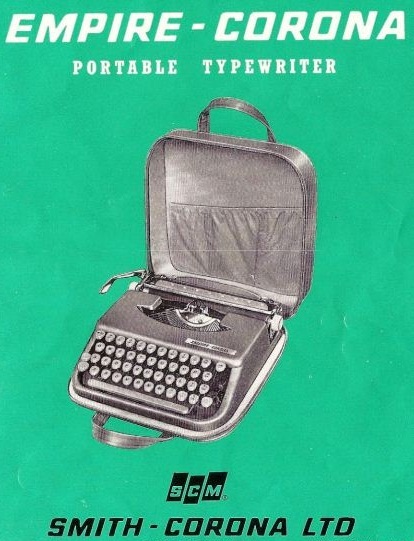
The Empire Corona Portable Typewriter

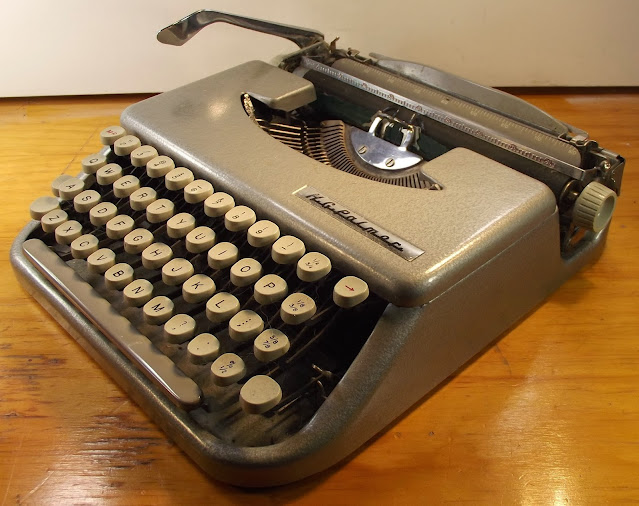
Relabelled again and sold in Australia through the H.G. Palmer department stores.

I was rather surprised yesterday to find that at the end of July 2007 I had not alone made an inventory of my typewriter collection, such as it was back then, but the inventory was still in existence. At that time, 14½ years ago, not many of my 193 typewriters were what could be called truly vintage. As the collection grew, by almost five times the number of machines I then owned, that situation very much changed. And with an emphasis on much older models, I naturally started to lose interest in those 1950s and ’60s machines which had once so fascinated me.
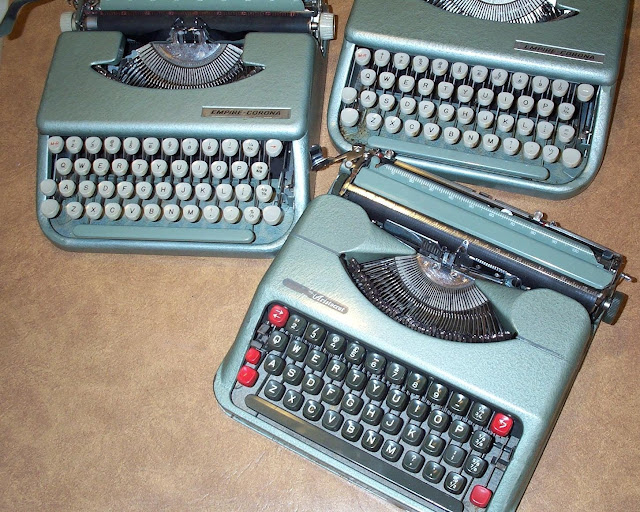

Near the top of the inventory, for example, were two metallic green Empire Coronas. Goodness knows where they are now. They were no more than relabeled Smith-Corona Skyriters,  of course, but back in my earliest days of typewriter history research I was intrigued by how an American machine could be sold as a British-made Empire Corona. (Bearing in mind my 2007 collection also included such little mysteries as a Czech-made Norwood and Japanese-made Pinnocks.) The Empire Corona had me scratching my head about things that had been going on in the typewriter world at the time I first started using a typewriter.

Rob Bowker's Empire Corona

In September 2007 I contacted Will Davis with some information I’d gathered for Will’s Portable Typewriter Reference Site. Will was almost as puzzled as I was by these Empire Coronas. “Here are a couple of interesting typewriters,” he wrote in a caption beside an Empire Corona with an Empire Aristocrat.  “Both were built in West Bromwich, England, in the same factory but at different times. Very rarely you will see a machine of the Hermes pattern with Corona or SCM labeling, made during a short period of ‘running down the stocks’.”
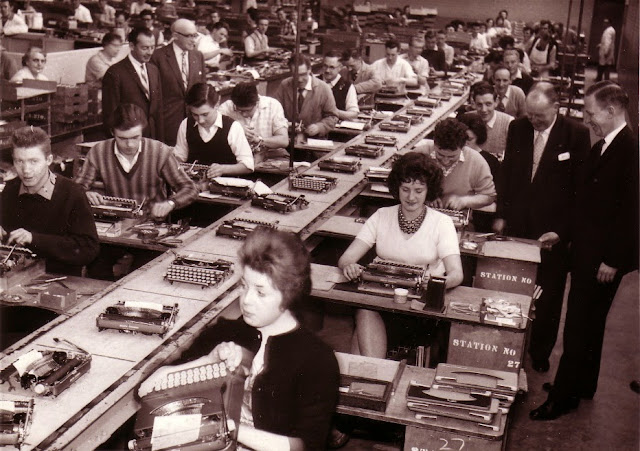
Assembling Skyriters and turning them into Empires

All would become clear to me in the next few years. But, reminded yesterday of my Empire Coronas, I was still interested in revisiting the events which led to Smith-Corona-Marchant taking over the old Salter typewriter plant in West Bromwich outside Birmingham in England.
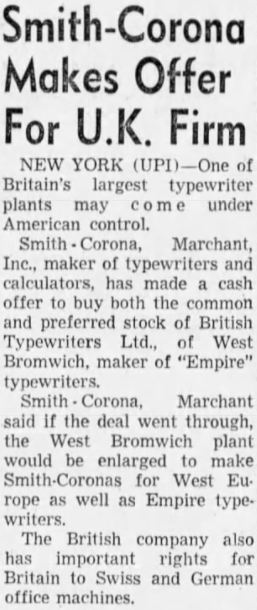

SCM’s cash offer for all outstanding 33,000 common shares and 39,267 preferred shares in British Typewriters Ltd of West Bromwich was announced on July 27, 1958, by SCM president Elwyn Smith, with a deadline for acceptance set at September 1. By August 26 the deal was done. (Elwyn Lawrence ‘Tump’ Smith, 1894-1979, was a son of Wilbert Lewis Smith and nephew of Lyman Cornelius Smith.)
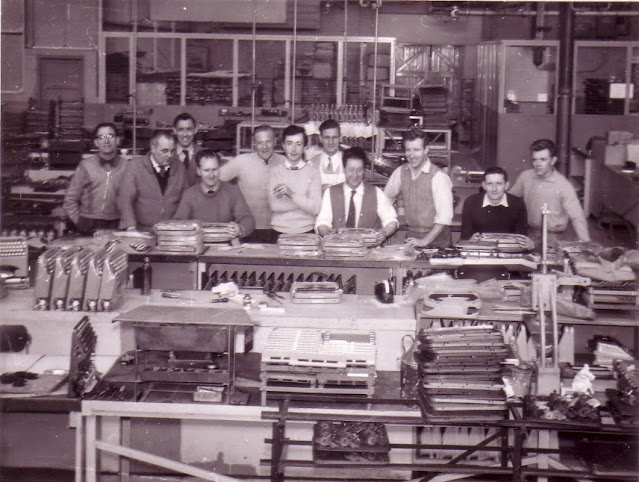

British Typewriters had gained the rights from E. Paillard & Cie in Yverdon, Switzerland, to make Hermes Featherweights as Empire portable typewriters, soon after the Featherweight was launched in 1935. Smith said SCM planned to enlarge the West Bromwich factory to make Corona Skyriter portables as well as the Empire. As it turned out, however, in its first year in Britain the American company merely assembled and relabeled the Skyriter. Still, rocky times lay ahead.
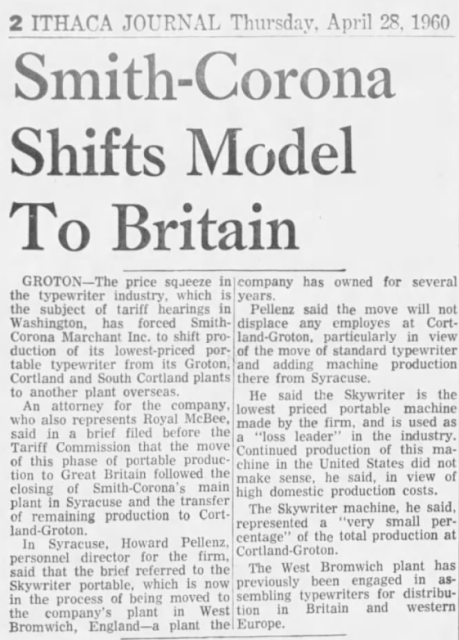

On September 17, 1959, British Typewriters and Smith-Corona dropped the prices of some models. At the end of April 1960, SCM said the price squeeze in the US typewriter market, the subject of tariff hearings in Washington DC, had forced the American company to move production of all of its portables from Groton, Cortland and South Cortland to West Bromwich.
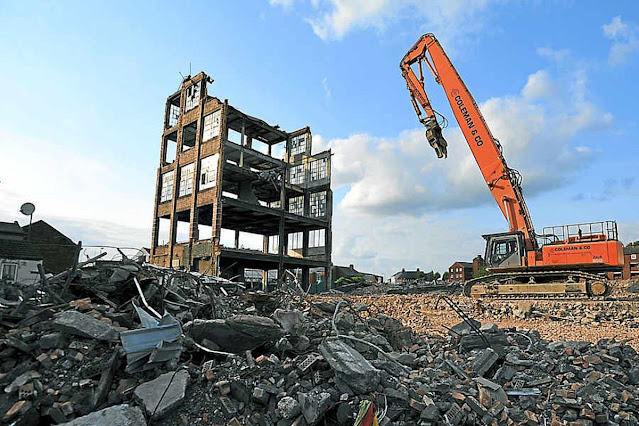
The Salter factory was levelled in June 2013.

A brief filed before the Tariff Commission said the move followed the closing of SCM’s main plant in Syracuse, with production first moved to Groton and Cortland then Britain. This, explained SCM’s Syracuse personnel director Howard Pellenz, referred only to the Skyriter, with standard size machines still to be made in the US. Pellenz called the Skyriter a “loss leader” in the industry. A loss leader is a pricing strategy in which a product is sold at a price below its market cost to stimulate other sales of more profitable goods. With this sales promotion-marketing strategy, a “leader” is any popular article sold at a normal price. Continued production of the Skyriter in the US “did not make sense in view of high domestic production costs”.
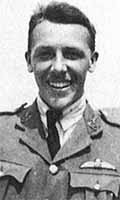

British Typewriters had taken over the old Salter plant in West Bromwich in 1936, soon after the company’s founder, former Imperial sales manager and Royal Flying Corps pilot Bill Mawle (above, 1897-1971), had acquired the rights to make a variant of the Hermes Featherweight portable. The plant was hit by German bombers in World War II and a rebuild was completed by 1954.


As part of SCM’s takeover offer, Mawle and his works manager J.C. Holdship, both of whom had been with British Typewriters since 1936, were retained in their positions. Mawle stepped down from the managing directorship in January 1962 and was succeeded by Holdship. At the end of 1974 SCM expanded the West Bromwich factory as well as opening a plant in Singapore. The West Bromwich factory was closed on February 5, 1981, with the lose of 230 jobs. Cortland was closed in 1993 and production moved to Mexico. SCM went bust in 1995.

Friday, 19 February 2021

Bigger Cars, Smaller Typewriters

Inspired by comments from Bill MacLane, Richard Polt and Bill Guthrie (I had a couple of Triumph Spitfires in the 1970s too, Bill, but my first car was a Morris Mini), and a thorough analysis from Paulo Dal Cheile, I went looking for more Big Gas-Guzzling Car ads.
I knew that if I dipped back into the late 1950s, I’d find some real beauties. And to my surprise I found an ad which combined both a Big Car and a typewriter – albeit a very small blue typewriter. I can’t make out what it is, but with the white keytops it could be a Olivetti Lettera 22 sold in the US from 1955 as a Sears Tower Courier or from 1956 as a Sears Tower Chieftain. Then again, the Couriers were primarily red in colour. (There is some suggestion they were made in the integrated works in Mexico City by Olivetti Mexicana SA). At the same time, with the higher carriage lever, it could be a Smith-Corona Skyriter, also sold as a Tower Chieftain. I really can’t tell. What I can say is that the massively long car in that ad is a 1959 Chevrolet Biscayne. Like I said in the earlier post, the names alone are synonymous with "BIG" - Pontiac, Studebaker, Cadillac, 
Chrysler ...
1959 Pontiac
1956 Cadillac
1956 Studebaker
Chrysler
1959 Ford Custom 300

1959 was also a year when the Royal FP standard typewriter was still a “drab blob” (Alan Seaver’s words on his "Machines of Loving Grace" website) – and you can tell by the way this schoolteacher is holding his head in his hands that he’s not happy about that. The Royal Electric in a pastel blue had arrived in 1954, just not at this guy’s school! And then in 1959 there were all those lovely portables, Laird Fortune Covey's Royal Futura in particular, but also the Remingtons, Joe Barkdoll's Smith-Corona 5TE electric portable and the array of Paul Braginetz-designed Underwoods.

And for the benefit of Bill Guthrie ...

Wednesday, 9 January 2019

There Must Be 32 Ways Of Losin' the Typewriter Blues That I Got From Lovin' You


Comments on my last blog post have only succeeded in intensifying my thinking about the Olivetti Letteras 22 and 32 (no, Ted, you’re not missing anything; 1964 was definitely the year for the 32*). The overriding impact of the comments was to reinforce the general Typospherian view that typewriter preference is very much a personal choice. Bill likes his Skyriter or Montana and goes for portability, while Richard seems to prefer something a little larger (a Series 5 Smith-Corona, perhaps, or a Royal Quiet De Luxe?). But the topic of choice made me wonder: What range of typewriters did others have to choose one from, back in the day?
In my case there was only one typewriter shop in town, Jim McNulty’s on Albert Street (although Hay’s Department Store later sold Olympia SM9s). In 1965, I probably went out of my way to walk down Albert Street at least three or four times a week, after school, just to make sure the Lettera 32 was still in the window. Someone else had to get it before me – it was just too gorgeous for words. I have no idea whether Jim had other portables for sale, the 32 was the only one in his window. When I did finally did get my hands on it, and took it proudly into the Grey Star’s newsroom, I quickly noted it was the only Olivetti on the seven desks. The editor had his 1956 taupe Lettera 22 amid the ash on his office desk, but in the reporters room there were only Imperial Good Companions (albeit in an eye-catching deep red) and Brothers. I didn’t think for one second I was kidding myself, in regarding mine to be vastly superior in all regards.
It’s a funny thing, looking back on it now, but when, after six years of yearning to start a journalism cadetship, the last thing I thought of taking into the newspaper office - when the chance eventually did come - was a typewriter. I must have thought the tools of the trade were supplied. Well, the pens and notebooks were, but not the typewriters. Of course, I did already own my own portable, an Underwood Universal, which was given to me by my Dad in 1957. But that machine got such a pounding on my home desk, I would never have taken it anywhere else. It deserved its occasional respite.
When I first started work at the newspaper, it was as an intern in the August school holidays. Jack Turner, the chief of staff, scoured the building for me, and found a clunky old Remington standard somewhere out the back, in the print shop. I was far from unaccustomed to using standards, and the Remington suited me just fine, although its racket probably disturbed the concentration of the older reporters around me. Soon after joining the staff full-time, in early December, I was given the nod to go down to McNulty’s and buy the Lettera 32. The company paid for it, and would dock my wages a few shillings each week to settle up. But the Olivetti was mine, all mine! And I loved the feeling that I was its proud owner.
From that point on, as I travelled across the world, working in Auckland, Sydney, Cork, Dublin, London and then back in Australia, and was sent on assignment around the globe –to places as exotic as Fiji and Egypt – I always used a Lettera 32. I never considered a change for one moment. That enormous amount of usage naturally entrenched my loyalty to and passion for the 32.
I have to confess portability – the weight of the Lettera 32 in its snazzy, tight-fitting carry case – was always an important factor, right up there with never wavering reliability. In 1974 I worked so late in the Press Room at London’s Twickenham rugby stadium that when I finally emerged, the lights were out and the 20-foot high gates were locked. I got out, with typewriter, by pushing the Olivetti through the palings and dropping it on to the ground outside, then scaling the gates. I’d never have managed it with anything bulkier.
Me, Auckland, June 1971
So I came back to the matter of choice. Yes, the Lettera 32 greatly appealed to me in 1965. For one thing, my editor owned a taupe 22 and, after all, he’d got it at the Melbourne Olympic Games. More importantly, however, I liked the look of the Olivetti, the way I liked the look of Carter Brown potboiler covers, of a 57 T-bird or a Triumph Spitfire (got to own a couple of them, too), or a Jaguar Mark 2 (still dreaming). The Lettera 32 was sleek and modern and – well, very sexy. I liked the concave keytops in grey plastic, I liked the steely blue colour. I liked the state-of-the-art case.
Were there any other criteria when it came to making my selection? Not one. I only had eyes for this one portable anyway. But how the Lettera 32 typed, how it suited my typing, what its features were - I didn’t give a single jot for such things. It was so beautiful, I would have to fit myself around its needs, not it around mine. It’s bit like the way one feels about a girlfriend: she could say, “Go jump” and you’d ask, “How high?” It was the same for me and the Olivetti.
We’re told one never forgets a first love. I can’t say I’ve ever really fallen completely out of love with the Lettera 32, it’s just that many other loves have come into my life in the past 54 years, and some I’ve loved even more than the 32. But I’ve never been able to abandon the 32 either. Oddly enough, when I was asked about a machine for The Typewriter orchestral performance in November, my mind drifted toward the 32 – now, I suppose, I tend to think of it as my “old reliable”.
Most Typospherians have, in the past decade or so, given themselves the chance to use a whole wide range of typewriters. Many have collections, and can make a daily choice from a selection of dozens. That’s what the typewriter obsession is really all about – trying out new machines, experiencing as many as financially and physically possible, being the Lotharios of typewriting. I’ve never once received a “new” old typewriter without wanting to type with it immediately. For me it’s a natural instinct. An insatiable curiosity, if you like, an ever-present need.
With these multiple experiences, preferences will naturally evolve. But while Richard talks about “the first typewriter I would grab to use”, I don’t think many us ponder that choice for very long. I’ve been asked the question, “What would you take if the house was on fire?” many, many times, and the answer probably changes every time. Hopefully, we’ll never have to make that decision. So it’s not worth sweating over. For me, it comes down to this: the Lettera 32 was my first love, the love wore off, but the affection remains. Other portables have, from time to time, filled the gap left in my heart. The Lettera 32 isn’t the one I’d grab in case of fire – they’re easily replaceable. Yet, for all that, I can’t forget the way I felt about it in 1965, and how it succeeded, back then, in mindlessly reducing my choice to one. It was the only choice I remember having. Most of the blokes who worked around me on the Grey Star in 1965 can’t recall what they used. I can and always will.
 
*Yes, Ted and John, “The Magnificent Seven” will be reprinted, hopefully sometime later this year.

Wednesday, 21 March 2018

Orinoco Flow with a Smith-Corona Skyriter

A 1950s Grumman canoe built in Marathon, NY
Alan Seaver's Smith-Corona Skyriter
Henry Whiting Ferris Jr 
Almost four years ago I posted about George Ely Russell, who in May 1919 set off from Seattle in an 18-foot long, canvas-covered Peterborough canoe to paddle 1000 miles to Juneau, Alaska. Russell took with him a Corona 3 folding portable typewriter (serial number 84165) he had used on the battlefronts of France in World War I. About one third of the way into his epic voyage, while approaching the Heiltsuk First Nation Reserve village of Bella Bella on the east coast of Campbell Island in British Columbia, 98 nautical miles north of Port Hardy on Vancouver Island, Russell dropped his typewriter into seven feet of water. Unable to fetch the Corona 3 off the bay floor with a salmon hook, Russell stripped off, dived in and rescued the portable from a salty grave. He wiped it off with an old rag, dried it in front of his night fire ... and went on to write one quarter of a million words with it! These were incorporated into a book called Eighty Days in the Wilderness: Seattle to Alaska by Canoe. 
Russell's great and justified faith in his Corona 3 was replicated 36 years later, when two young American ex-servicemen, the 5ft 8in, 10st 5lb Henry Whiting Ferris Jr (1931-) and John Alexander Thomson (1928-, not Thompson or Thomason, as often reported) took a 9lb Smith-Corona Skyriter with them on a trailblazing, year-long 7000-mile journey canoeing from Venezuela through Brazil and Paraguay to Uruguay and Argentina via those three mighty South American river systems, the Orinoco, the Amazon and the Plate. Later hailed by his local newspaper, the Ithaca Journal, as a modern-day Ulysses,"Whitey" Ferris was a 1952 Yale graduate in psychology and sociology and Thomson a 1954 UCLA arts (geography) graduate, although Thomson gave his home town as Portsmouth, Ohio. The pair bought the $69.50 portable typewriter, the sturdiest lightweight machine they could find, at Rudolph's in Ithaca just before departing for Philadelphia and on to Venezuela. Ferris and Thomson had a similar experience to Russell's, in that they lost one of two 16mm movie cameras and both of their 35mm still cameras when tides swamped their canoes in the early part of the adventure. The cameras were sent back to Caracas for repair. But, as with Russell, the Corona portable survived unscathed - only to be left behind in Buenos Aires in late October 1956. 
The Orinoco is the fourth largest river in the world by discharge volume of water. and the river and its tributaries are the major transportation system for eastern and interior Venezuela and the llanos of Colombia. Its source, 3455 feet above sea level near the Venezuelan–Brazilian border, at the Cerro Delgado-Chalbaud in the Parima Range, was not explored until 1951. Three hundred and fifty-six years earlier, Sir Walter Raleigh had sailed down part of the river in search of the fabled city of El Dorado.
Ferris was the grandson of Dr Harry Burr Ferris (1865-1940), professor of anatomy at Yale from 1895-1933 and a pioneer in the study of cancer, and the son of New York pathologist and director of the Tompkins County laboratory Henry Whiting Ferris Sr (1895-1985), a US Navy captain in World War II. Henry Jr served as a field medical aid with the Second Infantry Division and as a psychologist with the Eight Army Psychiatric Department in the Korean War. Thomson served in Japan and Korea in a fleet squadron and on escort carriers as a US Navy pilot after World War II.
Ferris and Thomson had been tutored at the American Institute for Foreign Trade (now the Thunderbird School of Global Management) in Phoenix, Arizona, by economic historian Professor William Lytle Schurz (right, 1886-1962), the institute's president from 1950 and its director of Latin American studies. The two young men, attending AIFT on the GI Bill, were fascinated by Schurz's assertion that the Orinoco journey was feasible. Schulz, in the immediate aftermath of the conquest of Everest, called the South American canoe venture, "One of the few feats requiring comparable courage and stamina remaining on the globe". Schurz had spent many years in Central and South America with the US Department of State, and he helped Ferris and Thomson plan their trip. Schurz taught at a number of academic institutions, including the University of California, of Wyoming and of Michigan and was US commercial attaché to Brazil during the Hoover administration. In 1922 he coined the phrase "The Spanish Lake" and his The Manila Gallion (1939) was a landmark study on the Spanish empire’s trans-Pacific commerce between 1561 and 1815.
Ferris and Thomson began preparations in June 1955, including making a sail out of an old army parachute, and left on a Swedish oil carrier from Morrisville, Pennsylvania, on October 1. Twenty-five days later, at 2am, their joined 59lb, 17-foot Marathon NY-made Grumman aluminium canoes were lowered into the waters at the mouth of the Orinoco in Venezuela. One year and one day later they arrived in Buenos Aires, Argentina. After some weeks of paddling, they branched off on to the Casiquiare, a distributary of the upper Orinoco flowing southward into the Rio Negro, in Venezuela. This forms a unique natural canal between the Orinoco and Amazon river systems. It is the world's largest river of the kind that links two major river systems, a so-called bifurcation. The area forms a water divide, more dramatically at regional flood stage. From the Casiquiare the pair traversed the Negro, Amazon, Tapajós and Juruena rivers, followed by 20 miles by truck and a final 2000-mile stretch of canoeing down the Cuiabá, San Lorenzo and Paraguay rivers to the Plate. 
Having achieved the longest inland water journey on record, at least from north to south in South America, Ferris and Thomson crossed the Plate to Montevideo and made their way back to Florida by train to Brazil (where they had their canoes sent from Buenos Aires to be swapped for parcels of land) and plane to Bolivia, Peru and the US. There had been a contract with New York publishers E.P. Dutton for an illustrated book but, perhaps because of the damage to the cameras, it does not appear to have seen the light of day. Instead, Ferris and Thomson gave talks about the trip to various groups back in the US, as well as in Paraguay.