Total Pageviews

Showing posts sorted by relevance for query olivetti lexikon 80. Sort by date Show all posts

Saturday, 1 December 2018

A Very Different Looking Olivetti Lexikon 80 Comes Back From the Dead

This is a very different Olivetti Lexikon 80 than the one I was given on Thursday morning. Different because it obviously doesn't have the same round, black Lexikon 80 keytops - the ones on this refurbished machine are from a discarded Olivetti Lettera 52, and they're being temporarily employed because the Lexikon I was given had quite a few keytops missing. Different, also, because it's not the seriously faded taupe colour it was (or at least appeared to be - in parts it was hard to tell) when I first glanced upon it, looking oh so forlorn on a kitchen stool on Thursday. (This colour is called Deep Ocean, in case you're wondering; I did toy with the idea of a darker shade of taupe called Jasper, but went with the grayish-blue). But, most importantly of all, this one is so very, very different because it is now in perfect working order. 
As I indicated in my last post, about work done on the Remington Compact portable given to me by Jack Palmer, the Lexikon looked at the time to be potentially an absolute nightmare. Resurrecting it from the dead turned out to be not quite as hard a task as I thought it might be - but it still took the best part of two days' work. Yet again I am regretting not taking "Before" photographs - I was too eager to get on with the job, and started taking the Lexikon completely apart without thinking of taking photos.
This was undoubtedly the most unprepossessing restoration project I have ever taken on. I gave myself little chance of bringing the Lexikon back to life. But it was given to me as a gift, so I figured I might as well at least try. And taking it completely apart was the first step. Nothing on it worked. The margin setters were rusted to their bar, the typebars were rusted together, the key rods were rusted and unmoveable, the drawband was, as I suspected and soon found, shredded, and the carriage simply wouldn't move in any direction. This Olivetti had, like Monty Python's famous Norwegian Blue parrot, gone to meet its maker, was bereft of life, had kicked the bucket, shuffled off its mortal coil, run down the curtain and joined the bleedin' choir invisible.
The outer signs weren't good - what there was of paint was, as I said, seriously faded, there were red and white paint spots across the front, the front section was bare metal (the paint had either been chipped or worn away), and on top of the ribbon spools cover was a most unappealing red "SOLD" sign - goodness knows what it might have fetched in this condition. Happily the sticker was old and dried and it just fell off. That was a promising start to proceedings. But the carriage section was richly laced with rust all over and needed a lot more elbow grease.
Once the casing was removed, however, the really serious problems emerged. Dead spiders, bugs, large lumps of thick matted lint, acres of dirt - and that was just for starters. There was rust everywhere. This was the filthiest typewriter I have ever encountered - and take my word for it, I've seen some filthy typewriters in my time. Yet the more grime and muck I found, the more determined I became to clean it up.
Yesterday was mostly spend on disassembling, repainting and getting the carriage, margin setters, keys and typebars to move properly, as well as degreasing, lubing, cleaning and removing rust. Today was mostly about attaching a new drawband (which also meant fashioning a new grip on the right end of the carriage), putting on the temporary keytops (a few don't correspondent with the typebars, as you will see from the scan below, but all will be well when I get replacement Lexikon keytops) and reassembling the machine. I removed the tab keys and bar from above the keyboard as I don't use such things.
What a good feeling when, finally, the Lexikon 80 started typing beautifully, as a Lexikon 80 should:
Just a few little touch-up jobs left to do, such as the spots for the ribbon colour switch, though since we can only buy black ribbon in office supplies shops in Australia, I might not bother. The important thing is that I can now type away happily on this machine because, as far as I'm concerned anyway, it's now a fully functioning Olivetti standard. The transformation from the machine I collected on Thursday is, even if I say so myself, remarkable, and I guess a salute to the durability of old Olivettis.  
This typewriter is BACK in the land of the living!

Sunday, 10 May 2015

Inside the Olivetti Typewriter Factory, Glasgow, Scotland

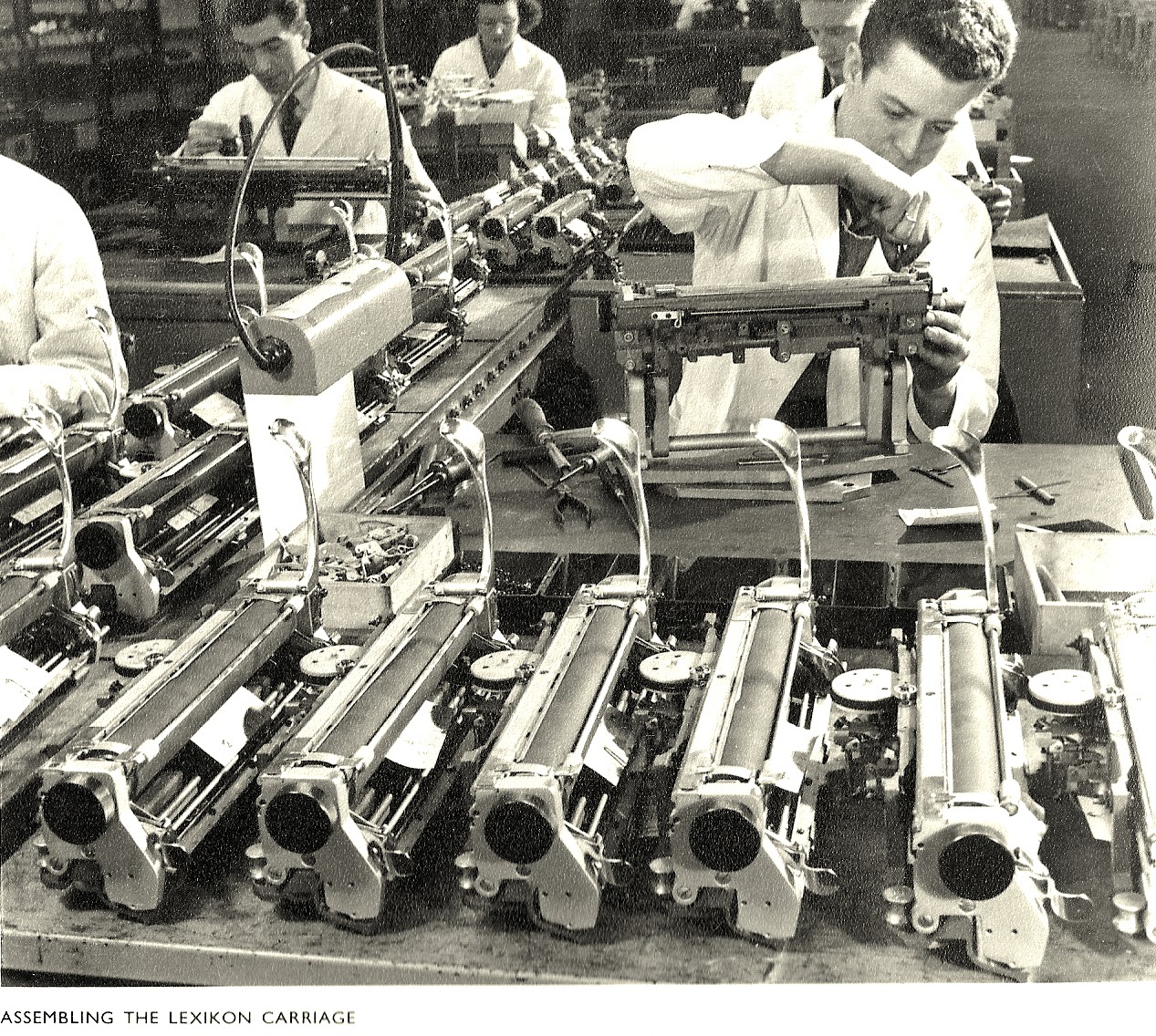
In August 2013 we were given a rare insight into the Remington Rand typewriter factory on the Hillington Industrial Estate in Glasgow, by Scottish-born historian Mary Doland, a Victorian lady whose father Jack O'Brien had been a shop steward at the plant in the 1950s. Now we are able to get an even more extensive tour, of the Olivetti typewriter factory on the Queenslie Industrial Estate in the same Scottish city, again in the 50s and again from a child of a factory manager. 
"Big" John Brady tests out an Olivetti Lexikon 80 in 1957. Mr Brady, manager of the Olivetti factory in Glasgow in its last years, was the father of our correspondent John J. Brady, who now works for Dell in Britain.
John J.Brady, global account director for Dell in Britain, is the son of "Big" John Brady, who worked at the Olivetti plant from its establishment in 1949 and managed it in its last few years of operation. It was sold to Smith-Corona to make daisywheel typewriters in 1981 (the factory closed in 1983 and was demolished in 1989). 
John Jr has become so enthusiastic with his memories of Olivetti's days in Glasgow, revived after he came across a photographic brochure of the Scottish plant, that he has gone out and bought himself a lovely Glasgow-made Lexikon 80, a fine example of the type of machine his dad worked on. A brochure page with a photo of his father is in the platen.
John Jr says that, at its height, the Olivetti factory employed more than 900 people, "most of whom lived within the immediate surrounding area, in the city's East End council estates, one of the poorest parts of Glasgow."
John Jr's post on the Lost Glasgow Facebook pages drew an enormous response from people who had worked at the plant, or had had family members employed by Olivetti. One, for example, was related to Franco Marco, who was sent from Ivrea in Italy to get the factory started. 
So here are the pages John Jr sent us:
The guy front left is drawing a segment.
Swaging is a forging process in which the dimensions of an item are altered using dies into which the item is forced. A reamer is a type of rotary cutting tool used in metalworking. Precision reamers are designed to enlarge the size of a previously formed hole by a small amount but with a high degree of accuracy to leave smooth sides. The process of enlarging the hole is called reaming.
Segments were made in full circles, sliced in half and machine grooved.
These more familiar photos are not from John Jr's brochure but were taken at the Olivetti Glasgow plant two years earlier, in 1955:

Wednesday, 4 May 2011

100 Years of Olivetti Typewriters: Adriano the Aesthete

In 1954, the first year of the Italian industrial design awards, for the Compasso d’Oro, the five-man jury, which included the awards founder Gio Ponti, handed out 15 golden compasses. The winners’ list covered an intriguing array of designs: from a toy monkey to an automatic hunting rifle, a fishing jacket, table lamps, chairs, a 24-hour business suitcase, a perfume travel flask and a blue glass vase. The only designer to pick up two of the first 15 stylish trophies was Marcello Nizzoli: one for a “supernova” sewing machine and the other for the Olivetti Lettera 22 portable typewriter (below in pistachio and salmon pink).
The latter Nizzoli award was at last some due recognition, after more than three decades of effort, for what had become internationally recognised and admired as “the Olivetti style”.
The Olivetti typewriter company’s founder, Camillo Olivetti, had set down the template for the “Olivetti style” in 1912. “A typewriter,” he wrote, “should not be a geegaw [decorative trinket; bauble] for the drawing room, ornate and in questionable taste. It should have an appearance that is serious and elegant at the same time.”
Camillo’s company had consistently put its first president’s policy into practise in the ensuing 42 years.
The company’s official history (Olivetti 1908-1958) described the “Olivetti style” as a “specific taste and trend … something more than transitory fashion or gifted improvisation. It means that the collaboration and joint effort of the management of an industry and a group of painters and graphic artists … architects and industrial designers has become a cultural reality. The Olivetti company gives and has always given as much relative importance to the choice of a colour [and] the design for a … machine, as to the choice of some technical procedure, a type of steel or a method of casting.”
In the second year of the Compasso d’Oros, a special award was made to Camillo’s son, Adriano, who had since 1932 been Olivetti’s director-general and since 1938 its second president. The award was “achievements in industrial aesthetics”.
The following year, 1956, Adriano won the Gran Premio di Architettura for “the architectural merit, original industrial design, social and human objectives incorporated in every Olivetti achievement”.
These prizes were much merited. Among his many other attributes, Adriano was and always had been a committed aesthete. And it is to Adriano that we owe the enduring visual delight of some of the most beautiful typewriters ever made. There can be no doubt that of all the major typewriter manufacturers of the 20th century, Olivetti stood apart for following Camillo’s credo: it achieved lasting elegance in its machines with an unparalleled standard of stylishness in design, and at the same time a serious, unwavering level of technological quality. Put together, these ensured Olivetti typewriters were seldom matched by other brands.
These are not machines of Adriano’s personal design. Yet Adriano’s imprint was on all of them. He had a deep, abiding appreciation of art and architecture. It was his decision for Olivetti to enter the portable typewriter market in 1932, it was his vision which brought to the Olivetti design table artists, architects and graphic artists who could give the Olivetti portable such a high degree of distinction.
It appears that, certainly in Adriano’s younger days, he and his father did not always see eye-to-eye. Unlike his father, Adriano, as an independent-minded adolescent, did not see his future in a typewriter factory. But after a home education under the tutelage of his mother, Luisa, Adriano was sent, perhaps against his wishes, to study industrial chemistry at the Polytechnic Institute of Turin, from 1919-1924. Perhaps the architecture school at Milan, some 80 miles further east of Turin, might have been more to his liking – he was certainly to later make great use of the products of that seat of learning. Or maybe somewhere else, to study art itself.
Dutifully, however, Adriano did as his father wanted – and that was for Adriano to train to work in the Olivetti factory. Having graduated from the Turin Polytechnic, Adriano was then sent to the United States, in 1925. There, during the course of the following year, he visited more than 100 factories, including the Remington typewriter factory. “I hoped to learn,” he later said, “the secrets of their administrative and organisational techniques. [Yet] To be applicable to conditions in Italy, what I learned had to be adapted and transformed, for I faced at the age of 25 the complex problem of modernising and enlarging an industry based on a semi-artisan system.”
A major part of Adriano’s almost immediate solution to this “modernising” problem was to successfully meld the manufacturing techniques of the US with the great traditions of Italian art and design; he tapped into the rich vein of Italy’s cultural history, and its natural national eye for classic beauty.
It was timely for Adriano to have visited the US in 1925-26. This was a period of change in the design of portable typewriters. After the “boom” in the portable market created by the Corona three-bank from 1912-1919, Underwood had entered the field, quickly followed by Remington. By 1926 Royal was carefully planning its assault. The Royal portable (the one pictured above from Wim Van Roompuy's typewriter.be site) was to be somewhat different to the norm – bulkier and higher than the Corona, Underwood and Remington four-banks, it was the beginning of the approach toward what we might call today a semi-portable. It definitely gave the appearance of being sturdier. The move was a success for Royal, which in the three years from 1928-1930, sold more than a quarter of a million units of its model.


Adriano was encouraged not just to add Olivetti to the list of portable makers, but to start looking at markets far beyond Italy.
Like George Ed Smith at Royal before him, Adriano’s approach to Olivetti’s entry into the portable market was meticulous. For the mechanical design of the now legendary Olivetti ICO MP1, Adriano enlisted Riccardo Levi, his wife’s uncle. (Adriano had, after his travels to the US and also to England, married Paulo Levi, the daughter of renowned histologist Giuseppe Levi and the sister of author Natalia Ginzburg, wife of writer Leone Ginzburg. One of Paulo’s brothers, Mario, also a writer, worked for Olivetti at the time as a commercial director. Riccardo Levi would in 1934 develop Olivetti’s first adding machine.)
Most importantly, however, Adriano had Aldo Magnelli design the die-cast alloy outer casing, one which wraps so tightly around the inner workings. It’s a work of artistic genius in the way it seamlessly merges a beautifully tiered, high curved collar around the typebasket with straight lines down to the sides of the keyboard.
It is a design decidedly born of the love Magnelli shared with his famous painter brother Alberto (above) for the geometric abstraction style of art which incorporated cubist and futurist elements. Alberto (1888-1971) was, at the time his brother was working on the MP1, returning to abstraction in the form of concrete art, featuring geometric shapes and overlapping planes.
Aldo Magnelli, from Florence, had worked on experimental physics in Rome with Enrico Fermi, and joined Olivetti as an engineer. He first designed for the company a horizontal five-drawer filing cabinet called a Synthesis (above), which went into mass production in 1931, with the Rome Municipal Registry Office putting in a first order for 1400. That same year, Adriano established an Olivetti development office, directed by Renato Zveteremich. The program recruited painters Alexander “Xanti” Schawinksy (below) and Nizzoli, along with architects, graphic artists and printers. One of the first projects was the MP1. By 1932 it was ready to be launched on an unsuspecting world. The following year, 9000 were made, and for the first time half the typewriters sold in Italy were Olivetti.
The Magnellis had close ties with South America, and Aldo was later sent to Brazil to represent Olivetti. In 1940 he opened a steel furniture company in Sao Paulo called Securit, now run by his daughter Christina Maria Magnelli. It manufactures office furniture systems which combine steel, aluminium and wood.
Meanwhile, in Ivrea, Adriano was moving toward bigger and great things for Olivetti. Having noted the success of the Royal portable in the US, and the readiness with which Remington and Corona, especially, had adapted the Royal portable’s size and shape to their own needs, Adriano began to plan a semi-portable. The MP1 had been introduced at a time when other parts of Continental Europe and Britain were producing similar machines, notably the Imperial Good Companion (based on the German Torpedo) and other German models, such as the Olympia, Continental, Mercedes, Triumph, Erika and Rheinmetall (see photo of  my collection below). The market was growing, but so too was the competition. Time for something almost completely different.
Instead of referring to it as a semi-portable, Olivetti chose to describe the Studio 42 as a “semi-standard” – half an office machine, in other words, rather than twice a portable. It was created in 1935 by engineer Ottavio Luzzati. Schawinsky combined his artistic skills with the ideas of architects Luigi Figini (1903–1984) and Gino Pollini (1903-1991) and factory technicians to come up with the futuristic outer design and produce, like the MP1, one of the most striking typewriters ever made.
Schawinsky was born in Basel in Switzerland on March 26, 1904, and educated in Zurich. From 1921-1923 he worked for the Cologne architectural firm Theodor Merill, then attended the School of Arts in Berlin and the Bauhaus in Weimar. In 1933 he joined the Milan advertising company Studio Boggeri, and through this organisation linked up with Adriano Olivetti’s development program. He died on September 11, 1979, in Locarno, Switzerland.
Just as Hermes in Schawinsky’s native Switzerland was returning portables to an ultra-flat, light, compact shape and size – one which was to be maintained in Germany after World War II by the like of Gossen and Groma, and in France by Rooy – Olivetti’s Studio 42 pointed to a whole new direction for the rest of the world.

After the War, of course, Olivetti returned to the light, compact roots of the portable, producing perhaps the most popular model of them all: Nizzoli’s Lettera 22. In 1959, the Illinois Institute of Technology approached 100 leading design engineers to vote on the best design product of the previous century – and the Lettera 22 came out on top. Little wonder it won a 1954 Compasso d’Ora. Other subsequent winners for Olivetti included Mario Bellini, who designed the Divisumma 24 calculator (awards in 1962, for a marking machine in 1964, 1970, 1979 and 2001), Ettore Sottsass for the Elea electronic computer in 1959, and Briton George Sowden with a fax machine in 1991.
Nizzoli was Olivetti’s director of industrial design from 1936 until succeeded by Bellini and then Sottsass. Both Bellini and Sottsass designed a number of the subsequent versions of the Lettera. Other great Nizzoli achievements were the Lexikon 80 (also 1948) and the Diaspron 82(1959).
Nizzoli was born on January 2, 1895, in Boretto, Reggio Emilia, and studied at Scuola die Belle Arti, the art academy at Parma. As a painter, he was committed to futurism. He opened a studio in Milan and designed silk scarves featuring patterns in the art déco style, as well as designing posters for Campari. Nizzoli's product design was an organic, sculptural form combined with functional machine construction optimised for industrial mass production. He died in Camogli, Genova, on July 31, 1969.
The legacy of Adrian Olivetti’s influence on the “Olivetti style” is the impressive list of artists and architects who worked for him at Olivetti. They include Franco Albini, Gae Aulenti, Walter Ballmer, Franco Bassi, Bellini, Carlo De Benedetti, Figini and Pollini, Fiocchi, Jean-Michel Folon, Jorge Fuentes, Roberto Gabetti and Aimaro Isola, Ignazio Gardella, Milton Glaser, Louis Kahn, Perry A. King, Le Corbusier, Leo Lionni, Vico Magestretti, Magnelli, Richard Meier, George Nelson, Constantino Nivola, Nizzoli, Camillo, Giovanni Pintori, Geno Prampolini, Bruno Scagliola, Carlo Scarpa, Giorgio Soavi, Sottsass (who had the original concept for the the Valentine, above, finished by King), James Stirling, Sowden, Schawinsky, Kenzo Tange and Marco Zanuso.
TOMORROW: Olivetti Conquers the World