Total Pageviews

Showing posts sorted by relevance for query royal diana. Sort by date Show all posts

Sunday, 8 January 2012

The Royal Diana Portable Typewriter

The Royal Diana portable typewriter was made in Holland by Royal-McBee Nederland N.V., a wholly-owned subsidiary of Royal-McBee Corp.
The company had originally been Halberg Machinefabriek (founded 1941), which produced the Halberg Traveler until Royal-McBee bought it out.
The serial number on this Diana model is DOP 86199, which suggests it was made in 1959 or 1960. On September 10, 1959, the Toledo Blade newspaper ran an advertisement for the Royal Diana, giving a price of $79.50, a reduction of $50 on the "regular" price.
Will Davis on his Portable Typewriter Reference Site features a Royal Diana with the serial number of DTE 85312, which he says indicates perhaps a 1959 or 1960 production. Will’s page on the Diana is at http://machinesoflovinggrace.com/ptf/Diana.html
It features a typewriter with a Royal-like Diana logo:
Here is a 1960 advert for the Royal Diana.
Georg Sommeregger tells us on his site http://www.typewriters.ch/collection/halberg_portable_typewriter.html
that Halberg Machinefabriek N.V. was first established in Limburg, a province in the deep south-east of Holland. Its directors were called Van Halder and van den Berg (from which comes Hal-Berg).
The company went public in February 1950 and started production of typewriters in 1952. In 1953 the factory moved to Cuijk, a town in the south of the Netherlands. On November 29, 1954, Halberg’s typewriter division and factory were taken over by Royal.
Here is a Royal Diana I found for sale in the US. It looks like an upgraded model, more like the one in the 1960 ad than mine:

Thursday, 15 August 2013

Royal Portable Typewriters 1958-1972

Late November 1960
Scrolling through the often richly coloured pages of LIFE magazines from the 1950s through the 60s makes one realise what a great source of information these must be for Mad Men creator Michael Weiner.  One gets a definite feel for the fashions, fads and foibles, the idioms and idiosyncrasies of the USA of the period.  Most particularly, this exercise is an acutely accurate guide to what was hot and what was not in corporate advertising back then - as well as to the style of such ads. And how launching products and their associated ad campaigns were handled.
It is also useful for typewriter enthusiasts, to get an good indication of what the various major typewriter brands were pushing - and when. And to whom ...
Early September 1961
After all, a series of full-page colour advertisements in LIFE would have been far from cheap.  When Royal, for example, embarked on a heavy advertising campaign for a particular model, or models, it would hardly have been for "yesterday's machine". It was for the company's "latest thing". The timing of these ads is thus telling, as is the way Royal spelled out what it saw as its target audiences for particular machines. 
"Royal Workmanship and Quality"? 
You're kidding, Royal!
Late October 1967. This ad very clearly states: "The New Royal Mercury Typewriter was made for kids."
We find, for instance, that the first Japanese-made Royal, the Mercury, manufactured by Silver-Seiko for Litton Industries, was expressly intended for CHILDREN. That's right, the style of Silver-Seiko and Nakajima portable typewriters that was to become so universally popular across all age groups from 1967-77 was originally devised to be used by littlies, not adults (or even those in their mid- to late-teens)! 
It is also interesting to find that in late 1967 Royal launched the children's Silver-Seiko portable concurrently with its ongoing promotion of the Safari made for Litton by Messa in Portugal.
The Futura is one fascinating example of all this. It was designed by Laird Fortune Covey for the Royal McBee Corporation in June 1957.  Most guides and reference sites that I have seen state the Futura was launched on the market in 1958 - which would add up. These include Will Davis's Portable Typewriter Reference Site.
Early December 1959
Yet Royal's advertising campaign for the Futura didn't start until just before Christmas 1959, and continued heavily for almost two years. Oddly, Thomas Russo's book Mechanical Typewriters shows a gold-plated Futura being presented to the National Office Machine Dealers' Association, allegedly in 1954,  as the four millionth Royal portable! 
 Russo dates this gold-plated presentation Futura to 1954, yet the Futura wasn't designed until 1957. Below, the plaque does not state a date.
That hardly seems possible. (Wikipedia says Royal produced its 10 millionth typewriter [all sizes] in December 1957). In reality, Royal had not launched a completely new design for its portables since Henry Dreyfuss came up with a new mask for the Quite Deluxe in August 1945. The cosmetic changes to this during the ensuing 12 years were marginal, to say the least. In late October 1956, Royal clearly stated:
Reference in this ad to the "96-Year Test" relates to the June 1953 robotic typewriting test to which this model had been subjected at the Royal laboratory in Hoboken, New Jersey:
February-March 1954
(As an intriguing aside here, Royal advertised in LIFE only two portable models throughout the 1950s - with the Futura sneaking in to join the Quite Deluxe in the last month of that decade. Royal NEVER advertised the Royalite in LIFE, nor other Dutch-made models, such as the early 60s Futura-lookalikes the Arrow and the Parade (as well as the updated Royalite '65, see Wikipedia list below; I'm not sure where the Heritage was made). Is it because these were made in Holland that they weren't marketed in the US the way the Futura and Quite Deluxe were? On the other hand, the work of a British typewriter historian, Wilf Beeching, jumps from the Dutch-made Diana [1953] to the Japanese-made Mercury and Portuguese-made Safari and Sabre, the last three of which Beeching dates from 1970, three years after they were marketed in the US.  Conversely, Russo jumps from the QDL to a Silver-Seik0-made Fleetwood, with the transistor radio in the case, and doesn't include the Royalite. Most curious. It's little wonder Will Davis's sites are so valued, as they give a more complete and accurate guide.) 
With the Futura, it is clear Royal saw its target market as college and university students, This would make the appearance of a Futura being used by Emma Stone (as student 'Skeeter' Plelan) in the 2011 movie The Help, set in the early 1960s, as one rare example of movie-makers getting the era and model of a typewriter absolutely spot-on (I must confess I didn't it was at the time of seeing the movie, being under the misapprehension the Futura came much earlier):
Naughty, naughty Eugenia "Skeeter" Phelan (played by Emma Stone) - putting Liquid Paper anywhere near a typewriter is worst than using WD40 on one!

 Late August 1960
Mid-May 1961
After Litton Industries took over Royal in the mid-60s, the next major Royal typewriter advertising campaign in LIFE magazine started in early September 1966, with the Safari, and then embraced two other models, the Ultronic electric and the Mercury. This ad is from December 8, 1967:

Early October 1966
Early September 1966
Late May 1967
In mid-September 1971 the Apollo was the new focus:
Here is Wikipedia's incomplete stab at a rundown:
A large number of machines, mostly Dutch-made, are tellingly not mentioned here. They include:
Arrow
Parade
Heritage (branded a Royal, but made for Montgomery Ward)
Futura in a Safari body
QDL in a Royal Skylark body (nothing like a Royalite!)
Century (descendant of the Diana)
Administrator (off-shoot of the Diana)
Safari IV (made in Bulgaria)


Friday, 17 May 2013

A Simple Twist of Fate: the Mysterious Remington Travel-Riter Portable Typewriter

After typecasting with my Remington Travel-Riter portable typewriter this morning, I was reminded of what had at first attracted my attention to this machine, when it was listed on Australian eBay in late March. At an initial, quick glance, it looked for all the world like a Dutch-made Royal Diana, and I had never seen a Remington so alike a Royal. 
My Royal Diana. Please excuse my drooping "U" key
At the time the Remington was listed, I did check Will Davis' The Portable Typewriter Reference Site and saw that Will had written, "In the middle 1950s, Remington's subsidiary company, Remington Rand Holland BV, began production of the small Travel-Riter, seen at left."
The Travel-Riter shown on Will Davis' website
Will went on, "This machine was Remington's competitor in the field of small portables.  It had carriage shift, and could most closely be compared with the (basket-shifted) Royal Diana, as far as offerings from US manufacturers are concerned.  This machine used a similar styling to the US-made units but was much smaller."
My Travel-Riter, as I first saw it on eBay
When I received my Remington Travel-Riter, I realised just how accurate Will's comments are - except for one very significant thing: My Travel-Riter is basket-shifted.
If I had gone back and checked Will's website again, and then done the research I subsequently did on Remington-Rand in Holland, I wouldn't have written what I did about my machine's country of origin in my typecast. It now seems highly likely my Travel-Riter was indeed made in Holland.
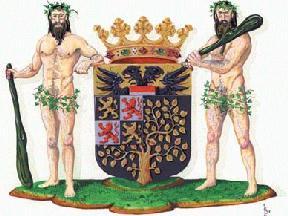
Clubbers: The striking coat-of-arms for Den Bosch
I had not previously seen any conclusive evidence that Remington was making typewriters in Holland at the same time as it had a factory on Woodside Crescent at the Hillington Industrial Estate in Glasgow in Scotland. (Remington began typewriter production in Scotland in 1949.) However, intensive digging today unearthed a Remington factory built in 1951 at 56 Onderwijs Boulevard in the historic fortified city of Den Bosch ("The Forest", also known as ‘s-Hertogenbosch), south-east of Rotterdam; Leiden, where Royal made its typewriters, is to the north of Rotterdam and south of Amsterdam.
The Maaskant-Herwijnen-designed Remington-Rand BV factory in Den Bosch
On October 12, 1950, Den Bosch mayor Loeff announced to his municipal council that Remington wanted to manufacture typewriters in the town. The council agreed to build a factory, which Remington would rent.  On July 30, 1951, eight-year-old Ingrid Meerwijk (the daughter of a Remington director) and four-year-old Dirck Loeff (son of the mayor) laid the foundation stone. In 1952 Remington started with 80 staff who made 70 typewriters in a week.  At the end of the 1950s, 800 workers produced 2100 machines a week.  In the 1960s, 1000 people made 1000 typewriters a day, of which 98 per cent were exported. Just as production reached 1600 a day, on August 19, 1971, Remington announced it was scaling back the production of portable typewriters and concentrating more on its factory in Naples, Italy (production had ended in Scotland on February 22, 1963).  In May 1981, the Den Bosche factory was declared bankrupt.
But getting back to my Travel-Riter, which has the odd serial number of ETR 106805-H. I suspect the "H" stands for Holland. "E" was a prefix letter first used on Remington portables back in the early 1930s. "EQR" (starting at #133700), "ELR" (#237791) and "EER" (#144740) were used in the 1950s for, respectively, Quiet-Riter (1953), Letter-Riter (1956) and Office-Riter (1953) portables, most of which, I think, were made in Scotland. There was also a Junior-Riter (#127913) in 1955. My "ETR" obviously doesn't fit into the sequence for these models, which may mean a different sequence was used for Dutch-made machines. The later (starting in 1960) Carl Sundberg-designed and Dutch-made models included an "ETR", which started at #133,000-H.
Will Davis refers to this model as representative of the "All New Remington Portable" which emerged in 1949. The example above is the British-made Quiet-Riter which is so common in Australia.
What differentiates my Travel-Riter from the Remingtons (described as the "All New Remington Portable Typewriter") shown in Thomas Russo's book as emerging in June 1949 are that the switches under the ribbon spools cover (which has no chrome rim) are to change ribbon direction (left) and, oddly enough, lock the carriage (right). Will Davis says, "The 'All New Remington Personal Portable' appeared at the very end of 1949, in a two-tone paint, using the body seen ... on the later and much more common Quiet-Riter.  Later, other variants in this body were added, such as the Letter-Riter.  This basket-shifted machine has a distinctive shape which most collectors will immediately recognise as the '1950s Remington look'." In this country, these models are very common, as they were made in Britain.