

Showing posts sorted by date for query remington portable. Sort by relevance Show all posts
Showing posts sorted by date for query remington portable. Sort by relevance Show all posts
Saturday, 13 August 2022
When Jeff Missed Out To The Typewriter Guy


Thursday, 9 June 2022
Johnny Depp and Typewriter

Have you Heard? Johnny Depp isn't taking any money from Amber but has bought himself a Glasgow-made Remington portable typewriter to write lyrics for a song he'll perform with Jeff Beck.

Saturday, 14 May 2022
"Death by Typewriter": How Dan Jenkins Dreamed of Using His Olympia to Kill His Editor
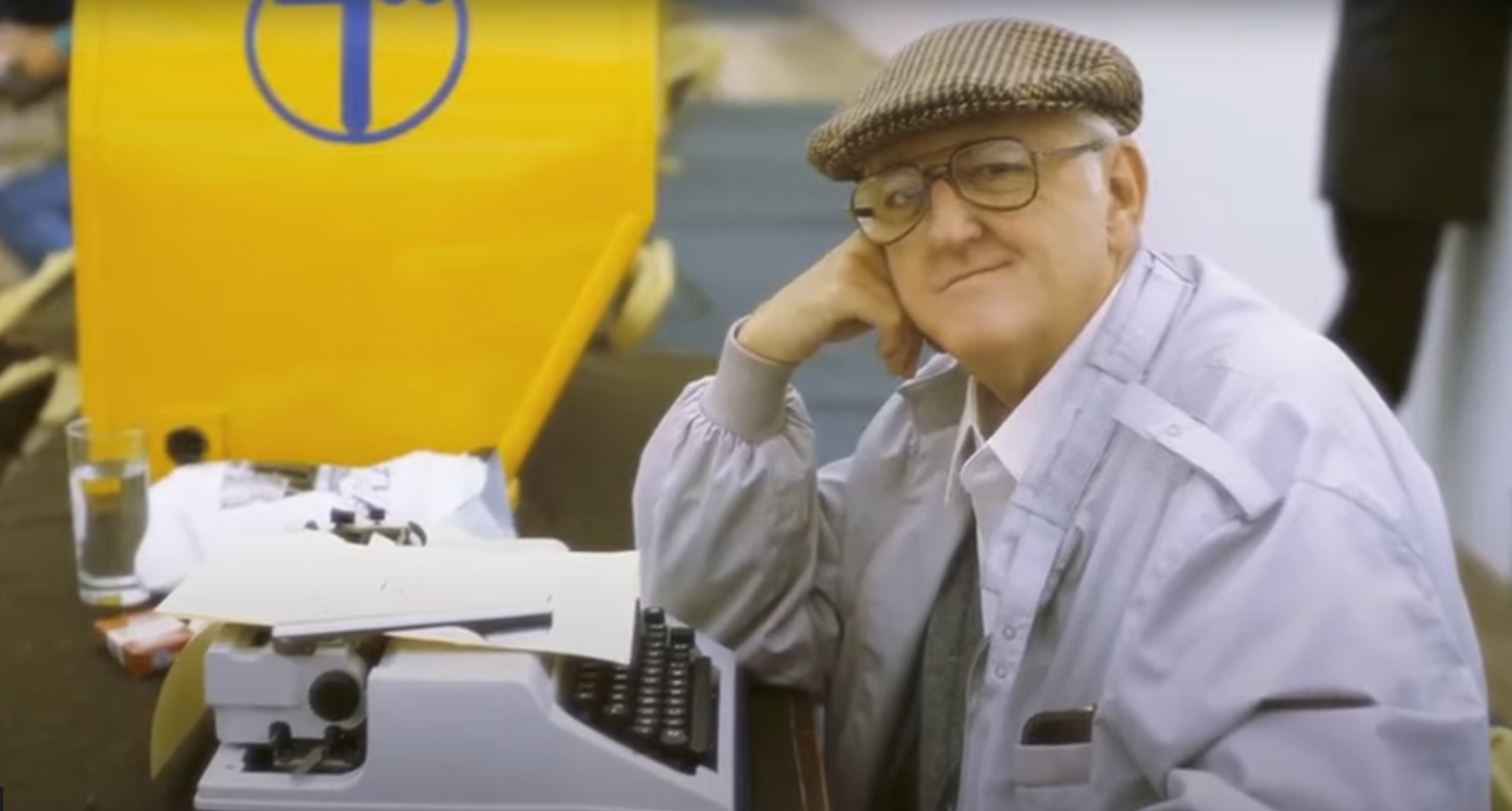
Here’s how I want the phony little conniving, no-talent, preppiewad asshole of an editor to die: I lace his decaf with Seconal and strap him down in such a way that his head is fastened to my desk and I thump him at cheery intervals with the carriage on my Olympia standard. I’m a stubborn guy who still works on a geezer-codger manual anyhow, so I write a paragraph I admire, the kind he likes to dick around with, especially if it’s my lead, then I sling the carriage at him, and whack - he gets it in the temple, sometimes the ear. Yeah, it would be slow, but death by typewriter is what the f**khead deserves. – The opening paragraph of Dan Jenkins’s novel You Gotta Play Hurt (1991)


A college golf champion himself, Jenkins, with cigarette, is seen
here covering a tournament in the 1950s.
Daniel Thomas Jenkins was born in Fort Worth
on December 2, 1928. In his semi-autobiographical novel You Gotta Play Hurt
(1991), Jenkins wrote about the main character, sportswriter Jim Tom Pinch, finding an old
Remington typewriter in the attic of his parents’ home in Fort Worth in 1938 and deciding,
at the age of 10, “that I intended to be a journalist so I could wear a press
card in my hatband like Clark Gable did.”Jenkins was recruited by “the Southern
Damon Runyon”, the remarkable William Forrest “Blackie” Sherrod, to join the
sportswriting staff of the Fort Worth Press in mid-1948, becoming its
sports editor by January 1958 when Sherrod moved to Dallas. Jenkins followed
Sherrod to the Dallas Times-Herald before having his dream come true
when Sports Illustrated managing editor André Laguerre offered him a job
in 1962. “Give me five seconds to think about it …” Jenkins told Laguerre. “Yes.”
Jenkins retired in 1985 after a dispute with then managing editor, Gilbert
Rogin. Jenkins’s obituary in The New York Times said he was “a
sportswriter whose rollicking irreverence enlivened Sports Illustrated’s
pages for nearly 25 years and animated several novels, including Semi-Tough,
a send-up of the steroidal appetites, attitudes and hype in pro football that
became a classic of sports literature.” The bawdy Semi-Tough (1972) has
often been cited as one of the funniest sports books ever written and was
placed No 7 on Sports Illustrated’s 2002 list of the best 100 sports
books of all time.
Jenkins at a Royal at the Sports Illustrated offices in New York in the 1960s.
Another paragraph from Jenkins’s You Gotta
Play Hurt:
Here's the deal: By the time the games come
around at the Final Four, you’re lethally bored from three days of going to
dreary press conferences to find out if any player has failed a drug test, from
loitering and gossiping in the hotel lobby with the nation’s coaches in the
hope of getting a scoop, an item, a quote. You’re suicidally hung over from
going to three nights of ice-sculpture parties and winding up each evening in
the hospitality room, drinking eccentric brands of whiskey in the company of
wobbling, nostalgia-stricken SIDs and lost-in-the-past sports writers like
yourself. This is where you remind the younger writers that you gotta play
hurt. It’s where you allow them to prod you into telling the same old tales of
yesteryear. So you talk far too long about the days when all of the athletes
and coaches in all of the sports were infinitely more heroic and infinitely
more accessible, days when all the writers chainsmoked and no writers jogged or
drank nonbeer, days when you could hear the words being made on the paper by
the deadline muse that lived in your typewriter, days when this guy and that
one wrote literature that still gets quoted today by young sports writers with
taste and a sense of history, whose ranks were growing a damn sight thinner
each year, it seemed.

Jenkins, centre in black shirt, covering a golf tournament.
For those interested in Jenkins’s story, I
recommend the YouTube video here. 
Sunday, 1 May 2022
Hans Fallada's Typewriter: A Remington Portable Model 3, or a Model 2?


The Fallada museum is in the terraced house in which Fallada (real name Rudolf Wilhelm Friedrich Ditzen) lived with his first wife, Anna Margarethe “Suse” (née Issel, 1901-90) and their newborn son Ulrich Ditzen (1930-2013) from June 1930 to November 1932, when the Nazis started to keep a closer check on Fallada. On Easter Sunday 1933, on the brink of Hitler's rise to power, Fallada was briefly jailed by the Gestapo for “anti-Nazi activities”.
The Neuenhagen municipality has invested 52,000 euros in the renovation and exhibition design. It also pays rent of almost 400 euros a month. It was in Neuenhagen that Fallada wrote his novel Kleiner Mann - was nun? (Little Man, What Now?), published in 1932. It was the work that made him world famous.

The publication of Little Man, What Now? marked the end of a period of relatively stable life for Fallada, during which he held down a string of respectable jobs in journalism, working for newspapers and eventually for the publisher of his novels, Ernst Rowohlt. Fallada’s novels had become noticeably political and started to comment on the social and economic woes of Germany. His breakthrough success came with 1931's A Small Circus (Bauern, Bonzen und Bomben - 'Peasants, Bosses and Bombs'), based on the history of the Rural People's Movement in Schleswig-Holstein and the farmers' protest and boycott of the town of Neumünster. It is regarded as “one of the most vivid and sympathetic accounts of a local revolt ever written”.

The people who put together the Neuenhagen museum concede it was a major challenge, since “the original inventory from Fallada's time” no longer exists. It is known that after Fallada’s death, in February 1947, his second wife (of two years), Ursula Mara Helene Agnes Losch (née Boltzenthal, 1921-58), even more seriously addicted to morphine than Fallada was, sold off Fallada’s unpublished works. It seems likely she would have sold his typewriter(s), too, to pay for her needs.

A revue version of Jeder stirbt für sich allein in Berlin
Fallada was born in Greifswald
on July 21, 1893. In the year of his death, aged 53, Jeder stirbt für sich
allein (Every Man Dies Alone) was published. An anti-fascist book, it was
based on the true story of a German couple, Otto and Elise Hampel, who were
executed for producing and distributing anti-Nazi material in Berlin during the
war. Written in a ”white heat” in a mere 24 days in a Pankow, Berlin, mental
institution between
September and November 1946, Fallada regarded this as his “great novel”.

Saturday, 30 April 2022
Murder, Mystery, Millionaires, Multiple Marriages - and the Typewriter That Went Missing From Mexico City

WARNING: This is a saga, an extremey long and involved yet fascinating story. I have tried my best to knit together its multitude of strands in a coherent way, and apologise if readers find it all just a little too tangled. To help, here is a brief summary of the main characters:

Mary Virginia Alexander (1897-1938): A once famous Texas-born social climber and gold digger. Adventurer and author of the 1930 novel Dagger. She was married to racketeer and murderer John Marcus, millionaiure artist Huntley Chapin, and for 11 years pretended to be married to millionaire businessman Bror Dahlberg.

Huntley Chapin (1905-1989): Scion of a rich Buffalo utilities family. He was Mary’s second legitimate husband. His millionaire grandfather, Charles Russell Huntley, worked for Remington when the first typewriter was made. He was married to Myrtice McLaughlin, Mary Alexander, Eulalia Miller and Salome “Sally” Taylor.

Bror Gustav Henrie Dahlberg (1881-1954): Swedish-born founder and head of the Celotex company, falsely thought to have been Mary Alexander’s second husband. Mary committed bigamy when she “married” Dahlberg in 1921. He later legitimately married Gilda Krieger.

John Marcus (1882-1930?): Notorious Ohio racketeer, bootlegger and killer. He was Mary’s first legitimate husband, and wasn't divorced from her until 1922. He was brutally murdered in Hamilton, Ohio. He was also married to Margie Hensley. There is a question mark over his date of death, because no one knows for certain when that was.
And so the sordid story begins …
When, on April 12, 1935, wealthy Buffalo artist
Huntley Chapin filed suit in the Mexico Federal District for divorce from his
wife of exactly 17 months - adventurer, author and socialite Mary Virginia Alexander
- all he really wanted was his Remington portable typewriter back. Huntley had
a particular sense of consanguinity with his Remington. The enormous wealth of
his benefactor, his maternal grandfather Charles Russell
Huntley, had been seeded in 1873 with writing machines, in his home county of
Herkimer, New York, where Charles R. Huntley joined the company of E. Remington
& Son as a clerk. He was there for the launch of the Sholes & Glidden
and the subsequent first Remington typewriter.
Adding considerably to Huntley Chapin’s concerns
in Mexico City in 1935, his wife Mary, as well as taking his Remington typewriter,
had threatened to have Huntley shot by gangsters – and, as Huntley was only too well
aware, she had been inimate with hoodlums. As a teenager, Mary Alexander had married
one of the most notorious racketeers and bootleggers in American history, the
evil Russian-born John “Jew” Marcus (1882-1931), mentor of “The Bourbon King” George
Remus.


As with Chapin, Mary’s marriage to Marcus ended in a divorce court - but in the case of the earlier union, it was the husband who ended it, in Cincinnati in 1922, a year after Mary had "married" millionaire businessman, Celotex company founder and president Bror Dahlberg. Marcus probably didn't enter Mary's mind again until the morning of Wednesday, February 4, 1931, when she read the screaming newspaper headlines that Marcus was dead. The previous afternoon, Lorenzo Miller, of Dayton Street, Hamilton, Ohio, looking for somewhere to rent, walked over to Line Road, 1½ miles from the Middleton Pike, to have another look at an abandoned Butler County Lumber Company house. This time Miller, with his wife and four friends, hoped to gain access to a secret, unlit basement, which had not long earlier housed an illegal still. Inside, near the back wall, they stumbled over Marcus’s long dead body, badly decomposed but still well dressed in a tailored suit, silk underwear and socks. Marcus was trussed up with picture wire, which sort of spoiled the look of the expensive clothing. Miller struck a match and saw a bullet hole near Marcus’s right temple (another was later found in the back of his head). A stream of dried blood led to a drain in the next room. Marcus’s ruthless rival Cincinnati bootlegger Robert “Foxy Bob” Zwick was initially suspected, but later it was believed the gun used had belonged to yet another Cincinnati crook, Larry Coates, who was in turn rubbed out on Wooster Pike on July 28. Nobody was ever charged with murdering Marcus.

Oh no, she wasn't. She was still Mrs John Marcus.
Mary Alexander was born to farmer Robert Silas
Alexander and his wife Lou Annie (née Lee, later Mrs Joe Fly) on September 14,
1897, at Bend, a village on one side of a horseshoe-shaped bend in the Colorado
River in San Saba County in western central Texas. Silas died in 1902, Annie
remarried in 1910 and by the age of 12 Mary was in the Independent Order of Odd
Fellows Widows and Orphans Home in Corsicana, Navarro. She often called herself
May, Virginia or Jennie, to distinguish herself from her older sister, Mary Cleopatra
Alexander. No doubt it was at Corsicana that the young Mary Viriginia Alexander
plotted ways of finding a better life for herself. Sadly that first led her to
an arch criminal, before betrothal – or at least the pretence of betrothal in
one case - to two millionaires, Bror Dahlberg and Huntley Chapin, one a self-made
man, the other the beneficiary of someone else’s business acumen. 
Mary’s second legal marriage was to Huntley “Hunt” Chapin. Huntley was born on June 20, 1905, in Buffalo, Erie, New York, the son of Robert Wheeler Chapin and his wife Mary (née Huntley). He grew up at 549 Linwood Avenue, a elm tree-lined promenade of grand homes in a variety of architectural styles, where people strolled to see and be seen. The Chapins had three live-in servants. Huntley’s father was the proprietor of a mill feed company, but the real money came from Huntley’s maternal grandfather, Charles Russell Huntley (1853-1926), a banking magnate and president of Buffalo General Electric at the time of his death. Charles R. Huntley and his bosom buddy, Charles Albert Coffin, first president of GE (a merger of Edison General Electric and Thomson-Houston) were regarded as being among the pioneers of American electricity, and died within weeks of one another.

Huntley Chapin was educated first at The Fessenden School for the intellectually gifted in West Newton, Massachusetts, graduated from the Culver Military Academy, Indiana, in 1923, attended Princeton in 1924 and entered Yale in 1925, graduating in 1929. His mother divorced Robert Chaplin in 1920 and two years later married Elmore Charles Green, an executive of the Statler Hotel chain. When Charles R. Huntley died in 1926, Huntley Chapin became an heir to his vast fortune. His mother, by then Mary Green, was a major influence in Huntley Chapin’s life, so much so she was accused by Mary Alexander of coming between husband and wife in Mexico in 1935.

In 1930 Mary Alexander, under her then assumed name of Mary Dahlberg, had published her widely syndicated and popular novel Dagger, (“Alexandra ‘Dagger’ Marley, 16-year-old niece of a Texas rancher, rescues Blaine Howard, American free lance vagabond, from some Mexican insurgents.”). In March and April 1935, she was at daggers drawn with Mary Green and her son Huntley Chapin. On March 15, before bolting from Mexico City, Mary Alexander hired prominent lawyer Guillermo Obregon to sue Mary Green for $500,000 for causing an alienation of affections from her husband. Obregon also sought a court order sealing safety deposit boxes containing Huntley Chapin’s trust funds, of which $200,000 was due to be received by Huntley on June 20, 1935, his 30th birthday. Mary Alexander claimed $1 million of it belonged to her. Mary said, “I sacrificed a lot when I married Huntley Chapin. I have supported him ever since. He has never done a stroke of work in his life.” Huntley was already receiving $1000 a month from his trust fund.
Once Mary had left Mexico City, by train for
Chicago, Huntley managed to persuade police to detain her in San Luis Potosí
City, and she was forcibly returned under police guard to face charges of stealing
her husband’s typewriter – and she literally fought the law. Mary Alexander was
at the time on her way back to Chicago to sue for divorce, charging Chapin
with cruelty. With Mary out of the way, and his typewriter recovered, Huntley
Chapin went legitimately gold digging in Mexico while Walter Winchell reported
across the nation that Mary had already set her sights on a 71-year-old unnamed
Chicago “shoe man”- at least more legitimate occupation than bootlegger.

Mary Alexander had only two years previously divorced Bror Dahlberg, who, when in May 1934 was asked to fork out more alimony to her, claimed he’d never been legally married to Mary. He was right. Mary had not been divorced from Marcus until 1922. Mary and Marcus wed at Butte, Montana, on October 4, 1916, two weeks after Mary had turned 18, the then minimum age of consent. They were together for their second wedding anniversary when both were charged with loitering while staying at the Hotel Howard in Cincinnati on October 5, 1918. On November 10, 1921, a little more than five years after marrying Marcus, Mary “married” Dahlberg. (At the time of Marcus’s gruesome slaying, he had been with another wife, Margie Hensley, who disappeared and was presumed to have been drowned.)

Soon after Chapin and Dahlberg were married, by County Judge Culver Alvaro Green in the San Luis Valley, Colorado, village of Conejos on November 14, 1933, Chapin began to find out just how exciting having Mary as his wife would be. At 2.30pm on March 1, 1934, the couple walked into the Embassy Club in the heart of San Antonio’s business district, ordered sandwiches and beers, and were suddenly ambushed by bar owners Walter “Skinny” Baker and Frank Nixon. Baker shot Chapin twice in the left foot with a revolver while Nixon hit Chapin in the face with brass knuckles. Chapin and his new wife had stopped off in the Texas city on the way back to their home in Taos, New Mexico, from a business meeting in Chicago. Baker was charged with assault to murder and Nixon with assault with a prohibited weapon. When witnesses were threatened, it turned out Mary’s younger brother, Robert Silas Alexander (1902-55), an oil man, had had an interest in buying the bar, and that Baker and Nixon thought they were “protecting their turf”.
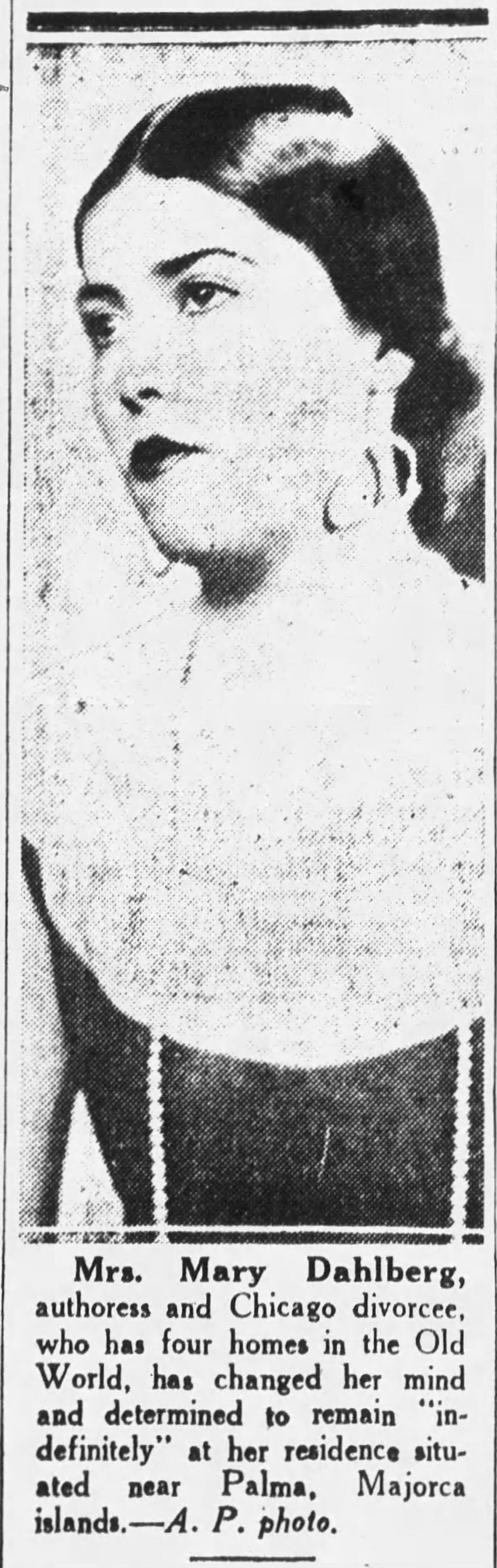
If Huntley Chapin hadn’t realised by that stage that marriage to Mary Alexander was going to be anything but smooth sailing, he was soon awakened to the realities. Even though Mary had left one millionaire for another, in May 1934 she charged “non-husband” Bror Dahlberg with contempt for court for being in arrears with alimony. He’d stopped payments once Mary married Chapin. Dahlberg, a very astute businessman if ever there was one, was determined not to cough up, telling Mary that since she’d married Chapin, she had no need for Dahlberg’s money. Mary countered that Chapin’s inherited millions were irrelevant, so Dahlberg “tossed a bombshell” into proceedings. That is, he told the court of Mary’s marriage to Marcus, which was still valid at the time Mary “married” Dahlberg. The hearings went into private chambers and instead of the $41,250 she had demanded, Mary emerged with a mere $2500. As Jess Stearn wrote about that lesser settlement in the New York Sunday News in January 1948, “You can draw what conclusions you like.” Stearn added of Mary, “Whatever else she was, she was interesting …”
Widely syndicated New York columnist Oscar
Odd McIntyre certainly found her so, with repeated references to Mary’s many
activities in the 1920s and 1930s. Walter Winchell also followed her movements
closely, but far less admiringly. In September 1932 Winchell said she was “of
Chicago divorce and jewel-theft renown”. Mary’s divorce proceedings against
Huntley Chapin dragged on until 1938, by which time Mary had settled down in
Albuquerque, New Mexico, while her husband remained in Mexico City with his Remington
typewriter. After a short illness, Mary died on July 26, aged 39. Her lengthy
obituary in the Chicago Daily Tribune gave no cause of death, surprising
for someone still so young and so nationally famous. In Taos three days after
Mary died, Huntley Chapin married for a third time, to “lush and lovely” Oregon-born
Hollywood model Eulalia Catherine Miller (née Gilmer, 1903-82). The happy couple
honeymooned in the Grand Canyon. This time, it seems, Chapin hadn’t got himself
into such a deep turbulence.

In his two-page January 4, 1948, New York Sunday News article about Bror Dalhberg’s equally eventful marital life, journalist and author Jesse Stearn devoted almost as much space to Dahlberg’s ex, Mary Alexander – about whom Dahlberg refused to speak – as he did to Dahlberg’s then wife, the former Broadway musical comedy star Gilda Kreegan (real name Rebecca Gilda Krieger, 1904-). As well as using his own undoubted skills, Stearn (1914-2002) - later an associate editor for Newsweek, admirer of psychic Edgar Cayce and early promoter of yoga - was able to call on the experience and digging of Wyoming-born “Headline Happy” writer Florabel Muir (1889-1970), a reporter and paper columnist known for covering both Hollywood celebrities and underworld gangsters from the 1920s through to the 60s. Muir had started with the New York Daily News as a police reporter in 1927 and became its Los Angeles correspondent. Florabel was one tough lady: In 1949, during a shooting attempt on the life of mobster Mickey Cohen at Sherry's restaurant on the Sunset Strip, Muir was hit in the backside by a stray slug.

Stearn gave a rundown of some of the “highlights” of Mary Alexander’s life in the 1920s and early 30s. She had labelled Chicago society as “washtub aristrocrats” – something which offended the socialites deeply (society leader Harriet Townley Brown sued for $200,000 for defamation). Mary managed to pull off a coup, and cause a great deal of envy in the process, by having Princess Marie de Bourbon of Spain, second cousin of King Alfonso XIII, visit her in 1926. Mary hired the American Historical Society to trace her and Bror Dahlberg’s roots. Even though it linked her to William the Conqueror and Robert Bruce, her husband refused to pay the society’s fee of $1700, and it was forced to take him to court to recover its costs.

Huntley Chapin had his own troubles, quite apart from those caused by Mary. His 1931 divorce from his first wife, Myrtice McLaughlin Chapin (1903-39), had been messy, and there was a 15-month-old son, Huntley Jr (1929-2020) involved. Myrtice got a $100,000 settlement and she and her second husband, Willard Frederick Cummings, raised the child. But when Myrtice died in August 1939, Huntley fought for custody. He succeeded in December 1940 and took the boy back to Los Angeles with him. In mid-June 1948 Chapin married yet again, to Salome “Sally” Taylor (née Jamison, 1911-99), giving Huntley Jr two step-sisters. Bror Dahlberg’s second wife, Gilda Krieger, also had a fondness for litigation and the resulting splash headlines. In 1929 she pursued a pretend Hindu potentate (or a rich Bengal manganese and radium mine owner) calling himself Cambridge-educated Sir Eric Edward Dutt (real name, apparently, Chand) for $150,000 for slander over her morals and breach of promise to marry, as well as $100,000 from wealthy widow Theresa Rosenfeld for alienating the affections of Gilda’s former husband Bertram Victor Lichtie.

Saturday, 16 April 2022
The Playwright Who Invented Himself, on a Remington Typewriter

Teddy Barclay isn’t Australia’s most famous playwright, far from it. That title would most likely go to David Williamson, who used an Olivetti Lettera 22 portable. But Teddy Barclay was possibly our most prolific playwright, certainly so in the now long-lost speciality of radio drama. And he was definitely the playwright who consistently pounded a typewriter with the most unforgiving zeal. Each day in the six months from March to September 1933, Barclay sat at his Remington 10 standard typewriter from 8am to 1am the next morning, and wrote an astonishing 14 radio revues.
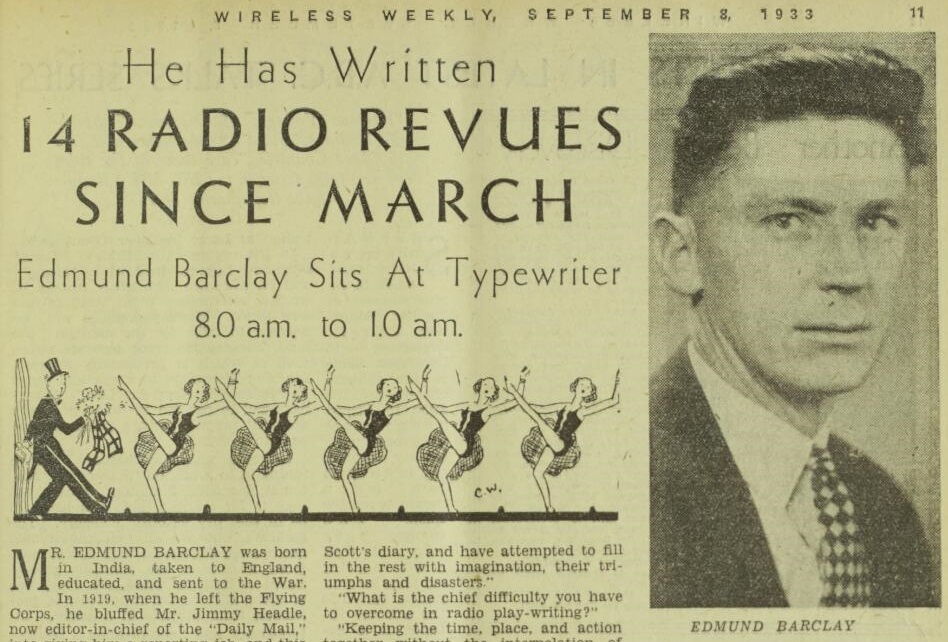
Or so Teddy said. The big problem with all this is that Teddy Barclay never existed. Unquestionably a highly inventive writer, Teddy’s most lasting invention was himself. In Leslie Rees’s 1982 book Hold Fast to Dreams: Fifty Years in Theatre, Radio, Television and Books, Rees described Barclay as “something of a minor genius”. His major genius was in creating a persona that Australians, to this day, believe to be true. Teddy Barclay was no mere writer's


Teddy Barclay is still, today, vaunted in print – most notably in no less than the Australian Dictionary of Biography - as an outstanding novellist and playwright. His ADB entry has been slavishly copied by Wikipedia. Trouble is, all of the details about his early life are quite obviously false - to start with, no one in real life has ever had the surname Compston-Buckleigh. Yet until now nobody has bothered to find out the truth about Teddy. And that seemingly unpalatable truth is he that he is Australian literature’s greatest liar.

Australian Who's Who, 1944
Radio historian Richard Lane, in The Golden Age of Australian Radio Drama 1923-1960, wrote that Edmund Piers Barclay was "Australian radio's first great writer and, many would say, Australian radio's greatest playwright ever”. According to the ADB, Wikipedia and all other sources, Barclay was born on May 2, 1898, at Dinapore, India, the son of Major Edmund Compston-Buckleigh, from Hendon, Middlesex, that he was educated at Stonyhurst College, joined the Middlesex Regiment at the outbreak of World War I and won the Military Cross and Croix de Guerre while serving with the Royal Flying Corps. Apart from the date of birth, none of these things are even vaguely correct.

Brighter London was actually a 1923 stage play, not a weekly newspaper.
The editor named was Jimmy Heddle, not Headle.
The ADB and Wikipedia say Barclay arrived in Australia in August 1926, “determined to show ‘he was the world's greatest novelist’”. It must have been a very long voyage, because, under his real name, Barclay actually left London on the Australian Commonwealth Line's MV Largs Bay for Australia on November 11, 1924. The fact is that he would have reached this country by January 1925 at the latest.

The unforunate wife of "Barclay" was London-born Helene Beatrice Barclay
(nee Date, 1903-), left, also a noted playwright and author.
The 1993 (Volume 13) ADB entry on Barclay was written by Marion Consandine, who had had no more luck finding out who Barclay really was than, apparently, such well-known historians as Ken Inglis and Clement Semmler, the State Library of NSW or AusLit. Some relied on an entry in the 1944 Australian Who’s Who, which devoted 17 lines to “Barclay (formerly Compston-Buckleigh), Edmund Piers, MC (with Bar)”. The first nine lines are just a succession of blatant lies.
It didn’t take all that much effort to find
the truth. All I needed to do was not copy what someone else (and especially Barclay)
had written.

Mechanics were not all he devised.
Barclay was actually Edmund Charles Buckley, not born in India but in Southport, Lancashire (at least the birth date he gave was correct). His dad was no more a “Major” than I am – he was in fact a Swinton-born bike and car engineer, Samuel Compston Buckley (1871-1929). Edmund Buckley didn’t serve in World War I, and wasn’t awarded any war medals. When he left England under his real name, in 1924, he declared his occupation was journalism. He might have added, “and monumental bulldust artist”.

Edmund Charles Buckley, who had become universally
known as Edmund Piers Barclay, died of a coronary occlusion on August 26, 1961,
at Gosford in New South Wales, aged 63. The truth about him was buried, along
with the body.
Wednesday, 13 April 2022
'The Duke' and the Remington Portable Typewriter

The Remington portable is on top of the filing cabinet as Jim Broadbent, playing Kempton Bunton in The Duke, is caught in the act of wrapping up the Goya by Helen Mirren, playing Bunton's wife Dorothy.

The model used in the movie


At the time of the robbery, Bunton was a 57-year-old
unemployed driver, of Yewcroft Avenue, Newcastle-upon-Tyne, in the
north-east of England. Constantly sacked from various jobs, Bunton had plenty of time on
his hands to sit at his typewriter in a spare bedroom writing scripts for television mini-series. The stories in folders were piled up in a wardrobe in the bedroom, alongside
the stolen painting. At the end of the movie, audiences are informed that none
of the many scripts typed and submitted by this ambitious aspiring playwright were
accepted for production by the British Broadcasting Corporation. Broadbent-Bunton is shown
receiving one rejection letter from the BBC, telling him it doesn’t find much
call for “grief” stories.

The real Kempton Bunton (1904-1976)
Between 1961-65, Kempton Bunton gave British
police plenty of grief. Finally the Bunton case reached the Old Bailey, the
Central Criminal Court in London, and was heard from November 4-9, 1965. This
was the subject of a 2016 book by American lawyer Alan Hirsch, The Duke of
Wellington, Kidnapped!: The Incredible True Story of the Art Heist That Shocked
a Nation. Hirsh wrote that the presiding judge Carl Aarvold was “once
oddly described by a journalist as ‘not only gracious in defeat but fluent in
French, a rare combination’.” Hirsch pointed out that Aarvold made the odd
judicial decision to instruct the jurors that they must acquit Bunton if they
believed that he always intended to return the painting. “[Aarvold] was
actually following the letter of Britain’s exceedingly odd larceny statute,”
Hirsch wrote. “Bunton’s defence team wisely latched on to the wording of the
law, which said you are guilty of theft only if you intend to ‘permanently
deprive’ the owner of his possession. The problem for the defence was that
while Bunton returned the painting, he did not return the frame [which the
Buntons had lost]. All of this tied the judge up in knots during his
instruction to the jury.” Even so, the jury managed to follow his instructions
- finding Bunton not guilty of stealing the painting, but guilty of stealing
the frame. Bunton served three months.
Bunton’s motive was to benefit “the good of mankind” and to pay off BBC TV licences for pensioners. His wife Dorothy (née Donnelly) considered her husband as, “above all a frustrated author who had written a novel and several plays without ever managing to get a line published”. However, 11 months after Bunton died, in April 1976, the Liverpool Daily Post put Bunton’s own typed words into print. The story was headlined, “How I Stole the Goya”.

Subscribe to:
Posts (Atom)