Total Pageviews

Monday, 23 January 2017

The True History of the British Oliver Typewriter Manufacturing Company (1927-1960)

An Italian-made Oliver portable sold by the BOTMC

Of all the British typewriter manufacturers,
the British Oliver Typewriter Manufacturing Company
of Croydon, London, has remained the
most mysterious. Until now...

Minnesota-born George Augustus Mower,
who seized upon the misfortunes of the
Oliver Typewriter Company in Woodstock, Illinois,
in June 1927 to buy the company and move it,
lock, stock and U-shaped typebar, to England.

After making 1.25 million machines, the end of the line for American-manufactured Oliver typewriters was announced simultaneously in Woodstock, Illinois, and London, England, on June 1, 1927. The Woodstock announcement said all the property of the Oliver Typewriter Company would be sold the next day, either at auction or by private sale. The Times of London, meanwhile, reported arrangements had already been made for the acquisition of the plant and the transfer of manufacturing to England. The buyer was American-born English businessman George Augustus Mower. The price, it later emerged, was £45,000. A week after the June 1 announcements, the last US-based president of Oliver, millionaire Edward Herndon Smith (1859-1943), celebrated having the company off his hands by marrying church worker Vera Lash Merrill (1894-) in Chicago. Meanwhile, the widow of Smith’s immediate predecessor, Ricord Gradwell (1869-1926), was left fighting over Gradwell’s $200,000 estate with Washington actress Elizabeth Irving.
John Whitworth, at the wheel, with an earlier Oliver president, Lawrence Williams.
Long-standing plant manager and company vice-president John Walter Whitworth (1853-1934) was left to clean up the mess at Woodstock (rather than, as has often been claimed, the young accountant Chester Irvin Nelson). Whitworth was born in St Petersburg, Russia, where his father, Walter Whitworth, a mechanical engineer and capitalist, introduced the manufacture of cotton cloth into Russia, building the first cotton mill there. John Whitworth was raised in Lancashire, England, arrived in the US aged 19 and became the capable manager at Woodstock in 1898. Whitworth announced the finalisation of the British deal in mid-October 1927.
Mower had bought 1500 special machines, tools, jigs and dies, which United Tools & Instruments Ltd later valued at £57,389 16 shillings alone, more than £12,000 above the price Mower had paid for the machinery, along with world manufacturing and marketing rights, goodwill, trademarks, patents and patent rights (800 drawings in all) and the freehold Woodstock factory (which it sold to Alemite Die Casting in 1928). Mower was only too well aware that the Oliver had 1400 moving parts, which had to be made exact to within 1000th of an inch. But Mower didn’t take everything. Liquidators advertised in Indianapolis, St Louis, Cincinnati and Detroit on July 24 for an auction of unwanted (by Mower) machines, tools, parts and assorted other bits and pieces, to be held in Woodstock three days later. Sterling brothers Dave and Harry Manfield took six trucks and seven assistants to pick up machinery and other equipment.
The British Oliver Typewriter Manufacturing Company was registered as a public company and incorporated on May 5, 1928. It had authorised capital of £130,000 from 260,000 fully paid 10 shilling shares. Within days of the incorporation, the value of shares rose to £14 3 shillings, and by the time of a statutory meeting on July 27, the value had settled at £12 9 shillings. Left with £85,000 after Mower had been paid back for his purchase of the Woodstock plant, the new company planned to expand its factory at the Victory Works, 80 Gloucester Road, Croydon, Surrey.
The BOTMC factory as it looks today
The BOTMC’s managing directors were American-born George Augustus Mower, of the Sturtevant Engineering Company, his countryman Major Walter Henry Ward, of Rockwood Co Ltd, and Englishmen Greville Richard Thursfield, of Igranic Electric, and Thursfield’s in-law Lieutenant-Colonel Adrian Francis Hugh Sibbald Simpson CMG, Royal Engineers, of Wireless Pictures. The registered office was further down Queen Victoria Street, at No 147, where Mower had headquartered some of his other companies. William Herbert Peak, of the Marconiphone Co, joined the board in 1930.
George Mower was born on January 31, 1860, in Stillwater, a city in Washington County, Minnesota, directly across the St. Croix River from the state of Wisconsin. He graduated from the Massachusetts Institute of Technology and travelled to England in 1883 as a representative of the Crosby Valve and B.F. Sturtevant companies, both of Boston. He remained to establish the Sturtevant Engineering Company in 1885 and later the Crosby Valve and Engineering Company. Mower acquired a controlling interest in the Bifurcated and Tubular Rivet Company and in 1898 was appointed agent for the Cutler Hammer Company of Milwaukee. He took control of Iris cars in 1909 and established the Igranic Electric Company in 1913. Mower retained the chairmanship of these companies until his death in Kensington, London, on November 26, 1941.
Mower’s typewriter company got off to a positive start. By the end of July 1928 3000 new machines were already "in an advanced state of manufacture" (Simpson). And in early February 1929 the BOTMC announced it had secured an agreement with the British Government to supply His Majesty’s (George V's) Stationery Office with British-made Olivers. The share price rose to £13 9 shillings. In October the first accounts showed a mere £1040 profit after a trading loss of £8697 from the development period to the end of June 1928 had been transferred to a development account. The BOTMC had also gained control of the United Tools and Instruments Co. The biggest problem encountered by the BOTMC was in finding and training staff in what Mower described as “practically a new industry in this country” – only one in four workers employed had been retained.
For this reason, the BOTMC’s initial venture into the portable typewriter market relied entirely on European-made machines, starting with relabelled German Fortunas in 1931 and moving on to Italian SIM and finally Swiss Patria models. The BOTMC abandoned the traditional standard Oliver design in 1933 (it returned to it during World War Two to meet Government orders when supplies from Europe were impossible to obtain) and started assembling relabelled Halda-Nordens from Sweden in 1935. The BOTMC returned to Haldas after the war, while also licensing European companies, such as Siemag in Germany, to make Oliver labelled machines.
Difficult trading conditions during The Depression lowered the BOTMC's annual profit to £365 in 1934-35 but it rose to £3396 and £3557 in the following financial two years. By 1937 a maiden dividend of 5 per cent was possible. The BOTMC held its ground in 1938 and its profit rapidly lifted in 1939, to £8053, allowing it to double its dividend.
Teddy Goddard, BOTMC's second chairman
Following the death of Mower, Edwin Alfred “Teddy” Goddard (1878–1954) took over as chairman of the BOTMC board. By this time the outbreak of World War II had also impacted significantly on Oliver’s trade and a lack of skilled labour was a telling factor. Goddard stressed the important role typewriters played in the war effort, yet said the Manpower Board did not recognise the need to keep the typewriter industry fully manned.
Just before Christmas 1942, Goddard signalled that the BOTMC was “tooled up” to make its own portable typewriter, but he did not expect the portable to go into production until after the war. Perhaps he was being a little too optimistic about when the war would end. Some £20,000 had been put aside to upgrade machine tools. In the event, however, £15,000 had to be borrowed for new plant and machinery by the end of the war, and in September 1948 the BOTMC sought to raise £39,000 and restore its capital to £130,000 by creating 780,000 ordinary 2 shilling shares. After a large order was placed for standard Olivers for US Air Force bases in Britain and Continental Europe in 1951, this share issue did not go ahead until October 1952, and by the time Goddard died in December 1954 the company was in dire straits. Rex Percy Cooper succeeded Goddard as chairman in February 1955 and three months later Goddard’s son John Howard Goddard (1919-1968) joined the board.  
In June 1956 the BOTMC decided diversification was the way to go and issued 1.7 million 2 shilling shares to acquire two allied engineering businesses as well as catering equipment manufacturer Gardiner and Gulland as a subsidiary. The ploy failed, and a profit of £6620 in 1955-56 turned into a massive £29,858 loss in 1956-57, providing for £38,177 in “obsolescence in stocks”. In December 1957 further expansion, and a name change (to Oliver Industries Ltd in April 1958), were seen as the way out of trouble. The rights to the Jardines’ Byron typewriter had been acquired, but Oliver was seeing itself as a more general industrial holding company, with interests in industrial banking, equipment hiring and TV rentals. For a short while the changes worked, and Oliver’s acquisitions resulted in a profit recovery to £28,109 by the end of 1958. In July 1959 Oliver ceased production of typewriters and before the end of the 1959-60 financial year it had suffered a net loss of £85,646. The receivers were called in. Thus ended 64 years of Oliver history.
The Woodstock plant in its heyday
A range of factors had contributed to the demise of the original Oliver Typewriter Company. Troubled times appeared on the horizon in March 1917 when, addressing the impact of World War I, the OTC drastically and suddenly lowered the price of its latest model from $100 to $49, stopped hiring salesmen, closed its branch offices and discontinued its agencies to rely entirely on mail order sales – declaring this to be a “revolution in the typewriter business”. 
The mail order "revolution"
Things were hardly improved by the death in August 1922, at the age of 60, of the company’s major investor, Cincinnati-born Delavan Smith. The OTC decided against switching to a conventional standard design. In February 1924 the general offices in Chicago were closed and staff moved to Woodstock. The McHenry County tax rate was hiked from 50 to 65 per cent when it was found Illinois was unable to meet an obligation to pay $4.125 million in soldier bonds, because county treasurers hadn’t handed over back taxes. Oliver had to cough up $7766 as its contribution. This followed the lose to fire of a staff accommodation house on Clay Street, Woodstock, and the sale of its car parts foundry to the Motor Valve Co of Chicago. The end was clearly in sight when in March 1925 Oliver entered into talks with Corona about a possible sale of the Woodstock concern to Groton, New York. Although in 1926 Oliver officials continued to put on a brave face concerning the size of the company’s staff and its ongoing production and sales, the downward spiral in its fortunes had obviously become irreversible. Borrowing and efforts to trade out of existing debt were out of the question and liquidation the only possible course of action.
The original OTC was incorporated in Springfield, Illinois, on December 28, 1895, with Lawrence Williams, later the long-standing company president, one of the incorporators, along with Douglas Smith and attorney Samuel Adams Lynde (1855-1940). Three weeks earlier it had been announced that a deal had been struck to move manufacturing from Epworth, Iowa, to Kenosha, Wisconsin. But on January 9, 1896, it was revealed by the Woodstock Public Improvement Association that “Woodstock got it”. The association donated its existing factory on condition that Oliver stayed in Woodstock for at least five years. The company took possession of the former Wheeler and Tappan pumping machine plant on January 14 and after a refit, operations started two months later. Orders were being taken by E.S. Sprague mid-May and machines were shipped by August. The major backers were Chicago capitalists John Villiers “Dutch” Farwell (1825-1908) and newspaper publisher Herman Henry Kohlsaat (1853-1924).
"Dutch" Farwell
One of the partners in a Farwell family legal firm, Chicagoan Charles Chase Whitacre, established the first British branch of the Oliver Typewriter Company, at 75 Queen Victoria Street, London’s “Typewriter Row”, in 1897. Whitacre died suddenly, aged 46, while holidaying with his family in Pointe-au-Pic, Canada, in September 1905. The building at 75 Queen Victoria Street housed a large range of agencies for American companies, many under the control of a John Sugden. Next door were the headquarters of the Richardson typewriter empire. The Oliver agency remained at No 75 after Whitacre’s death, and was also the base for the agencies for Hammond, National and Royal typewriters.
The Oliver Typewriter (Sales) Co Ltd remained in existence at 75 Queen Victoria Street after the establishment of the British Oliver Typewriter Manufacturing Company, with exclusive selling rights throughout Britain and Ireland. Upon establishment of the BOTMC, the Sales organisation placed an immediate order for 20,000 machines, with a profit of £2 a machine going to the BOTMC. Ironically, some of these machines were to be sold back in the good ol’ US of A!

Thursday, 19 January 2017

The Barbie Cipher Typewriter

My grand-daughter Ely and I found some respite from the crippling heat wave yesterday by going to the Australian War Memorial. I was delighted to see another typewriter had been added to the exhibitions - the Hermes Baby bought by Brigadier Alfred Thomas Jakins "Ding" Bell (1913-2010) in Palestine in 1940 and used by him on Crete during World War II. 
Of course, I immediately thought of Georg Sommeregger and his passion for Hermes Babys, as I enviously envisaged Georg feeling no need for an escape such as ours, given the much cooler climate of Switzerland. Little did I know it at the time, but the machine in front of Ding Bell's Baby would lead me back to Georg's typewriters.ch site for an entirely different reason.
While I tried, in vain, to get a decent photo of Ding Bell's Baby, I paid little attention to the Enigma Ultra machine in the foreground. Much later in the day, long after the sun had gone down - and taken with it much of the discomfort we'd had to endure - a truly weird connection emerged. It dawned on me that Ely, at the tender age of just 16 months, owned both typewriters AND a cipher machine
This became apparent from a Google alert to an article by Sophie Chou and published yesterday on Public Radio International's The World site, headed, "Barbie typewriter toys had a secret ability to encrypt messages". Chou wrote, "In 1998, Slovenian toy company Mehano designed a line of children’s electronic typewriter toys with the ability to write secret messages. Eventually, the company licensed the typewriter to another company that had something altogether different in mind for the toys. Slathered in pink, it was soon headed to market to appeal 'to girls' ... [from Mattel as a Barbie typewriter] ... But there’s a catch - the secret messaging feature was completely pinkwashed - never revealed as a capability of the new Barbie typewriter."
"The four encryption modes - each featuring a simple alphabet substitution cipher (or 1-to-1 encoding) - were left out of Mattel's instruction manuals and advertisements."
My earlier non-electronic model and its patent, below.
What was revealed, on this very blog more than four years ago, is that the story goes much deeper than Mehano and the Barbie typewriter. What became the Barbie was first produced in 1988 by Mehano Društvo s Ograničenom Odgovornošću, Izola, and designed by Marko Piasni, Giudo Pezzolato, Andrej Pisani, Joze Brezec, Franc Branko Cerkrenik and Andrej Mahnic. Later a close business relationship between Mehano and the Elite Industrial Group in Shenzhen, China, developed. This resulted in, among other things, Elite producing an “adult” form of the Barbie as the Olympia Traveller C (later seen as the Royal Scrittore II).
When I posted on this link between the Barbie and China, it was none other than Georg Sommeregger who commented about his own pages on the Barbie, which can be seen here and here. Some of Georg's images have been used in a detailed look at the cipher capacity of the Mehano toy typewriters, written by Paul Reuvers and Marc Simons of the Crypto Museum in The Netherlands and titled "Mehano Typewriter: Toy typewriter with built-in encryption". See in particular "Barbie Typewriter: Alphabet substitution cipher".
In June last year, Reuvers and Simons wrote, "It is little known that all electronic variants have a hidden built-in cryptographic capability that allows secret writing ... Whilst the earlier models were all made at the Mehano factory in Slovenia, the latest one [E-118] is assembled in China.
Georg Sommeregger's image of the E-115
"The original version [E-115] ... was capable of encoding and decoding secret messages, using one of four built-in cipher modes. These modes were activated by entering a special key sequence on the keyboard, and was explained only in the original documentation. When the E-115 was adopted by Mattel as an addition to the Barbie product line, it was aimed mainly at girls with a minimum age of five years. For this reason the product was given a pink-and-purple case and the Barbie logo and images were printed on the body. As it was probably thought that secret writing would not appeal to girls, the coding-decoding facilities were omitted from the manual. Nevertheless, these facilities can still be accessed if you know how to activate them." (Encryption is not available on the earlier mechanical typewriters.)

Tuesday, 17 January 2017

The Typewriter as a Double Entendre: Smitten by Tubby's New Yöst


Tubby's Typewriter is a short silent film from 1916 directed by Frank Wilson, the second in the series of comic The Adventures of Tubby produced by Cecil M. Hepworth. Sadly the original print was burned by Hepworth in 1924, and the final scene is missing here. But one can easily imagine what happens when Mrs Tubby turns up at The Ship restaurant.
Australian actress Violet Hopson plays Tubby's jealous wife
Johnny Butt plays Tubby, smitten by a New Yöst typewriterHis young wife is played by Violet Hopson (1887-1973), born in Port Augusta, South Australia as Elma Kate Victoria "Kitty" Karkeek. A major star of the silent era, Violet started out as a child actress with the Pollard Opera Company in Australia and New Zealand in 1898 before going to Britain with her older sister, Ora Zoe Harris Karkeek, in 1900. Violet later became a pioneer in the British film industry when she set up her own production company.
Washington Post, 1920
My New Yöst

Thursday, 12 January 2017

Backspacing to 2016

With this blog passing two and three-quarter million page views tonight, six weeks shy of its sixth anniversary, I thought it opportune to backspace over 2016. My “output” last year was a mere 145 posts (630,000 page views), down by 100 from the previous year, which in turn was half what it was in 2014. So I guess it’s fair to say ozTypewriter is gradually winding back, and my gorgeously cool granddaughter Ely might have something to do with that.
Still, there was plenty to write about in 2016, as there will be in 2017.
I didn’t bother posting on Bob Dylan when he received the Nobel Prize in Literature in October (I was too busy organising a grand garage sale at the time). Not surprisingly, all the Dylan books went from my library at that sale, and there was a sudden surge in interest in my blog posts on Dylan’s typewriters. One, titled “How Many Typewriters Will it Take Till He Knows?” reached a staggering 8593 page views, making it by far the most popular among my 2258 posts, almost 2000 ahead of “Reattaching the Drawband to the Mainspring on a Portable Typewriter: The Layman's Rudimentary Way”. Sometimes the level of renewed interest in a particular post is unfathomable, such as in the past few days with “Køhl's Kryptograf Writing Ball”.
Another singer-songwriter who, in my book at least, would have been a contender for the prize earned by Dylan was Leonard Cohen, who died in November. Cohen’s passing also drew a lot of page views to various posts about his typewriter use, most notably “So Long, Marianne”, posted after Marianne Ihlen died in Norway in July. David Bowie, who died in Manhattan exactly 12 months ago, aroused some typewriter interest because his Olivetti Valentine portable sold at auction for more than $75,000 late in the year. Similar interest may now attend my October post on Clare Hollingworth, the British journalist who scooped the world with news of the outbreak of World War II - she died aged 105 in Hong Kong yesterday.
Internationally, in strictly typewriter terms, the high points of 2016 were the presenting of a QWERTY Award to Herman Price in West Virginia in October and the publication of a new book from Peter Weil and Paul Robert, Typewriter: A Celebration of the Ultimate Writing Machine, in November. Newark’s Peter Weil is himself a previous winner of the QWERTY Award (in 2013), following on from Richard Polt from Cincinnati the preceding year and being followed by Mike Brown of Philadelphia and myself in 2014 and Gab Burbano from Little Falls, New Jersey, in 2015.
It was great to see in the Texas Monthly in July that Larry McMurtry, who turned 80 the previous month, is still using his (topless) Hermes 3000s - in fact, since praising the Hermes 3000 when winning a Golden Globe in 2006, McMurtry has increased the number of this model he keeps around the country from seven to more than two dozen. Nonetheless, he's still be to be photographed using one. “Well, my fingers aren’t as nimble as they once were,” McMurtry told the Monthlyso I have trouble changing my typewriter ribbon. And there are days my vision gets so blurry that I can’t always see what I’ve typed. There are other days when my energy lags.” In this heat wave, I know exactly how he feels!
Along the way in 2016, ozTypewriter corrected some serious misconceptions about Ernest Hemingway’s supposed Corona 3 in Cuba and Alger Hiss’s Woodstock, located Lewis Carroll’s Hammond and revealed much about the Australian lass subjected to Raymond Chandler's lurid typed love letters. It also presented a detailed history of 20th Century typewriter collecting. The movie typewriting performance of the year came from Bryan Cranston as Dalton Trumbo, followed at the length of a country mile by Alex Jennings as Alan Bennett. I also liked seeing the post-war Soviet-era typewriters being used in Klaus Härö’s excellent Estonian sleeper The Fencer.
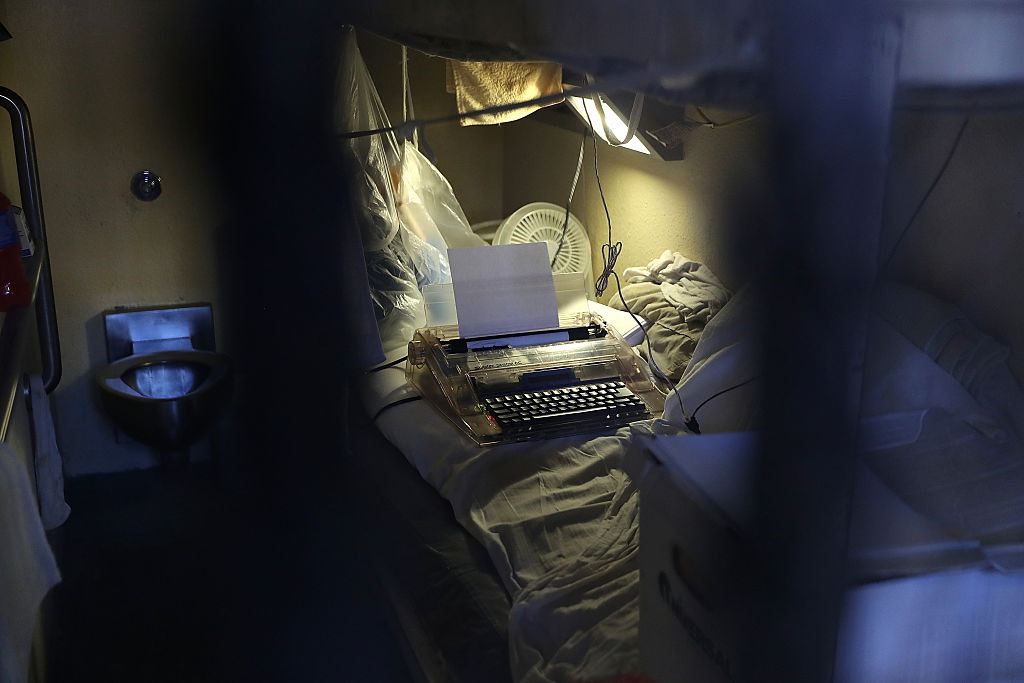
This image, taken of a see-through typewriter in a cell at San Quentin in August, left me with mixed feelings. The machine sits on the bed of a condemned inmate on death row. It's made the way it is so that nothing can be concealed inside it.
Little was concealed during the Rio de Janiero Olympic Games, which kept me glued to the TV set for a few weeks mid-year. During this time ozTypewriter page views skyrocketed (for reasons unrelated to typewriters). I managed to extract the heat from that situation, my first real taste of the Internet's incredible capacity to distort the truth. The consolation was watching Fiji humbly win its first Games gold medal, succeeding the United States as Olympic rugby union champion. And that led me to the rediscovery of a childhood hero, Joe Levula, and one of the best sports photos I've ever seen, taken in Brisbane in 1952.
Meanwhile, a former colleague, writing from the sailing in Rio, asked me to compare the equipment I had needed to cover the Olympics in bygone years with the mind-boggling tangle of bits and pieces that went with his laptop in 2016 (see images above).

There were seven typewriter presentations in
Canberra, each giving me yet another chance to dust off a few prized machines and talk about them. On his trip to England, Richard Polt had far greater success finding interesting typewriters in museums, and I was deeply envious. Frankly, our own National Museum is an utter embarrassment, and the best I could see there were Mary Gilmore's L.C. Smith, now associated with a new $10 banknote, and an IBM paper tape reader.  
David Lawrence was able to locate much more interesting machines on Trade Me in New Zealand, and one image he alerted me to was right up Georg Sommeregger's alley - a "Down Under" Empire Aristocrat. Yep, that's the way it was presented in its listing. It seems Flying Fish typewriters are also in favour in New Zealand.
 
For me, however, the typewriter highlight of 2016 was definitely the advent of weekly gatherings in Sydney involving Richard Amery, Phil Card, Warren Ingrey, Terry Cooksley and Phil Chapman of Charlie Foxtrot. These culminated in a Big Typewriter Bash last month, also attended by typewriter technicians Michael Klein from Melbourne and Jim Franklin from Canberra. The Chapmans depart Australia next week to set up a British branch of Charlie Foxtrot, but the Sydney gatherings are bound to roll on unabated in 2017.
The Big Bash was held back until Richard Amery returned home from a typewriting cruise to New Zealand aboard the Emerald Princess. The ocean liner was back in the news last week when a Sydney woman’s six years on dialysis, waiting for a kidney transplant, ended with her being winched off the ship into a helicopter in Bass Strait. She was choppered to Bairnsdale, Victoria, flown by fixed wing plane to Sydney's Bankstown Airport and driven by ambulance to Westmead Hospital. This remarkable story made me wonder if the same effort would have been made if Richard had run short of ribbons for his Olivetti Lettera 22.
My own kidney yarn didn't concern an emerald but an alleged sapphire. It involved strenuous work from Phil Card, Warren Ingrey and Terry Cooksley in helping me find the escapement wheel “jewel” in Smith-Corona Galaxies IIs. This was all for the sake of an article in ETCetera, and meant completely stripping down two portables. The truth was duly exposed, but the SCMs got their revenge when I later fell on them and broke three ribs. The pain was so intense for a long while that I actually feared I’d pierced a kidney, and would need my own transplant. It took two months for the ribs to fully repair themselves, but by Christmas we were all having a hearty laugh about it.
Miss Dactylo 1960: Simone Simion, Paris
I wasn't chuckling so much when AdSense, the outfit that pays me a princely 76 cents a day for placing adverts on my blog, wrote saying it had received a complaint about a June 2015 post showing nude women sitting on typewriters (it was actually about the use of Paul Robert's Sexy Legs erotica images in an ABC TV series called Miss Fisher's Murder Mysteries). AdSense showed no sense in wanting the post removed, and in this case I flatly refused. Then a helpful reader sent me an image to add to my post on a collection of British cheesecake photos ("Titillation with Typewriters", Boxing Day 2015). So to cheese AdSense off properly, I'm adding it here:
The typewriter-related story which amused me most in 2016 concerned a luminary among the twittering classes, one Marcin Wichary, who in October tweeted furiously on a “serendipitous and magical event”. While looking for a Dali museum, he’d stumbled upon industrialist Pere Padrosa’s well-known El Museu de la Tècnica de l'Empordà in Vigo, in the north-west of Spain. I take up Wichary’s tweets as he walked towards it: I see this sign pointing the other way, saying ‘Museu de la Tècnica’, with a cute gear icon. I don’t have internet because of another earlier snafu (bad SIM card), but I had the foresight to save offline Google Maps. But Google Maps returns nothing for the museum, so I don’t know where it is exactly. I follow the sign’s directions the old-fashioned way.”  I don’t know about anyone else, but for me the idea that Wichary had to resort to “the old-fashioned way” to find a typewriter museum was just dripping in irony.
And so on to 2017 ...

Sunday, 8 January 2017

GULLIVER’S TYPEWRITER

In his 2017 paper “The Life, Death and Rebirth of Typewriters”, Richard Polt says the 1714 patent of English engineer Henry Mill reads as if it is describing a typewriter, but “We do not know what Mill’s invention looked like or what, exactly, it did.” From that same early 18th Century period, although presumably on a somewhat larger scale, is a contraption that is now also being labelled a “typewriter”. This is the “Lagado machine” for writing books in politics, poetry, philosophy, law, mathematics and theology. It is outlined by Anglo-Irish satirist Jonathan Swift (1667-1745) in Gulliver’s Travels (1726). And thanks to the marvellous inventive ingenuity of French caricaturist Jean-Jacques Grandville (real name Jean Ignace Isidore Gérard, 1803-47) for the 1838 French translation of Gulliver’sTravels, we know what it looked like. Or, to be more precise, what Grandville was able to construe from Swift’s creative and detailed writings.
J.J.Grandville
Dean Swift
        With regard to the “Lagago typewriter”, Swift is believed to have been heavily satirising the Royal Society as well as caricaturing the far-sighted work of Leibniz and Llull. Gottfried Wilhelm von Leibniz (1646-1716), a German polymath and philosopher, was one of the most prolific inventors in the field of mechanical calculators. While working on adding automatic multiplication and division to Pascal's calculator, he was the first to describe a pinwheel calculator, in 1685, and invented the Leibniz wheel, used in the arithmometer, the first mass-produced mechanical calculator. He also refined the binary number system, which is the foundation of virtually all digital computers. Leibniz was influenced by Ramon Llull (1232-c1315), a philosopher, logician, Franciscan tertiary and Majorcan writer considered a pioneer of computation theory.
Gulliver's Travels comprises four books – each recounting voyages by Lemuel Gulliver to fictional exotic lands. Part III is titled “A Voyage to Laputa, Balnibarbi, Luggnagg, Glubbdubdrib and Japan” from 1706-10. In chapter five, Gulliver describes a visit to “the Grand Academy of Lagado in Balnibarbi” and records seeing great resources and manpower employed on researching completely preposterous schemes. Among these is a “permutational [the process of altering the order of a given set of objects in a group] machine” for improving “speculative knowledge”. The device consists of a frame holding blocks. Swift wrote:
14    WE crossed a Walk to the other part of the Academy, where, as I have already said, the Projector in speculative Learning resided.
15    THE first Professor I saw was in a very large Room, with forty Pupils about him. After Salutation, observing me to look earnestly upon a Frame, which took up the greatest part of both the Length and Breadth of the Room, he said perhaps I might wonder to see him employed in a Project for improving speculative Knowledge by practical and mechanical Operations. But the World would soon be sensible of its Usefulness, and he flattered himself that a more noble exalted Thought never sprung in any other Man's Head. Every one knew how laborious the usual Method is of attaining to Arts and Sciences; whereas by his Contrivance, the most ignorant Person at a reasonable Charge, and with a little bodily Labour, may write both in Philosophy, Poetry, Politicks, Law, Mathematicks and Theology, without the least Assistance from Genius or Study. He then led me to the Frame, about the sides whereof all his Pupils stood in Ranks. It was twenty Foot Square, placed in the middle of the Room. The Superficies was composed of several bits of Wood, about the bigness of a Dye, but some larger than others. They were all linked together by slender Wires. These bits of Wood were covered on every Square with Paper pasted on them, and on these Papers were written all the Words of their Language in their several Moods, Tenses, and Declensions, but without any Order. The Professor then desired me to observe, for he was going to set his Engine at Work. The Pupils at his Command took each of them hold of an Iron Handle, whereof there were fourty fixed round the Edges of the Frame, and giving them a sudden turn, the whole Disposition of the Words was entirely changed. He then commanded six and thirty of the Lads to read the several Lines softly as they appeared upon the Frame; and where they found three or four Words together that might make part of a Sentence, they dictated to the four remaining Boys who were Scribes. This Work was repeated three or four times, and at every turn the Engine was so contrived, that the Words shifted into new places, or the square bits of Wood moved upside down.
16    SIX Hours a-day the young Students were employed in this Labour, and the Professor shewed me several Volumes in large Folio already collected, of broken Sentences, which he intended to piece together, and out of those rich Materials to give the World a compleat Body of all Arts and Sciences; which however might be still improved, and much expedited, if the Publick would raise a Fund for making and employing five hundred such Frames in Lagado, and oblige the Managers to contribute in common their several Collections.
17    HE assured me, that this Invention had employed all his Thoughts from his Youth, that he had employed the whole Vocabulary into his Frame, and made the strictest Computation of the general Proportion there is in the Book between the Numbers of Particles, Nouns, and Verbs, and other Parts of Speech.
18    I made my humblest Acknowledgement to this illustrious Person for his great Communicativeness, and promised if ever I had the good Fortune to return to my Native Country, that I would do him Justice, as the sole Inventer of this wonderful Machine; the Form and Contrivance of which I desired leave to delineate upon Paper as in the Figure here annexed. I told him, although it were the Custom of our Learned in Europe to steal Inventions from each other, who had thereby at least this advantage, that it became a Controversy which was the right Owner, yet I would take such Caution, that he should have the Honour entire without a Rival.