Total Pageviews

Tuesday, 3 September 2019

Canberra Typewriter Fest Under a Bubble

VERY excited about a typewriter event coming up in Canberra on September 22. It's under an actual (BIG) Bubble at Haig Park. I will be exhibiting some historically significant typewriters, including a Remington 2, a Blickensderfer 5, author Miles Franklin's Corona 3, a downstroke Oliver and a Salem Hall index typewriter. There will also be typed letterwriting and a Type-In. Sounds like a lot of fun. Here's what the Bubble will look like:

Tuesday, 27 August 2019

The Great Typewriter Explosion of 1919


It’s 100 years since the great typewriter explosion cleared almost everybody out of Everybody’s Theatre on Cathedral Square in Christchurch, New Zealand.
Everybody’s Theatre was screening Everywoman at the time, and every woman, man and child in the audience headed for the front exit. The rear exit was on fire, all the windows were shattered and the back wall dividing the theatre from a typewriter workshop at the adjoining 5 Chancery Lane had bulged out to the point of collapse.
Quite apart from smoke and burning debris, there was still a smell of Chloro-Menthene in the theatre air, sprayed as a precaution against the Spanish influenza epidemic.
Only the orchestra stayed in their seats, continuing to provide musical accompaniment as the silent allegorical film rolled on. The musicians were just a few yards from where the explosion had occurred.

The typewriter workshop, which was operated by a man called W.J. Bull, was in ruins, with walls blown out and the ceiling falling in.
What had caused the massive explosion was 17-year-old Charles Edward McGlashan cleaning a Rex typewriter with benzine. At 2.45 on the afternoon of August 23, 1919, the volatile, highly flammable petroleum distillate Charlie was using as a solvent ignited. 
Poor Charlie was thrown backwards, cut to shreds and badly burnt about the face. He was quickly carted off to hospital.
Charlie McGlashan, born in Dunedin on Christmas Day in 1901, gave up typewriter work, moved to Kaikoura and became a motor mechanic. He lived to an old age and died in 1975. It probably became more difficult for him to explain the “Doris” tattooed in a heart on his left forearm to his wife Caroline than the scalded typewriter scars on his face.

 Illustration by Peter Sheaf Hersey Newell (1862-1924), American artist and writer.

Monday, 19 August 2019

Work in Progress: Guess the Typewriter Model

Working on a personalised typewriter for a third grand-daughter - the first two have been an enormous success (well, the grand-daughters just love them to bits!). This one has been primed before being painted predominantly pink, with sparkles and possibly rainbows and unicorns.
You can tell from this photo which colours she prefers:

I picked this one up cheap in Chiltern in Victoria last week - working nicely, but fairly battered. Can anyone guess what model it is? Some of these models were made in Pakistan, but this one comes from the original country of manufacture, also starting with the letter "P". Come on, it's as easy as "A ..."
This is the previous effort, which went to an eager young author in London, England, and has been greatly appreciated:

Monday, 5 August 2019

Alphonse Mucha and the Bar-Lock Typewriter Posters


Flicking through the pages of The New Yorker edition of July 8 & 15, I came across an image which, at first, I thought was of a poster for the Bar-Lock typewriter. Instead, it was a Sarah Bernhardt poster, created in 1894 by Alphonse Mucha, the most celebrated graphic designer of the Art Nouveau movement. The Bernhardt-La Plume image appeared with The New Yorker’s A Critic at Large column, written by Hua Hsu and titled “Beauty in the Streets: How Posters Became Art”. It related to an exhibition, “Alphonse Mucha: Art Nouveau/Nouvelle Femme” which opened at the Poster House - the first museum in the United States dedicated exclusively to posters - at 119 West 23rd Street, New York City, on June 20 (and continues until October 5).
At a quick glance, it’s easy to see the likenesses between the Bernhardt poster and the early British Bar-Lock poster “Fate the Key to Fortune”. With the Bernhardt artwork, Mucha introduced the innovative feature of an ornate rainbow-shaped arch behind the actress’s head, almost like a halo, which focused attention on her face. This becomes a bright yellow light surrounded by flowers around the head of the woman in the Bar-Lock poster. While Mucha continued to use this style in later posters, so too did Bar-Lock, most notably in its “Supremacy - Truth” and “Visible Writing” posters, as well as in its “Father Time” poster.
As with Mucha's work, the people in Bar-Lock posters aren’t always shown using the product they’re advertising, but they often look enraptured. The curvaceous women have long, wavy hair, and look bold and independent.
Still, while Mucha went on from Bernhardt and art to create purely commercial posters, including for bicycles, it’s highly unlikely that any of the Bar-Lock typewriter posters are his – we almost certainly would know about it if they were. No typewriter posters appear in his extensive catalogue of 119 works. But given the timeframe is right, it seems highly probable Mucha’s work directly inspired and influenced the Bar-Lock artists. After all, in 1901 Mucha had published Documents Decoratifs, a guide for aspiring artists and designers to replicate le style Mucha. It became an Art Nouveau bible, widely used in art schools and factories.
As far as I know, the creators of the Bar-Lock poster artwork have never been positively identified. The earlier posters, for the US (Columbia) Bar-Locks (left), were produced by Wagstaff & Co of New York. Since the Richardsons in London did not take full control of the Bar-Lock name until November 1913, it’s possible advertising artwork was shared across the Atlantic, with machines sold in Britain from 1895 labelled “Royal Bar-Lock”.
After striking a deal with Charles Spiro in New York, the Richardsons first sold Spiro’s typewriter in Britain in 1888, simply as the “Bar-Lock”. The Richardsons did not add “Royal” to the brand name until after they acquired Queen Victoria’s patronage. This allows us some idea of the timing for the appearance of the various posters.
Alphonse Maria Mucha was born in Ivančice in Moravia (not Bohemia), then a province of the Austro-Hungarian Empire, in 1860. He went to Paris in 1887, but it was not until the end of 1894 that his career took a dramatic and unexpected turn. On December 26, Bernhardt made a telephone call to Maurice de Brunhoff, manager of the publishing firm Lemercier, which printed her theatrical posters, ordering a new poster for the continuation of the play Gismonda. She wanted it ready by January 1, 1895. Because of the holidays, none of the regular Lemercier artists were available. When Bernhardt called, Mucha happened to be at the publishing house correcting proofs. Brunhoff asked Mucha to quickly design the new poster for Bernhardt. The poster was more than life-size at more than two metres high, with Bernhardt in the costume of a Byzantine noblewoman, dressed in an orchid headdress and floral stole, and holding a palm branch in the Easter procession near the end of the play.
Mucha’s new-found fame coincided with with a poster craze that swept through Europe and the US in the mid to late 1890s. Magazines, galleries and clubs quickly emerged to respond to this appetite. At parties, women dressed up as their favourite posters and others guessed which ones they were. Posters even influenced the colours used in turn-of-the-century clothing.
The Bar-Lock posters lack the fine, detailed draftsmanship in the backdrops in Mucha’s work, such the Byzantine mosaic tiles in the Bernhardt-La Plume poster.  But some match Mucha’s delicate pastel colours, and the words are distinctly stylised and ornamented. Mucha’s Bernhardt poster appeared on the streets of Paris on January 1, 1895, and caused an immediate sensation. This was, remember, the same year the Royal Bar-Lock took its new name.
Bar-Lock posters remain among the most outstanding examples of typewriter-related artwork ever created. The likelihood that they were inspired by Mucha's early work makes them, I believe, all that more interesting and desirable.

Saturday, 3 August 2019

Typewriter Wizard Albert Tangora: Boy Wonder to World Beater


Marking the Centenary of Tangora’s 
World Amateur Title Win
Tangora at 14, 1917
Tangora at 22, 1925
Take your pick - 147 words a minute for an hour under one set of rules, 142 under another. Either way, Albert Tangora most probably remains to this day the world's fastest ever operator of a manual typewriter. Tangora was just 13 years and two months old when, in September 1916, he left Paterson Central High School and started taking typewriting lessons at the (still extant) Spencer's New Jersey Business School, then run by Bushrod Hamilton Spencer (1864-1948) at 160 Market Street, Paterson.
Paterson college president B.H. Spencer.
Within seven months Tangora was the Eastern States novice speed typing champion, after winning the title with an average of 91 words a minute over 15 minutes at the New England Business Show at the Boston Mechanics Building on April 9, 1917. He actually typed at more than 100 words a minute, but made 30 errors. Six months later, on October 15, at the international championships at the 69th Regiment Armory on Lexington Avenue, Manhattan, Tangora added the world novice title with an average of 110 words a minute, an improvement of 19 words on his effort in Boston. He typed at 119 words a minute, but made 27 errors. Newspapers described his progress, 13 months after taking up typing, as “astounding”.
Tangora suffered a lapse in 1918, when he graduated to the amateur division and finished a distant ninth in the world championship, with 117 words a minute. Even putting aside his 34 errors, he was still well behind Rose Bloom, who won with 142 words a minute over 30 minutes. But Tangora made amends the following year, 1919, winning the world amateur championship with an amazing 133 words a minute, which, even taking into account his 26 errors, meant he had typed faster than the winner of that year’s professional title, Bill Oswald (who upset Margaret Owen’s plan of delaying her wedding so she could regain the world title).
Tangora had to wait until 1923, however, to topple the great George Hossfeld as world professional champion. He won that title with what remained the highest championship one-hour score until the advent of electric IBM machines in 1941 – averaging a staggering 147 words a minute. The scoring system was adjusted in 1924 but Tangora continued to dominate, holding the title for two more years and regaining it in 1928. Naturally, he insured his hands for $100,000 ($1.464 million in today’s money).
The 1.5 million dollar hands
Tangora switched from Underwood to Royal in 1935 and won three more world championships. Tangora produced an effort of 142 words a minute to finish second behind Margaret Hamm’s IBM in 1941, and that effort remains the highest score with a manual typewriter under championship conditions, with the revised scoring system.
Nonetheless, when Tangora died of a heart attack in Evanston, Illinois, on April 7, 1978, aged 74, newspapers reported that “His record at 147 words per minute for one full hour, established in 1923, is still in the Guinness Book of World Records.” The Chicago Tribune added it was “believed to be still unbroken”. After serving in the US Navy as a lieutenant in World War II, Tangora had been running his own typewriter business in Evanston for some years before he died.


Jean Porter and Sally Biddleman, both 17, time Albert Tangora at 140 words per minute at the world championships at the Jones Commercial High School in Chicago in 1936. 

Sunday, 21 July 2019

The 50th Anniversary of the Moon Landing and two Royal Express Typewriters


The restored Empress
This 50th anniversary of the Moon landing has been both a joyous and eerie time. The eeriness is mostly typewriter related.
Some weeks ago an older lady I only know as Mrs Miller (with no connection to a McCabe, as far as I know) contacted me out of the blue with the offer of a “fairly modern” Royal typewriter. Given that description, I was expecting a Nakajima portable, but Mrs Miller’s gift turned out to be a hefty 32lb standard – which I soon discovered to be a mid-60s Empress.
Mrs Miller's gift
The machine was in serious need of restoration, so I took it completely apart, repainted it and reassembled it. It now looks absolutely splendid, but the tab set and tab clear buttons were missing when I took possession of it, plus the small knob on the ribbon colour selector switch. As well, the two ends of the platen knobs were broken. I attached some ad hoc buttons and repaired the platen knobs as best I could, but it still seemed a pity the gorgeous-looking restored Empress was not as manufactured and sold in every way.
I had photographed the typewriter in the shabby state I received it, throughout the restoration process and the finished – or so I thought at the time – product. I was planning to publish a blog post on the work, but Instagram was as far as I got. I would probably have got around to posting in the next week or so.
In the meantime I have come down to the town of Kyneton in country Victoria for a family gathering. On Friday, the eve of the Moon landing anniversary, I popped into the Salvation Army op-shop to see it had any typewriters – as one always does - and lo and behold there was another Royal Empress. It has all the buttons and knobs intact, so naturally I’ve grabbed it as a spare parts machine.
The Kyneton Empress
Mrs Miller’s gift was the first Empress I’d ever seen – and, as I thought back then - the first time I had ever even been aware of the Empress (there’s a very interesting story behind its production, by the way). Anyway, upon researching the model, I discovered that three years ago I had identified it for Steve Kuterscz (“writelephant”) in Western Australia. Steve had written a blog post about a 1968 episode of Star Trek, “Assignment Earth”, in which the Enterprise time travels back to Earth and an interstellar agent called “Gary Seven” (Robert Lansing) plans to intervene in 20th Century events. Incidentally, that blog post was only added to a month or so ago, with a comments exchange between Steve and Ted Munk. (Ted’s online repair manual for the Empress was really helpful when it came to me reassembling my machine – for once, not a single spare screw was left over!)
A scene from Star Trek.
The missing buttons and broken knobs aside, there was only one problem with my restored Empress – the carriage lever wasn’t turning the platen as it should. One part of the eeriness of all this is that a small part of the platen assembly had fallen off. Mysteriously, it suddenly turned up on one of my typewriter workshop benches weeks later, but I’ve yet to work out exactly where it fits to make the Express fully operational. I’ll be able to do that when I take my latest Empress apart.
The clincher in this series of weird but happy events is that, with the Moon landing anniversary in mind, I looked up my blog post from August 2015 – about the tracking stations in the Canberra area which were used to transmit images from the Moon on July 20, 1969. The key – and almost universally forgotten – link in the transmission was Honeysuckle Creek. And on my post from four years ago was an image of a station support worker.
What typewriter was she using?
Yes, you guessed it – a ROYAL EMPRESS!!!
To add to all this spookiness, we found a great urban winery in Kyneton yesterday (July 20) and sampled red wine with labels showing the Earthside and Farside of the Moon. What else were we to do?
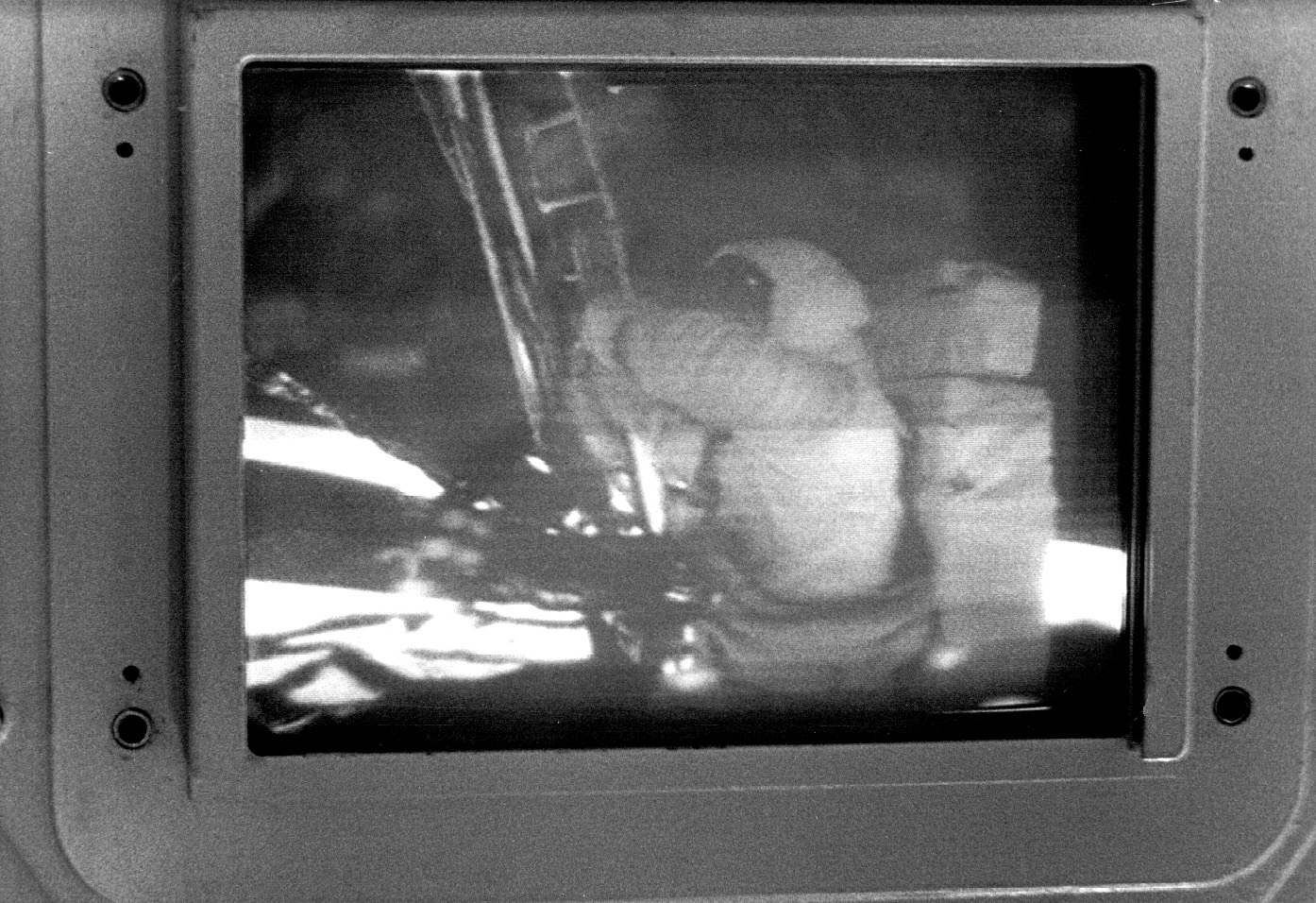
The Honeysuckle Creek Tracking Station, such an important part of the first successful Moon landing, is no longer. The facility which received the first 8½ minutes of footage of Neil Armstrong walking on the Moon has sadly been dismantled.
Honeysuckle Creek came into being when, on March 6, 1963, the Australian and United States governments jointly announced a deal to construct three US National Aeronautics and Space Administration (NASA) deep-space tracking stations just outside Canberra, in what was then termed the Tidbinbilla Valley. These stations would be at Tidbinbilla itself, completed in 1965 on the edge of the national capital, Honeysuckle Creek and Orroral Valley. All that remains of the three stations is what is now called the Canberra Deep Space Communication Complex, centred at Tidbinbilla. It is part of the Deep Space Network run by NASA's Jet Propulsion Laboratory and is the only NASA tracking station still in operation in Australia. Australia's Commonwealth Scientific and Industrial Research Organisation (CSIRO) manages most of NASA's activities in this country.
Honeysuckle Creek as it was.
Honeysuckle Creek was completed in 1967 and was built primarily to support the Apollo Moon missions, mainly communications with the Apollo Command Module. It was home to the antenna which received and relayed to the world the first historic television images of Armstrong setting foot on the Moon.
Image received at Honeysuckle Creek.
At least in the initial 8½ minutes of Armstrong's descent from the lunar module and his walk on the Moon, Honeysuckle Creek was able to receive and send (to Sydney and through Sydney to Houston) far clearer images than the Lyndon B. Johnson Space Centre in Houston, Texas. However, nearby Parkes in New South Wales was then able to provide the better images.
Honeysuckle Creek and Tidbinbilla also had voice and telemetry contact with the lunar and command modules. After the Apollo Moon missions ended in 1972, Honeysuckle Creek began supporting regular Skylab passes, the Apollo scientific stations left on the Moon by astronauts, and assisting the Deep Space Network with interplanetary tracking commitments, in support of the Viking and Voyager projects.
Honeysuckle Creek was closed in 1981 and its 85-foot antenna was moved to Tidbinbilla.
Honeysuckle Creek as it looks now.