Total Pageviews

Wednesday, 26 January 2022

The Cooee March, the Corona Portable Typewriter and the first Australia Day*


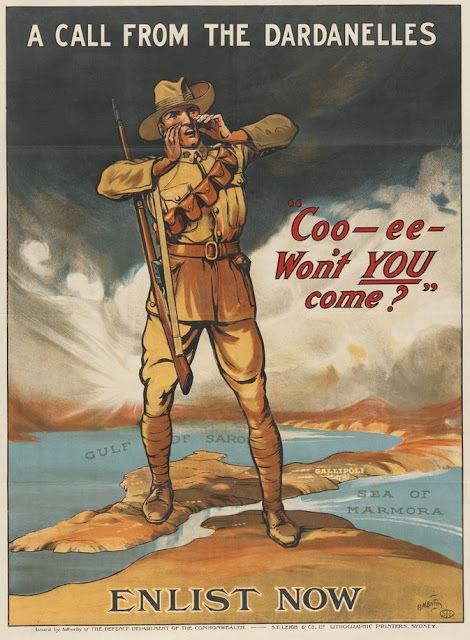
On the weekend of October 2-3, 1915, 43-year-old career public servant Edward Hugh Palmer took his Corona portable typewriter with him on a 546-mile round train journey, northwest of Sydney to the Central West New South Wales town of Gilgandra and back. There was an intense sense of urgency about his mission. Since the beginning of May, five months earlier, casualty lists revealing the slaughter of Australian and New Zealand troops at Gallipoli and on the Western Front had been appearing in Australian newspapers, and the nation was naturally appalled. Many Australians, especially the mothers of enlisted soldiers, quickly formed the opinion that “enough was already enough”. Where once young Australian men had queued up to enlist to fight for the English king and his country, now recruiting had stalled almost to a standstill. Palmer, secretary of the New South Wales State War Council, and a man vitally concerned with recruitment, had on September 1 read news in the Australian Town and Country Journal that a 51-year-old Gilgandra plumber called Bill Hitchen was proposing a “moving army” recruitment march from Gilgandra to Sydney. This was exactly the type of movement Palmer badly needed. Indeed, it was a recruitment officer’s dream come true. As Hitchen and his Gilgandra march organisers cried out for some sort of official endorsement for their plans, Palmer raced to Gilgandra to find out for himself what was happening there. On October 5 he took out his Corona and typed a three-page letter to his superiors in Sydney, strongly advising moral and material support for the Gilgandra marchers.

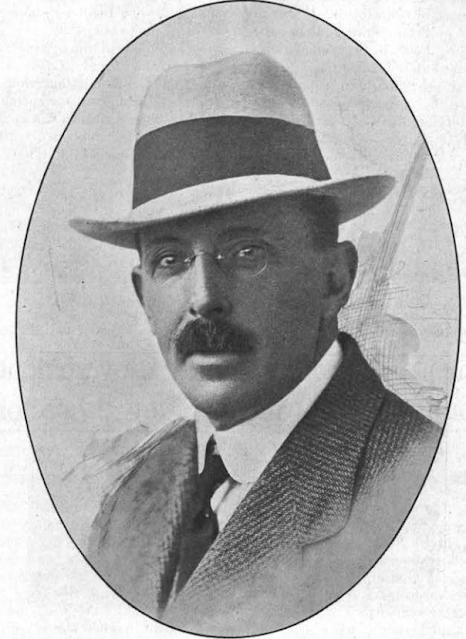
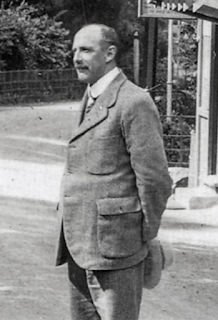
Edward Hugh Palmer


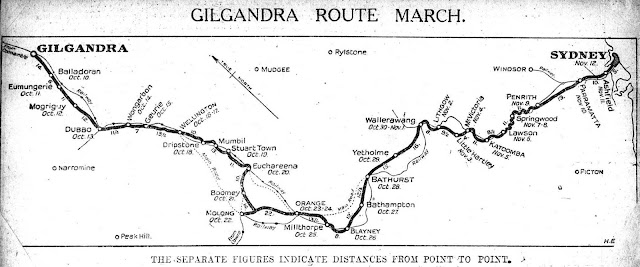
The “snowball march” which set off from Gilgandra on October 10 became known as the “Cooee March”. Twenty-six men started out, led by Hitchen. At each town on the route the marchers shouted "cooee" to attract recruits and held recruitment meetings. By the time they reached Sydney just over a month later, on November 12, the numbers had swelled to 263 recruits. The march had covered 320 miles. Cooee! is a shout originated in Australia to attract attention, find missing people, or indicate one's own location. The word originates from the Dharug language of Aboriginal Australians in the Sydney area. It means “come here” and has now become widely used in Australia as a call over distances.


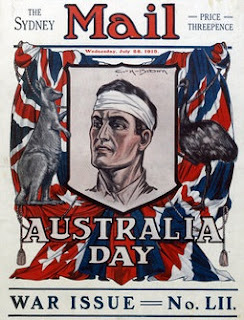
By October 1915 Palmer’s word was near to being gospel in Sydney. He had already organised, with enormous financial success, two appeals, called the Belgian Day Fund and Australia Day Fund.  The latter was held on July 30, a date which has no particular relevance in Australian history. Nonetheless, this 1915 event, launched to raise money for the Red Cross to aid wounded soldiers, is considered by some historians to be the first Australia Day.

Medal presented to Mrs Wharfton-Kirke

The idea came from a Mrs Ellen Wharton-Kirke of Manly, Sydney, whose four sons had enlisted and who suggested a fund raising event in this form of Australia Day to NSW State Premier Sir Charles Wade. By August 3, a staggering £739,489 had been raised in NSW, Victoria, South Australia, West Australia, Tasmania and the Northern Territory. That sum surpassed even the massive amount raised in May on behalf of stricken Belgians.

Edward Hugh Palmer, right, born in Sydney in 1872, the son of NSW Civil Service Board secretary Edward Gillett Worcester Palmer (1842-1914), joined the NSW public service himself in 1892. He was moved from treasury to become one of the first officials appointed to the NSW Premier’s Office when it was established in 1907. In 1912-13 he was sent to London on special duties, working for the NSW Agent-General Sir Timothy Coghlan. Back in Sydney, Palmer, as well as being the driving force behind the two fund raising events, was deeply involved in pushing for the creation of Anzac Day, first celebrated in 1916, as well as with repatriation for soldiers. He later became superintendent of the NSW Immigration and Tourist Bureau and resident controller of the Jenolan Caves, limestone caves in the Central Tablelands region, west of the Blue Mountains, 109 miles west of Sydney. The caves are the most ancient discovered open caves in the world and include Silurian marine fossils.

New South Wales was hit by the “Spanish flu” pandemic on January 27, 1919, and a month later it reached Jenolan. Palmer coordinated the response and converted his bungalow residence to a hospital. He organised for doctors to tend to the sick and installed an inhaling chamber. The NSW Government approved of Palmer’s suggestion to use Caves House for 40 convalescent nurses. Palmer retired at the end of 1921 because of ill-health and died at Bulli on February 26, 1922, leaving a widow and three children.

*Today, January 26, is Australia Day, as it has been nationally since 1935. It marks the anniversary of the 1788 landing of the First Fleet at Sydney Cove and the raising of the Union Flag by Arthur Phillip.


Monday, 24 January 2022

H. Allen Smith, his Oliver Typewriter, and Getting ‘Stranded on the Davenport’

H. Allen Smith, second from right, at an Oliver typewriter in the newsroom of the Huntington Press in Indiana in 1923. It was on just such an Oliver in the Press office that one Sunday evening in early 1924 Allen Smith wrote his "Stranded on a Davenport" story, the one that resulted in him being charged in court with writing 'obscene literature'. In this photo, on the far right, below the naked lightblub, is George Donnelly 'Don' Sullivan (1902-1975), whose designs on Allen Smith's older sister, Jean Elizabeth Smith (1901-1990), led to him getting Allen Smith a job as a reporter on the Press. Don and Jean were married in 1928 and Don went on to make a name in journalism in his own right..

Sitting at my desk at the back of Miss Crumpton’s fourth-form English class, I watched as Pauline Williams in the front row leaned to her left and surreptitiously handed Georgina Nielsen, the girl beside her, a sheaf of yellow paper. My heart was pounding. As much for Pauline – she who’d never been kissed - as the thought that she might as well have been passing along my death warrant. Had Miss Crumpton spotted the exchange, she would undoubtedly have asked to see the document. And at the very least, I figured, that would have led to me being expelled from Greymouth High School. Worst still, to me having my Underwood Universal portable typewriter confiscated by my parents – or the police - and being the subject of a small town salacious scandal, satisfying the demands of a municipality of gossipmongers for months ahead.

The yellow sheets contained the latest in my series of novellas about the MI6 spy Anthony Marks, 005. These exceedingly juvenile works, inspired and completely informed by Carter Brown pulp fiction and James Bond movies – where else would I have found such ideas? - were typed on the Underwood at night in my bedroom, stapled together and taken to school for the benefit and lurid imaginings of my equally sex-starved classmates. Pubescent virgins and bull virgins, each and every one of us. That none of my novellas ever fell into the hands of an adult, teacher or parent, continues to be regarded by me, these 59 years later, as something of a minor miracle. I knew full well back then that the consequences would have been indeed dire, and so as to not push my luck any further I gathered together all the Anthony Marks stories and destroyed them. Being handed from student to student in class, avidly read and absorbed in acts of dissipation by such impressionable young yokels, was a risky business. That the memory of their contents is still firmly instilled in 70-year-old minds was made clear to me only a couple of years ago.

It was during a brief, intemperate but exhilarating period in 1963 that the escapades of the amorous Anthony Marks leaped unfettered – and largely in Marks’s state of undress - from my typewriter on to the paper offcuts – pink, pastel blue and green, yellow – given me at Digby and Phil James’s printery. It all came back in vivid recall when my wife read to me H. Allen Smith’s hilarious confession “Stranded on a Davenport” from the 1954 collection The World, The Flesh and H. Allen Smith, edited by Bergen Evans. (“Stranded on a Davenport” had originally appeared in Allen Smith’s 1941 memoir Low Man on a Totem Pole, under the heading “Newspaper shops, large and small”). The similarities between my dabbling in literary titillation and Smith’s 1924 “odious opus” (as he called it) are striking – except I never got caught and never had to go to court.

Allen Smith’s version of events in “Stranded on a Davenport”, written 16 years after they occurred, is not entirely factual – for one thing, it is set in 1924, when Allen Smith had just turned 16. But it is a wonderful piece of writing nonetheless, and some poetic license is surely justifiable. The original “Stranded on a Davenport” was written in an Indiana newspaper office on newspaper copy paper using an Oliver typewriter, which Allen Smith described as “an instrument as rare in Indiana as the barracuda”, In truth. all the three reporters in the photograph at the top of this post are using Olivers. That said, here are the pertinent details, as outlined by Allen Smith himself in Low Man on a Totem Pole:

                                         The "stone" on the Huntington Press in 1923.

“I had been employed on the [Huntington] Press for about a year. The Press was a morning daily, and the Herald came out in the afternoon … The Press did not publish on Monday mornings, for that would involve desecrating the Sabbath by working on it – wherefore, the two-story building which housed the paper was closed tight on Sundays.

“All employees carried keys to the shop, however, and it was a Sunday night that Rome Brading [Rome Maurice Brading, 1906-1977] and I wandered into the deserted newsroom with no thought in mind of offending the peace and dignity of the people. Brading was my best friend. He attended the public high school, whereas I had abandoned education on completing the eighth grade at St Mary’s. Brading’s father owned a barbershop on Jefferson Street, and sometimes we would go there late at night, tilt the chairs back and lie in them, talking about the anatomy of girls and other matters.

“On this summer Sunday night Brading sat down at a typewriter and began pecking out a special-delivery letter to his girl (who lived a block and a half from him). Having nothing better to do, I went to work at one of the old side-wheeling Olivers and in about thirty minutes, I knocked out the bawdy screed that was to send me forth into the world, a disgrace to heaven, home and mother.

“I titled it ‘Stranded on a Davenport’, and in length it ran, I should say, close to one thousand words. It was in the first person, written supposedly by a young woman with swivel hips and animal appetites. It described in luxuriant detail the inception, progress and conclusion of an extremely amorous adventure. It was one of those things – well, as Mart O’Malley [Allen Smith’s lawyer, Martin Joseph O’Malley, 1891-1972] told the jury: ‘I’ll venture to say, gentlemen, that there’s not a man among you who never has had such a piece of literature in his possession.’

“I pasted the sheets together and tossed the completed essay over to Brading. He read it and as he read he giggled and guffawed and slapped his lean thighs in the manner of prurient youth. After that we adjourned to Tommy Ellis’ restaurant for coffee.

“By the next day I had forgotten it. Not so Rome Brading. He took ‘Stranded on a Davenport’ to school Monday morning. Somehow it got into the hands of his girl friend, who was studying typing. She made half a dozen copies and distributed them among her female friends, and they made copies, and by the end of the week the thing had snowballed into a circulation of astounding proportions. All this time I was blithely going from undertaker to feed store to interurban station in pursuit of little news items, oblivious of the terrible storm soon to break.

“It was said that every teacher in high school had her personal copy of’ ‘Stranded on a Davenport’ before two weeks had gone by, but the explosion came when the principal – a male creature – got his hands on it.” The principal was Charles Emory Byers (below, 1882-1930).

Allen Smith and Brading were tried separately, 13 days apart. O’Malley advised Brading to plead not guilty to “giving away obscene literature” and on April 15, 1924, a jury acquitted him (see newspaper report below; this was written by Allen Smith himself, at his editor’s insistence). Allen Smith wrote in Low Man on a Totem Pole, “Several high-school girls squirmed and blushed their way through admissions that they had received copies of the contaminating document. Each admitted that she had read it, volunteering the information that she had no idea of what it meant.” Allen Smith added that assistant prosecutor Cato Burdge Hurd (1894-1987) called Brading and Allen Smith “corrupters of maidenhood, sin-sodden wolves bent on sullying the fair name of Huntington before the world. (I have no hesitancy in saying that at this time I was a virgin. I think the fact stands as a tribute to my literary skill.)”

To his surprise, Allen Smith was told by O’Malley to plead guilty when he appeared on April 28 before Justice of the Peace Squire George Washington Stults (right, 1843-1941), to answer a charge of “authorship and circulation of lewd, licentious, obscene and lascivious literature.” The trial was over very quickly, and Allen Smith was fined $10, with $12.50 costs, and given 90 days to pay the $22.50. As well, city attorney Wilbur Emmett Branyan (1879-1941), described by Allen Smith as “a pious gentleman who took an interest in the morals of his neighbors”, told Allen Smith he was “going to spend two hours with him each week studying the Scriptures”. Allen Smith added that he “had discovered that I could no longer get a date with a decent girl in town (no indecent ones were to be had).” The $22.50 was paid by July 27 and Allen Smith left Huntington on September 9 for Jeffersonville. But he was back for a visit to his family in Huntington for Christmas 1924.

Allen Smith claimed in Low Man on a Totem Pole in 1941 that in Huntington “The great ‘Stranded on a Davenport’ case has been forgotten. And so, I found, have I.” Neither claim was, of course, true. In my case I know the Anthony Marks novellas have not been entirely forgotten either. But, like Allen Smith, I have learned to “never trust a cop” and, as far as I’m concerned, that applies to high school teachers, too.

Footnote: Allen Smith described Squire Stults (above right) as "a little old man straight out of a Keystone comedy. He was skinny, bald, and wore white chin whiskers which fanned the air when he talked in precisely the manner of a rube comic.  He had a habit of spitting tobacco juice over his right shoulder just before speaking."

Friday, 21 January 2022

The Boxer Who Bashed Out the ‘Bad Boy’ Book on a Borrowed Typewriter, and Other H. Allen Smith Stories


A typewriter can be a pretty formidable contraption when you sit down in front of it and say: ‘All right, now I'm going to be funny.’

-       H. Allen Smith (1941)

Writing a story on a typewriter is just putting the right ends together and then sort of weaving them around the middle.

-       Boxer Matty Mario (1939)


My wife is a prodigious reader. Fortunately, we have a vast array of books here, books of much variety and many vintages, stacked in every room, and sometimes Harriet can dig out and dust off something she hasn’t already read. One such find was a book given in 1958 to her mother, Pat Horner (author of When Words Fail) by Elizabeth Warburton, wife of Dunedin-born adult education lecturer Jim Warburton. It’s called The World, The Flesh and H. Allen Smith, edited by Bergen Evans and published in London by Arthur Barker in 1954.


Bergen Evans - like H. Allen Smith a proud Midwesterner, unlike Smith a professor of English - selected from the prolific writings of Smith prime pieces to be included in this work. Evans knew good writing when he saw it – indeed he relished it. As Phyllis McGinty wrote in The New Yorker, "I'd take more pleasure in discussions schola'ly / If Bergen Evans wouldn't laugh so jollily." Evans would be in his element today, in this regressive time of pandemic deniers, vaccine sceptics and other Flat Earth believers. He’d have found so much material for his column  "The Skeptics Corner", and to follow up The Natural History of Nonsense and The Spoor of Spooks and Other Nonsense.

So, too, would H. Allen Smith have found today’s world ripe for the picking. As it is, Harriet was delighted to come across The World, The Flesh and H. Allen Smith, even though its wonderful array of whimsical yarns about long-gone characters belongs to another age. On the other hand, Smith could be way ahead of his time: consider “Naming the Baby”, which predated the mindless monikers given grievously unfortunate children by present-day celebrity clowns (Reignbeau, Sage Moonblood, Moxie Crimefighter, Breeze Beretta, Audio Science, Bronx Mowgli, Moon Unit, Pilot Inspektor). One of the many reasons I love Harriet so much is that we have the same tastes in humorous writing – we discovered early on in our relationship that we shared a great passion for the like of S.J. Perelman, Damon Runyon and Flann O’Brien.


Harry Allen Wolfgang Smith (1907-1976) fits right into that group. He was a journalist and author but most importantly he was a  brilliant humorist. Born in Illinois, it was in Huntington, Indiana, that Smith dropped out of high school and, in 1922, found work as a journalist with the Huntington Press. This was the first of a string of newspapers for which he worked. Smith found fame when his book Low Man on a Totem Pole became a bestseller during World War II. This was followed by another bestseller, Life in a Putty Knife Factory, and a third, Lost in the Horse Latitudes. Which enabled Smith to write in 1946 The Truth: How it Feels to Be On the Best Seller Lists For 108 Weeks. His novel, Rhubarb, about a cat that inherits a professional baseball team, led to two sequels and a 1951 film adaptation.

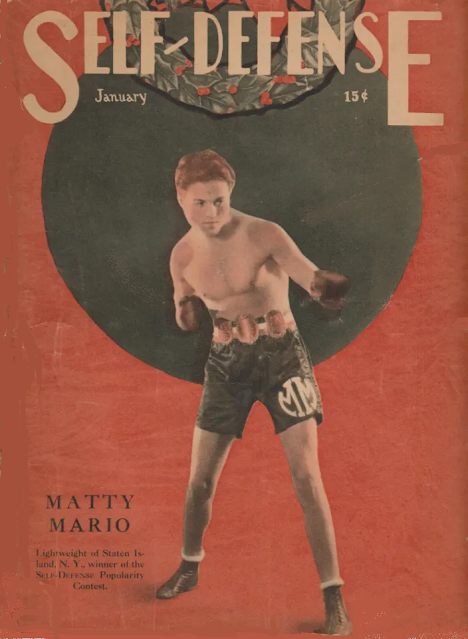
Harriet knew that I would take enormous pleasure in reading many of the articles in The World, The Flesh and H. Allen Smith - and one in particular, titled “The Story of ‘Bad Bad’”. It’s a brilliantly witty piece about a prize fighter called Matty Mario, right, from Dongan Hills, Straten Island, who borrowed a typewriter from a man called Ed Ratigan and on it wrote a book called Bad Boy. All this I can confirm is true – except for Mr Ratigan, of whom I can find no trace. Smith interviewed Matty in 1939, when the boxer was 35. “I typewrite my own stuff,” Matty told Smith. His book, edited by Harry T. McHugh, a teacher at an orphan’s home, was published by Broadway Printers & Publishing Co on February 17 that year. It concerns a boxer called Johnny Conway, fighting under the name Johnny Kid Reed.


Other than what Smith wrote, factually, about Matty, copyright details of Bad Boy and his boxing record, nothing has ever appeared online about Matty – until now. For the first time in Internet history, we can reveal that Matty Mario was Mario Giacomo Ghiselli, who was born to an Italian bartender, Giovanni Ghiselli, and his wife Rosina (Rosie) on MacDougal Street, Manhattan, on October 3, 1904 (Smith said Greenwich Village, which is technically correct). A welterweight boxer, Mario fought 69 times between 1924-44, winning 35 bouts. In the early 1930s he was considered a world title contender.


As Matty told Smith, he had worked on the automobile assembly line at the Ford plant at Edgewater and by the late 30s had become a licensed masseur. During the Second War World he served as what was officially classified a boatswain’s mate class one (BM1) with the US Coast Guard, but unofficially he was a physical fitness and martial arts adviser. This was under a scheme put together by Matty’s friend, the great heavyweight champion Jack Dempsey. From June 1942 Dempsey had a commission as a lieutenant and director of physical education for the Coast Guard Reserve at its training station at Manhattan Beach, Brooklyn. The Dempsey group was released from active duty in September 1945. Unfortunately Matty’s athletic instruction business in Brooklyn had suffered in his absence on war duty and he had to file for bankruptcy at the end of October 1946.


Matty tried selling his movie (Double Cross, In-Law Interference), play (The Unknown Substitute) and TV scripts without a lot of success, but he did find a number of ways to make ends meet. For example, he made trans-Atlantic voyages on the ocean liner the SS America in 1946-54, on the New York-Le Havre-Bremerhaven-Cobh route, working as a passenger’s masseur.  While on shore leave, Mario was a pictorial model for fiendish characters in detective magazines, refereeing professional wrestling bouts with comical zeal, and playing villains on television crime shows such as Richard Montgomery Presents. His son, Richard Matthew Ghiselli (1929-1993), was a highly decorated combat veteran from the Korean war. Mario died in New York on August 2, 1977. In some ways - especially in light of his long boxing career - it seems surprising that he outlived H. Allen Smith. But then, Matty may well have been a lot smarter than Smith made him out to be. 

A Spike in Newspaper History: H.L. Mencken's 'Copy Hook'


Print newspaper journalists who worked in the good old days of 'hard' typewritten copy and hot metal will know what this is, and what it was used for. It was indispensable to editors, the more so on those occasions when they found themselves having to deal with the kind of copy which these days gets published, unchecked, online. But I wonder if even those old-time journos know how these things were made? Where were the “raw materials” obtained from? Clue: something used in Linotype machines was a key component.


It’s a copy spike, but the one in the Stanley Farrar photo (top of post) is no ordinary copy spike. This was the spike “souvenired” by H.L. Mencken when he was city editor of the Baltimore Morning Herald, after the Great Baltimore Fire had swept through downtown Baltimore on February 7, 1904, destroying the Herald building on the northwest corner of St Paul and East Fayette streets. (In exchange for providing photos of the fire to the Washington Post, the Post printed an edition of the Herald on the first night of the fire. For the next five weeks the Herald was printed by the Philadelphia Evening Telegraph and transported 100 miles to Baltimore on a special train, provided free of charge by the B&O Railroad.)


As he dug with his hands through the ruins of the fire, the only thing worth saving that Mencken could find was what he called his “copy hook”. He kept it until he died on January 29, 1956. Fellow journalist H. Allen Smith had asked Mencken to pass the spike on to him and some weeks after Mencken died it was sent to Smith in a custom-made, velvet-lined box. Smith moved to Alpine, Texas, in 1967, and kept the spike on a shelf in his study. In 1974 University of Texas journalism lecturer Martin L. “Red” Gibson asked Smith to pass the spike on to him, and Smith did so. Smith died on February 24, 1976. Gibson died in Austin, Texas, on May 22, 1993, after a brief battle with lung cancer, and the present whereabouts of the spike is unknown. 
However, writing about the history of the spike in the Baltimore Sun on February 5, 1978, Gibson said, “Don’t write and inquire about my health and suggest that I ought to be making plans to pass the Mencken spike along to younger hands. I may take it with me.”


Tuesday, 18 January 2022

Metropolis Revisited: Superman, Jimmy Olsen and the Cute Corona Skyriter Typewriter (Oh, and Puff the Magic Dragon Too)

Blinky watches Lois Lane type on the Corona Skyriter

Subjected by John Lennon to a Proust Questionnaire on a flight from Paris to Lyon in 1965, George Harrison said his favourite hero in fiction was Jimmy Olsen. Given, at the time, Harrison felt his music writing was being grossly undervalued by his fellow Beatles, he could well have been identifying with Jimmy Olsen, whose role as a flunkey to Clark Kent and Lois Lane was never meant to steal scenes from the stars. The late Jack Larson, who played Daily Planet cub reporter Jimmy in 101 episodes of the TV series Adventures of Superman, from 1952-58, might have felt flattered by Harrison’s accolade, except that Larson found being typecast by Jimmy had become a “nightmare”. “I thought playing Jimmy ruined my life,” Larson said in an interview with Reuters in 1987.

I was reminded of Jimmy Olsen about six weeks ago, when a friend, Peter Crossing in Adelaide, emailed me to say he had come across an episode of Adventures of Superman on an obscure community channel, 44. “It had us reliving the days of early TV long ago,” wrote Peter. “This particular episode, ‘Stamp Day For Superman’, had a discussion that centred around Jimmy Olsen’s brand new typewriter.” I made a mental note to have a look for ‘Stamp Day for Superman’, but it was a fascinating book we got for Christmas from our daughter in London that finally got me into gear. The book, Word Perfect by Susie Dent, devotes a chapter to a different word for each day of the year. For January 16 the word was “Screamer” (as in the exclamation mark, of which DC Comics are so fond) and it pointed out that it was on January 16, 1939, that the Superman comic strip made its debut in American newspapers. (First strip below).


Anyway, I watched ‘Stamp Day for Superman’, presented in 1954 by the US Treasury Department, and another happy memory of Peter Crossing’s time in Canberra came full circle. Jimmy Olsen’s "cute" typewriter was a Corona Skyriter, which he had proudly bought from stamp savings bonds. The Skyriter plays a pivotal role in the Superman episode, as it is used by both Lois Lane (Noel Neill) and the crook Blink (Billy Nelson). In particular it is used by Lois to type an ID picture of Blinky as well as a plea to be rescued, sent out as a paper plane.


Why the Skyriter brought back memories of Peter’s Canberra days is that he used to present the blues and jazz program "Down in the Basement" on ArtSound community radio, and each year would invite us to a trivia quiz night to raise funds for ArtSound, These included a “Who Am I?” contest and one year the teasers concerned the writing of the Peter, Paul and Mary hit Puff the Magic Dragon. The clues started with Peter Yarrow finding in a typewriter at Cornell a poem written by Lenny Lipton. I was intrigued by all this, and set out to discover more. To cut a very long story short, the upshot was that I was able to track down Lipton and ask him what model typewriter he was using to write the poem Yarrow found. Lipton and Yarrow consulted, and the answer was …

A Corona Skyriter! (! as in a Screamer!).

Jack Larson at school in Pasadena.

Monday, 17 January 2022

Setting Up a 1940 Remington Portable Typewriter From Right Across the Continent

Long distance information, give me Freo WA

Help me find a party who’s 2000 miles away

She did not leave a number, but I know who placed the call

'Cause I saw her little typer sitting right there in the hall


Last evening, just as I was settling down to watch the cricket Test on TV, a photo of a typewriter popped up on my Facebook page. Nothing unusual in that. Facebook friends often post typewriter images on my page, or otherwise draw my attention to them, which is very thoughtful and nice of them. Usually they have come across a typewriter at a market or an op-shop or bric-a-brac store, or on display somewhere. They’re not interested so much in the typewriter itself, it’s just that they know I’m interested and they’d like to encourage my interest.

It turned out the typewriter photo that landed up on my Facebook page last evening was different. It was owned by a Facebook friend, a former colleague from my days working for West Australian Newspapers in the 1980s. In fact, my old friend, Jolly, had only just received the typewriter herself. I had belonged to her mother, a former country correspondent for West Australian Newspapers and for what was back in the day the Australian Broadcasting Commission (since 1983 a corporation).  The typewriter had been stored in a garage since her death in 2002, and was handed to her daughter, Jolly, only last week.

It is a 1940 Remington Standard Model 5 portable (which in itself raises some questions*). Jolly asked for my advice, given my “expertise” on the subject of typewriters. What did I think? I wasn’t sure what to think at first, apart from making some observations based on the photos. The case was obviously water damaged, and its clasp was clearly rusted. But the typewriter itself looked to be in very good condition for its age.


I suggested Jolly should go to Richard Polt’s Classic Typewriter Page, click on the link to his page of detailed information about Remington portables, and get some idea about the age of the machine.  Then I noticed the typewriter was sitting in the lid of the case and the base, with its two clasps to hold the typewriter in place, was acting as the lid. This is a very common mistake people make – they assume the thinner of the two case sections is the lid.


Anyway, this observation lead to a exchange on Messenger that lasted a good hour or more. In the end, not only was the typewriter clasped in place in the base of the case, but it was working and Jolly was thrilled to be writing with it. In the meantime, we had worked out such things as the where the carriage lock was, the correct threading of the ribbon, the ribbon spools movement, getting fresh ribbon through Richard Amery, if needed, where the apostrophe was (above the 8), the right margin release key, the back space key, the ribbon colour selector switch and the touch control switch.

At first I had wondered what use I could be in offering any technical advice from a distance of 2000 miles, one side of the Continent to the other. Jolly still lives in Western Australia, I am in Canberra, and our means of communication was Messenger. But it all turned out fine, with the best possible result at the end of the evening – Jolly so happily typing away on her mother’s old Remington portable. During our exchanges (37 in all) a group of mutual friends joined in – mostly by simply reading our messages – and they too expressed their delight in following the whole procedure.

And I was left of a feeling of satisfaction that all this could be achieved over such a vast distance.


*I'm a bit curious about how this 1940 model reached Australia. After tariffs had been doubled here in 1932, imports were greatly restricted four years later. The Australian Government, reacting to a yawning imbalance in trade between this country and the United States, barred fully assembled American typewriters from being imported. Remington assembled US-made parts in Sydney and sold the machines as "Australian built", but these were confined to earlier portables, such as the Model 4. I know of a former West Australian editor who brought a Remingon Rand Model 1 back home from the US for personal use, but by and large it would have been very difficult for an Australian to get his or her hands on "new" Remingtons during the early years of World War II.

Sunday, 16 January 2022

Corona Four-Bank Portable Typewriter Stars in 'Mrs Wilson"


We watched the three-part BBC TV series Mrs Wilson on the weekend and were spellbound by it. Gripping stuff, with loads and loads of lovely typewriters (the star turn belongs to a black Corona four-bank, but in war-time government offices there are lines of Imperial standards, and rightly so). Mrs Wilson is a 2018 British historical drama, executive-produced by and starring Ruth Wilson, who plays her own grandmother, Alison Wilson.


Alison is a widow who uncovers the mysterious and secret life of her late husband, Alexander Joseph Patrick Wilson (1893-1963). Alex Wilson was an English writer, spy and MI6 officer. He wrote novels under the names Alexander Wilson, Geoffrey Spencer, Gregory Wilson and Michael Chesney. After his death, his family discovered that he had been a serial polygamist and a pathological liar. As of 2018, documents that could shed light on his activities remain classified as “sensitive” by the British Government’s Foreign and Commonwealth Office, under section 3(4) of the Public Records Act 1958.


The series is based on Alison Wilson’s memoir Before & After, but as might be expected, in creating dramatic effect scriptwriter Anna Symon has played free and easy with the facts in the original story. This was with the apparent approval of the lead actor, Ruth Wilson. Each episode starts with the words “The following is inspired by real events”.


The series was of particular interest to me, as for the past couple of years I have been working on the biography of the man who was the real inspiration for James Bond. There are certain similarities between Alex Wilson and my man, but in my case the subject’s family has not been cooperative. That’s a shame, as I believe my man’s story knocks Alex Wilson’s into a cocked hat. He was the real deal, whereas Alex Wilson comes across as a great pretender when it came to intelligence work.